
Antique Bird Prints for Wall Art: 7 Best Picks
Table of Contents
- Why Antique Bird Prints Work as Wall Art
- Quick Comparison: Antique Bird Prints by Era and Price
- 1. John Gould, Tinnunculus Alaudarius, 1862-1873
- 2. John White, The White Vented Crow, c1789
- 3. Silvester Diggles, Honey Eaters, 1866-1870
- 4. George Shaw, Ostrich, c1808
- 5. Pauquet, Owls, Plates 122 and 123, c1830
- 6. Magnus von Wright, Wood Sandpiper, c1917-1929
- Authenticity vs. Reproduction: What You're Actually Buying
- How to Frame Antique Prints Without Damaging Them
- Gallery Wall Layout Ideas for Bird Print Collections
- Styling Bird Prints by Species and Room
- Frequently Asked Questions
Last Updated: September 14, 2026
Why Antique Bird Prints Work as Wall Art
Antique bird prints for wall art combine scientific precision with decorative warmth, and at Antiquarian Print Shop we've watched collectors and designers return to them again and again. This guide covers seven standout picks, from John Gould's Australian birds to lesser-known European lithographs, with pricing and era details, plus how to choose, frame, and hang them.

The appeal runs deeper than nostalgia. A hand-coloured copperplate engraving made two centuries ago holds detail modern digital reproductions rarely match, and its paper has aged into a tone no printer can fake. Understanding the era and technique behind a print changes how you value it.
Quick Comparison: Antique Bird Prints by Era and Price
| Artist | Era | Technique | Price | |
|---|---|---|---|---|
| Tinnunculus Alaudarius | John Gould | 1862-1873 | Reproduction, museum matte paper | $3,950.00 |
| The White Vented Crow | John White | c1789 | Copperplate engraving | $395.00 |
| Honey Eaters | Silvester Diggles | 1866-1870 | Original lithograph, hand colour | $250.00 |
| Ostrich | George Shaw | c1808 | Copperplate engraving | $250.00 |
| Owls, Plates 122 & 123 | Pauquet | c1830 | Steel engraving, hand colour | $150.00 each |
| Wood Sandpiper | Magnus von Wright | c1917-1929 | Chromolithograph | $150.00 |
1. John Gould, Tinnunculus Alaudarius, 1862-1873
John Gould is the name most collectors search for first, and this reproduction of Tinnunculus Alaudarius shows why. Gould, the "Bird Man" of Victorian England, produced The Birds of Australia between 1840 and 1848, setting the standard for scientific bird study (Making sure you're not a bot!). Original Gould plates remain among the most sought-after natural history art available.

Printed on museum quality matte paper, it captures the original's vivid hand-finished colouring with only very slight age markings. At $3,950.00 it sits at the investment end of the range: Gould's reputation underpins long-term value in a way few other names match.
Australian Museum's natural history collections overview
2. John White, The White Vented Crow, c1789
History buffs should start here. John White served as Surgeon General to the First Fleet, and his Journal of a Voyage to New South Wales ranks among the foundational works of Australian natural history. This hand-coloured copperplate engraving, published by J. Debrett in 1789, measures 245 x 195mm and remains in very good condition.
Few of these engravings survive in this condition, and White's plates are collectable because they document species at the moment of European encounter. At $395.00, it's the most historically significant piece here per dollar spent.
3. Silvester Diggles, Honey Eaters, 1866-1870
Australian avifauna has no better early champion than Silvester Diggles, whose Brisbane-published work documented local species with real affection. This original lithograph with later hand colouring measures 275mm x 375mm and arrives in excellent condition, a rarity for its age.
The Honey Eaters plate suits anyone collecting Australian birds specifically. At $250.00, it makes a focused collection achievable rather than aspirational.
National Library of Australia's Trove collection on colonial natural history
4. George Shaw, Ostrich, c1808
George Shaw co-founded the Linnean Society and published the first scientific description of the platypus. This original copperplate engraving, over 215 years old, came from his Zoological Lectures published by Kearsley in London in 1809. It measures 155 x 230mm and is in good condition.
Shaw's work carries weight with collectors who value scientific provenance, and the ostrich suits larger rooms where a bold single-subject print anchors a wall better than a small cluster. Priced at $250.00.
5. Pauquet, Owls, Plates 122 and 123, c1830
The Pauquet brothers produced some of the 19th century's most popular illustrated works, and this pair of hand-coloured steel engravings from c1830 works beautifully as a set. Each plate measures 135 x 220mm with a print size of 95 x 165mm, in good condition with tonal markings on the page edges. At $150.00 each, they're the most accessible entry point here.
Buying both plates creates a natural diptych for a hallway or study, and the owl subject matter suits darker, moodier interiors.
6. Magnus von Wright, Wood Sandpiper, c1917-1929
Magnus von Wright began as a taxidermist at Helsinki University before becoming one of Scandinavia's finest zoological illustrators. This chromolithograph comes from Svenska Foglar Efter Naturen Och Pa Stenritade, published in Stockholm between 1917 and 1929. Paper size is 270 x 375mm, image size 165 x 215mm, in very good condition.

The lithography is genuinely difficult to distinguish from hand-painting, which is why von Wright's plates hold their own beside earlier engravings. At $150.00, it's a strong choice for a later-era print with the same visual richness.
Authenticity vs. Reproduction: What You're Actually Buying
Knowing whether you're buying an original or a reproduction protects both your wallet and your wall. An original antique print is a sheet pulled from the plate at or near the time of publication; a reproduction is a later copy, often printed digitally on modern paper. Both have a place, but they carry very different price tags.
Most sellers describe everything as "antique style" or "vintage inspired", which tells you nothing. Here is how to tell them apart yourself.
Physical checks you can do in person
- Plate mark. A genuine intaglio print (copperplate or steel engraving, etching, aquatint) shows a visible indentation where the press forced the damp paper into the recessed plate. Hold the sheet at a low angle under raking light and the rectangle of the plate should be obvious. Digital reproductions almost never replicate this convincingly.
- Chain lines and laid paper. Pre-1800s European and colonial papers were made in moulds and show faint parallel chain lines and a laid texture when backlit. Wove paper (smooth, no chain lines) became common from the late 1700s. A print dated 1789 on bright, uniform, modern-looking paper is a red flag.
- Dot pattern under magnification. A jeweller's loupe or a phone macro lens reveals a continuous tone on a genuine engraving, but a regular grid of tiny coloured dots (a halftone or inkjet rosette) on a digital reproduction. This is the fastest single test.
- Foxing and toning. Genuine age produces irregular brown spots (foxing) and an overall cream-to-buff tone that varies across the sheet. Uniform yellowing or a perfectly even tone often signals artificial ageing.
- Ink behaviour. Hand-colouring on originals sits in the paper fibres and often bleeds slightly past the printed line. Modern colour sits on top and looks flat and opaque.
Documentary checks
Ask the seller to state, in writing:
- The technique (engraving, lithograph, chromolithograph, etching)
- The publication title, author, publisher, and year the plate appeared in
- The paper size and image size in millimetres
- The condition report, including any toning, foxing, tears, or edge damage
A seller who can name the publication and the plate number is almost always selling an original. A seller who can only say "antique bird print" usually is not.
What reproductions are actually for
A well-made reproduction on museum-grade matte paper has a legitimate role: it lets you hang a Gould or an Audubon in a bright, high-traffic room without risking a fragile 150-year-old sheet, and fill a large wall at a fraction of the cost. The mistake is paying original prices for one. If a listing shows a famous plate at a low price with no publication details, assume reproduction.
At Antiquarian Print Shop, every listing names the artist, engraver, publisher, paper size, technique, and condition, so you know exactly what's arriving.
How to Frame Antique Prints Without Damaging Them
Correct framing is the single biggest factor in whether an antique print survives another fifty years. Antique paper is sensitive to acidity, UV light, and moisture, so conservation framing isn't optional.
Why each rule exists
- Acid-free materials. Wood-pulp mount board and backing contain lignin and acids that migrate into the print, browning and embrittling the paper. Conservation-grade board is buffered to a neutral or slightly alkaline pH and will not off-gas into the sheet.
- UV-filtering glass. Ultraviolet light breaks down paper fibres and fades ink and hand-colour. UV-filtering glass doesn't stop fading entirely but slows it dramatically, the difference between decades of colour and a few years in a bright room.
- Mat border. A window mount keeps the print off the glass. Contact allows condensation to transfer ink onto the glass and stain the sheet, leaving a permanent mark.
- No dry-mounting, no trimming. Dry-mounting fuses the print to a board with heat-activated adhesive. It is irreversible. Trimming removes the plate mark and the margins, which are the two features collectors use to authenticate a print. Both actions permanently reduce value.
- Hinges, not glue. The print should be attached to the backing with acid-free linen or Japanese paper hinges and a starch paste that can be reversed by a conservator. Never use sticky tape, spray adhesive, or PVA.
Framing for the local climate
Humidity swings and strong sun are the biggest threats to antique paper in Australian homes. A few adjustments:
- Avoid hanging prints on external walls, which are the coolest and dampest surfaces and encourage mould behind the frame.
- Keep frames out of rooms with high moisture, such as bathrooms and laundries, and away from kitchen steam.
- On north- and west-facing walls, use UV-filtering glass and consider a linen or fabric-covered mount to reduce glare and heat.
- In humid coastal areas, ask your framer to seal the backing with a moisture barrier and to leave a small ventilation gap rather than a fully sealed package, which can trap condensation.
Period-appropriate frame choices
- 18th and early 19th century engravings. Gilt gesso or dark stained timber with a simple profile. Avoid heavy ornate frames that compete with the print.
- Mid to late 19th century lithographs and chromolithographs. Slimmer gilt, ebonised timber, or natural oak. These prints are often larger and benefit from a lighter frame.
- Mixed-era gallery walls. Unify by frame colour and profile rather than by era. A consistent 20mm gilt moulding across five prints of different periods reads as a collection; five different frames read as clutter.
What conservation framing costs and why it is worth it
Conservation framing adds a meaningful premium over standard framing, driven by the mount board, UV glass, and labour. On a print worth several hundred dollars that premium is a small fraction of the value it protects; on one worth thousands it is non-negotiable. Ask your framer to specify the brand and grade of mount board and glass on the invoice as a record if you ever sell.
Use these practices:
- Request archival quality paper and acid-free mounting materials
- Specify UV-filtering glass to slow fading
- Ask for a mat border so the print never touches the glass
- Keep the frame away from direct sunlight and damp walls
- Avoid dry-mounting or trimming, which permanently reduces value
- Ask for the mount board and glass specification in writing
For a period-appropriate look, gilt or dark timber frames suit 18th and 19th century engravings, while slim black or natural oak frames suit later chromolithographs. Custom framing lets you match odd wall dimensions without cropping the sheet.
Gallery Wall Layout Ideas for Bird Print Collections
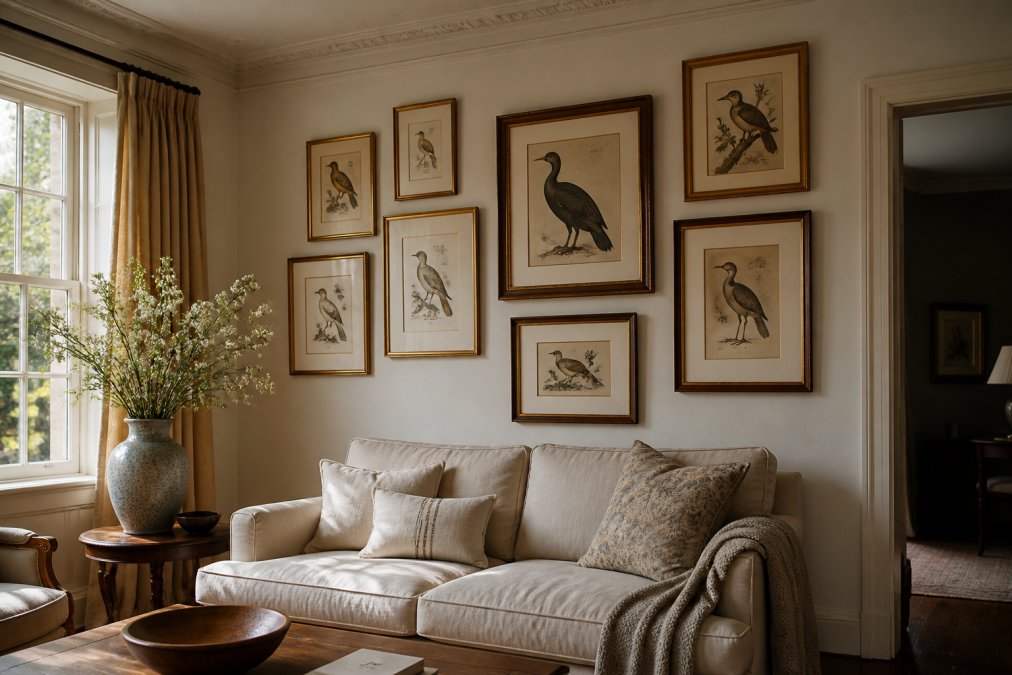
The best gallery wall starts with a grid, not a guess. Lay your prints on the floor and photograph the arrangement before touching a hammer. Symmetrical grids suit matched sets like the Pauquet owl pair; salon-style clusters work better for mixed sizes and eras.
Leave 50-70mm between frames for a tight, considered look, and align the centre of the arrangement at roughly eye level. If you're mixing eras, group by frame colour rather than by species to keep the wall visually calm.
Styling Bird Prints by Species and Room
Matching subject to room changes everything. Owls and raptors suit studies, libraries, and darker walls where their tonal depth reads well. Waders and shorebirds, like the von Wright sandpiper, work in lighter, airier spaces. Australian honeyeaters and crows bring a local narrative that suits heritage homes and modern interiors alike.
For a cottagecore aesthetic, pair smaller hand-coloured engravings with linen textiles, dried botanicals, and warm timber. For classic interior design, group larger plates in matching gilt frames above a mantel or console.
Frequently Asked Questions
How do I identify authentic antique bird prints?
Check the paper for a plate mark, the indented border left by the printing press, which reproductions rarely have. Look at the print method: copperplate engravings show fine, slightly raised lines, while chromolithographs have a flat, painted look. Examine the paper under light for chain lines and watermarks typical of handmade stock. Finally, research the artist and publication. A John Gould plate from The Birds of Australia will carry specific plate numbering and publisher details that a modern copy will not.
What are the best framing styles for vintage bird illustrations?
Museum-grade framing with acid-free mounts and UV-filtering glass protects both the paper and the colours. For period pieces, a simple gilt or dark timber frame with a wide mount suits the era. Modern interiors often pair these prints with slim black or natural oak frames for contrast. Always use archival materials, because acidic backing board causes yellowing and foxing over time, and hang away from direct sunlight to slow fading.
How to group bird prints for a gallery wall?
Start with an odd number of prints and arrange them on the floor first. A symmetrical grid works well for same-size pieces like the Pauquet owl plates, while a salon-style cluster suits mixed sizes. Keep 50 to 80mm between frames and align the centre of the arrangement at eye level, roughly 1450mm from the floor. Group by species, era or colour palette so the wall reads as one collection rather than scattered pictures.
Are antique bird prints a good investment?
Rare originals from celebrated illustrators such as John Gould have historically held and grown in value because supply is fixed and demand from collectors continues. Condition matters most: prints with strong colour, wide margins and no foxing command higher prices. Reproductions and common plates are decorative purchases rather than investments. Buy the best condition you can afford, keep provenance records, and store or frame them archivally to protect long-term value.
How do I protect antique paper prints from humidity and sunlight?
Keep relative humidity between 40 and 50 per cent and avoid rooms prone to damp, such as bathrooms and unventilated kitchens. Hang prints out of direct sun and use UV-filtering glass or acrylic. Acid-free mounts and backing boards prevent chemical damage from within the frame. Check frames every few months for condensation or insect activity, and store any unframed prints flat in an acid-free portfolio away from light and heat.
Building a wall of antique bird prints rewards patience. The right piece, properly framed and thoughtfully placed, becomes the anchor of a room rather than a passing decoration. Antiquarian Print Shop curates over 1,200 authentic original and reproduction prints, offers custom sizing to fit awkward wall dimensions, and works in traditional methods like etching, engraving, and lithography. Start with the collection and find the piece that belongs on your wall.