
Best Ways to Preserve Antique Prints: A 2026 Guide
Table of Contents
- Why Preservation Matters More Than Restoration
- The Risks of Storing Antique Prints in Basements and Other Wrong Places
- Archival Materials: What to Look For When Preserving Antique Prints
- Preventing Foxing on Antique Prints: Causes and Practical Fixes
- Archival Framing for Antique Prints: Doing It Without Causing Harm
- Handling, Cleaning and Everyday Care for Fragile Items
- Digital Preservation and Budget-Friendly DIY Solutions
- Frequently Asked Questions
Last Updated: September 13, 2026
Why Preservation Matters More Than Restoration
Preservation controls the environment and materials around an antique print so it survives unchanged; restoration repairs damage already done. Almost every collector asks about restoration first. That order is backwards.
Restoration is irreversible: cleaning, washing and chemical treatment strip away part of the object's history, and curatorial standards treat reversibility as the first test of any intervention. Preservation asks nothing of the print except that you stop hurting it. The best ways to preserve antique prints begin with that shift in mindset.
The Risks of Storing Antique Prints in Basements and Other Wrong Places
The risks of storing antique prints in basements, attics, garages and sheds come down to one thing: those spaces are the least stable rooms in the house. Basements hold damp, attics bake and freeze, and garages swing between both.
Paper is hygroscopic: it absorbs and releases moisture until it reaches equilibrium with the air. When relative humidity rises, cellulose fibres swell; when it falls, they contract. Cycle it repeatedly and the sheet cockles, the ink lifts, and mould finds a foothold, and inside a storage box, a print can deteriorate for years before anyone notices.
The fix is mundane and effective: an interior room with stable conditions, away from external walls, kitchens, bathrooms and laundry areas. A wardrobe shelf in a spare bedroom beats a sealed basement cupboard every time.
Temperature, Humidity and the Damage They Cause
Aim for a stable storage environment rather than a perfect reading. Fluctuation does more harm than a slightly high or low figure held consistently.
Most conservation guidance converges on roughly 15-22°C and 45-55% relative humidity for mixed paper collections (canada.ca). The exact figure matters less than the swing: a room drifting from 30% to 70% relative humidity across a week damages paper faster than one held at a steady 60%, because each cycle of swelling and contracting stresses the fibres and can crack the sizing.
- Keep temperature steady and moderate, avoiding radiators, heating vents and direct sun
- Hold relative humidity in a mid-range band and, more importantly, keep it from swinging
- Monitor with a cheap digital hygrometer, because guesswork fails here
- Avoid the kitchen, bathroom and laundry, where humidity spikes daily
In a humid climate, a small dehumidifier does more than any box you can buy. Environmental monitoring is the unglamorous habit that separates collectors whose prints hold their value from those whose prints develop problems quietly.
Pests, Mould and Light: The Hidden Threats
Mould needs damp and still air; pest control means denying insects food and shelter. Silverfish and booklice graze on paper and starch paste and thrive in dark, undisturbed boxes. Silverfish chew irregular holes and leave yellow stains, while booklice prefer the microscopic mould on damp paper (si.edu).
Light is the slowest threat and the most permanent: UV exposure fades inks and yellows paper, and the damage cannot be reversed. Keep prints out of direct sun and never store them where a window throws light across a shelf. Even brief daily exposure accumulates, a print hung opposite a window can shift fugitive pigments within a few years.
Material-Specific Considerations: Not All Prints Age the Same Way
A wood-pulp paper from the 1890s and a cotton-rag etching from the 1790s do not respond identically to the same room. Wood-pulp paper contains lignin, which breaks down into acidic compounds as it oxidises, so it embrittles from within and is more sensitive to humidity swings (loc.gov). Cotton-rag and linen papers are far more stable.
Ink type matters too. Iron-gall ink, common in older documents and some engravings, can burn through the paper from the reverse, ink corrosion. Lithographs with coloured inks may be more fugitive than black-and-white etchings. If unsure what you have, err toward the tighter end of the humidity range and keep the print flat and interleaved.
Archival Materials: What to Look For When Preserving Antique Prints
Archival materials are storage products made to be chemically stable and safe in direct contact with paper over decades. The wrong box does not just fail to protect a print; it actively attacks it.
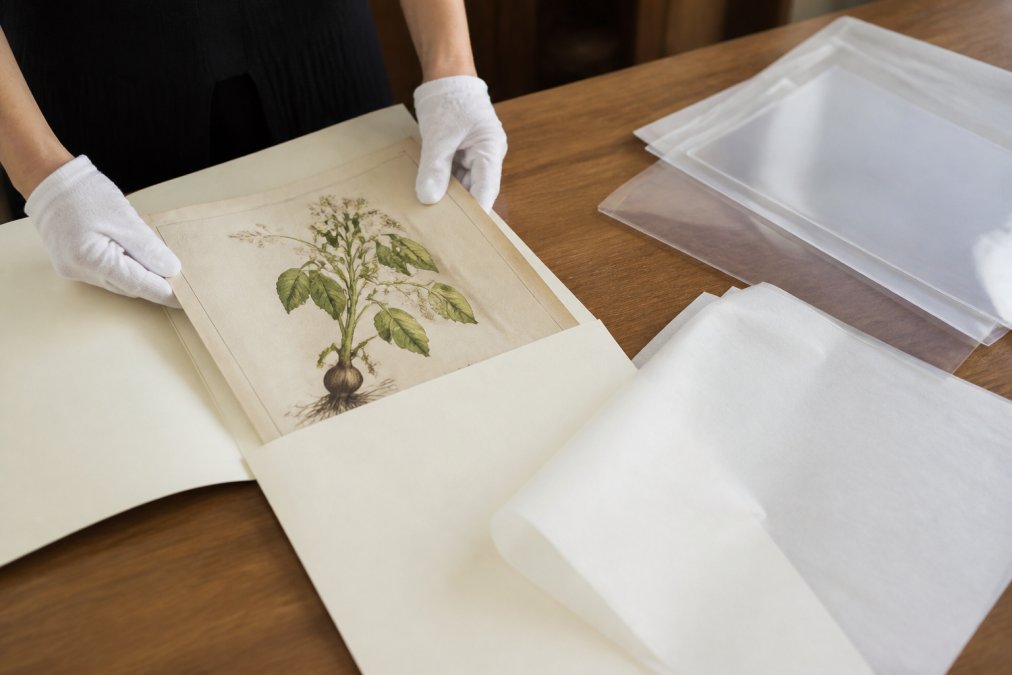
Ordinary cardboard, newsprint and cheap plastic sleeves contain acids and lignin that migrate into paper, discolouring it and making it brittle. This process, acid migration, is a common cause of avoidable damage. Look for boxes, folders and tissue described as acid-free, lignin-free and pH neutral, and buy from suppliers who state the material composition rather than just promising "archival quality".
Acid-Free, Lignin-Free and Buffered: Decoding the Labels
Acid-free means the material has a neutral or slightly alkaline pH and will not introduce acid into your print. Lignin-free means the wood-derived component that breaks down into acid over time has been removed. Buffered means an alkaline reserve, usually calcium carbonate, has been added to neutralise acids as they form.
Buffered materials suit most paper prints but are not universal. Photographic prints and some textiles and leathers do better with unbuffered, pH neutral storage. If unsure, unbuffered archival tissue is the safer default.
Polyester sleeves, often sold as Melinex or Mylar, are inert and transparent, ideal for prints you want to handle without touching the surface. Interleaving sheets between stacked prints prevent abrasion and stop one sheet's problems spreading to the next.
Preventing Foxing on Antique Prints: Causes and Practical Fixes
Foxing is the appearance of small reddish-brown spots on aged paper, caused by mould activity, metal particles in the paper and localised moisture. It is the most common condition issue in antique prints and far easier to prevent than to treat.
Practical fixes start with the environment, because foxing needs moisture to develop:
- Move the print out of any damp room and into stable, mid-range humidity
- Store it flat, interleaved with unbuffered archival tissue
- Check existing storage for metal clips, pins and staples, which corrode and stain
- Inspect the collection twice a year for new spotting
Once foxing is established, treatment means washing and chemical bleaching, restoration, not preservation. It changes the paper permanently and belongs with a conservator, not a home remedy. Deacidification sprays sold for home use can do more harm than good on fragile items.
Archival Framing for Antique Prints: Doing It Without Causing Harm
Archival framing for antique prints means every material touching the paper is chemically stable and every method reversible. Framing is where most well-intentioned collectors cause permanent damage.
Two rules matter: nothing adhesive touches the print, and the print never sits directly against the glass. Dry mounting, spray adhesive and double-sided tape are permanent. Matting and mounting should use hinging with Japanese paper and starch paste, or photo corners, so the print can be removed without a trace.
Matting, Mounting and UV Protection
Matting does more than make a print look finished. It creates an air gap between the artwork and the glazing, which prevents condensation from transferring onto the paper surface.
- Specify mat board that is acid-free and lignin-free, not standard backing board
- Ask for UV-filtering glazing, and accept that it slows fading rather than stopping it
- Ask explicitly for reversible hinging, and check before the frame is sealed
- Keep framed prints off walls that receive direct sun or sit above a heat source
Display conditions matter as much as storage conditions. A print hung above a fireplace or in a sunlit hallway will fade regardless of how good the frame is.
Handling, Cleaning and Everyday Care for Fragile Items
Handling protocols protect prints more than any product you can buy. Clean, dry hands are the minimum; white cotton gloves are better for anything valuable, because skin oils transfer to paper and attract dirt. But the material changes the protocol, and most guides skip that distinction.
Handling by Material Type
A cotton-rag etching from the 18th century and a late-19th-century chromolithograph on wood-pulp paper behave differently in the hand. The rag sheet is flexible and forgiving; the wood-pulp sheet is acidic and brittle, and a corner lifted carelessly will crack rather than flex. For brittle papers, slide a rigid support underneath rather than lifting.
Surface texture dictates handling too. Mezzotints and aquatints have delicate plate tone a thumb can abrade; engravings with heavy plate marks are more robust but suffer if stacked face-to-face. Photographic prints need unbuffered enclosures and different gloves from those used for acidic materials.
Cleaning: What You Can and Cannot Do
On cleaning, the honest answer is that you should do very little. Surface dust can be lifted with a soft, clean brush. Anything beyond that, erasing pencil marks, removing tape, treating stains, is conservator territory. Household cleaning products, erasers and water cause damage that cannot be undone.
A few traps are worth naming. Pressure-sensitive tape, even the 'archival' kind sold in craft shops, leaves an adhesive residue that stains and cannot be removed without solvents; rubber cement and spray adhesives are worse. Pencil marks made by a dealer decades ago are part of the print's history, removing them removes provenance. And water, even a damp cloth, drives soluble acids deeper into the sheet and causes tidelines more disfiguring than the original mark.
Everyday Storage Habits That Prevent Damage
Work on a cleared, clean surface. Support the whole sheet with both hands rather than lifting a corner. Never fold, roll tightly or stack prints face to face without interleaving. Keep food, drink and pets away.
A few habits that experienced collectors adopt almost without thinking:
- Store prints flat rather than rolled; rolling puts long-term stress on the paper and encourages it to curl
- Interleave with unbuffered archival tissue so surfaces never touch directly
- Keep a written or photographic record of condition at the time of storage, so changes are detectable
- Handle one print at a time, and return it to its enclosure before starting the next
When to Stop and Call a Conservator
The line between preservation and restoration is the line between reversible and irreversible. If a treatment can be undone without trace, it may be within reach of a careful collector. If it cannot, it belongs with a professional conservator. Tape removal, stain treatment, washing, deacidification and flattening of cockled sheets all fall on the irreversible side. So does any intervention on a print with significant monetary or sentimental value, where a mistake costs more than the treatment would have.
Digital Preservation and Budget-Friendly DIY Solutions
Digital preservation means creating high-quality scans of your prints as an insurance record, not a replacement for the physical object. A good scan documents condition, proves provenance and gives you something to compare against if damage appears later.
For a budget setup, you do not need a studio. A high-resolution flatbed scanner, or a phone camera on a tripod with soft, even, indirect light, produces a usable record. Scan at a resolution high enough to show paper texture and existing spotting, save in a lossless format, and back up in two places. Photograph the back too, where dealer marks, inscriptions and framing history often sit.
Where the budget genuinely stretches, prioritise in this order:
- A stable storage location, which costs nothing but discipline
- Acid-free folders and interleaving tissue for your most fragile items
- An archival box for flat storage, sized so prints lie flat without pressure
- Polyester sleeves for pieces you handle often
- UV-filtering glazing for anything going on a wall
That sequence buys you the most protection per dollar. And if you are weighing whether a damaged piece is worth professional attention, the rule of thumb is simple: preserve what you have, and consult a conservator before attempting anything that cannot be reversed.
Frequently Asked Questions
How to preserve art prints?
Store prints flat in acid-free folders or polyester sleeves, away from light, heat and damp. Keep relative humidity stable between 45 and 55 percent and temperature around 18 to 22 degrees Celsius. Frame only with archival matting and UV-filtering glass. Handle with clean cotton gloves and avoid direct sunlight. These steps slow acid migration and prevent foxing, mould and fading, keeping your antique prints in good condition for decades.
Why should you avoid storing antique prints in basements?
Basements trap moisture and experience fluctuating temperatures, which accelerates acid migration, mould growth and foxing on antique prints. Damp air weakens paper fibres and encourages pests. Even finished basements can suffer from condensation and poor air circulation. Instead, store prints in a cool, dry interior room with stable conditions, ideally in acid-free boxes or flat files raised off the floor and away from exterior walls.
What materials are considered archival-quality for print storage?
Archival materials are acid-free, lignin-free and pH neutral. Look for unbuffered or buffered archival boxes, folders and tissue paper, plus polyester sleeves for fragile items. Buffered materials suit most paper but avoid them for photographs or blueprints. Interleaving sheets protect surfaces. Matting and mounting boards should be museum-grade. These materials prevent acid migration and support long-term preservation of antique prints.
Are antique prints worth anything?
Value depends on rarity, artist, condition and demand. Botanical, bird and fashion illustrations from well-known printmakers often hold value, especially when colours remain vivid and the paper is free from foxing or tears. Prints in poor condition lose significant value. Preservation directly protects investment potential, so proper storage, archival framing and careful handling matter as much as the print itself.
Antique prints reward patience more than products. If you would rather start with pieces that are already sound, well documented and ready to store properly, Antiquarian Print Shop offers a curated collection of over 1,200 authentic original prints and high-quality reproductions, including botanical, bird and fashion collections, with custom sizing to suit your wall. Shop original prints and give your collection the conditions it deserves.