
Buy 19th Century Fashion Illustrations Online: Expert Guide
Table of Contents
- Why 19th Century Fashion Illustrations Belong on Your Wall
- From Victorian Era to Edwardian Style: A Collector's Timeline
- Where to Buy 19th Century Fashion Illustrations Online
- Identifying Original Antique Fashion Plates vs. Reproductions
- Understanding the Value of Victorian Fashion Illustrations
- How to Frame Antique Prints for Preservation and Display
- Your First Purchase: A Practical Checklist for Buying Online
- Build Your Collection with Confidence
- Frequently Asked Questions
Last Updated: September 10, 2026
Why 19th Century Fashion Illustrations Belong on Your Wall
Before photography captured every hemline, fashion plates were the only way most people saw the latest Parisian silhouettes. These hand-coloured engravings and lithographs, published in periodicals between the 1830s and 1900s, documented style with an artistry that modern catalogues cannot match. Buying 19th century fashion illustrations online lets you bring that history into your home, transforming a wall into a conversation about craft, colour, and social change.
Antiquarian Print Shop offers a curated selection of authentic original antique prints for collectors and interior enthusiasts alike. Our founder, curator Iris Windsor, built the collection around traditional printmaking methods like etching and lithography, ensuring every piece carries a tangible connection to the past. A single framed plate can anchor a room, offering the kind of visual depth that mass-produced posters simply lack.
These works are more than decoration. They are documents of an era when fashion journalism was visual, when magazines like La Mode Illustrée shaped taste across Europe. Each plate tells you something about the wearer, the occasion, and the values of the time. That narrative quality is why designers, stylists, and historians continue to seek them out for reference and inspiration.
From Victorian Era to Edwardian Style: A Collector's Timeline
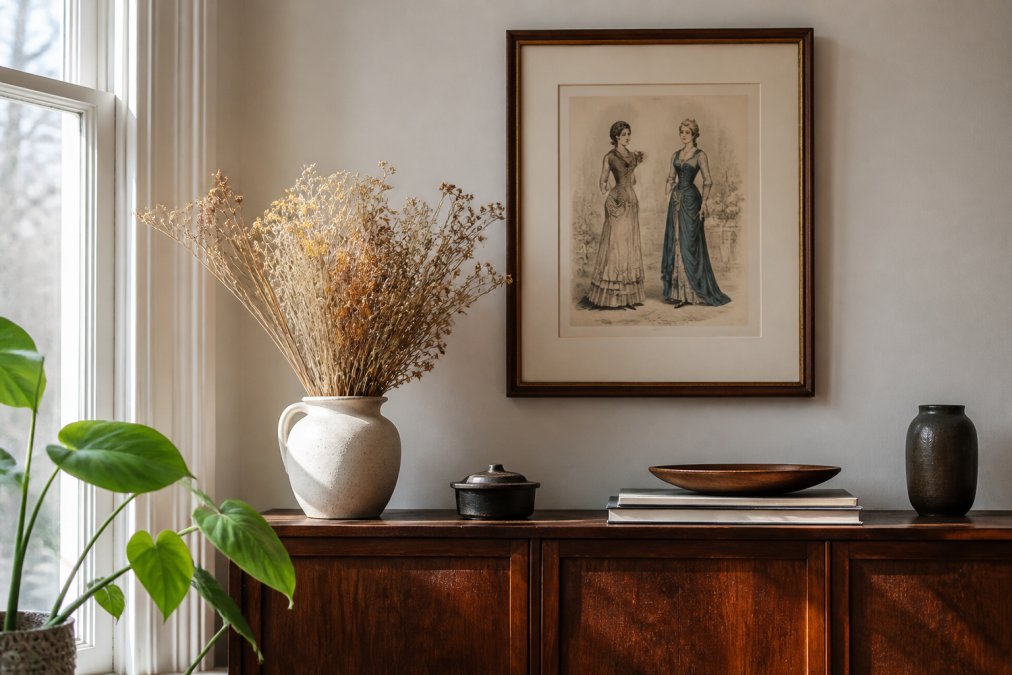
Understanding the eras helps you buy with intention rather than impulse. The Victorian era, roughly 1837 to 1901, produced plates dominated by corseted silhouettes, crinolines, and bustles. Early Victorian illustrations often show modest, high-necked gowns, while the 1860s and 1870s bring the dramatic expansion of the cage crinoline.
As the century progressed, the silhouette shifted. The 1880s introduced the bustle, and by the 1890s, sleeves reached their most exaggerated proportions. Then came the Edwardian style, spanning 1901 to 1910, where the S-curve corset pushed the bust forward and the hips back, creating that distinctive, elegant posture we associate with the era.
A quick reference timeline helps:
| Era | Silhouette | Typical Palette |
|---|---|---|
| 1840s-1850s | Small waist, full skirt | Soft pastels, floral prints |
| 1860s-1870s | Cage crinoline, dome shape | Bright jewel tones |
| 1880s | Bustle at back | Deep burgundy, forest green |
| 1890s | Gigot sleeves, narrow waist | Muted earth tones |
| 1900s-1910s | S-curve, monobosom | Ivory, pale blue, grey |
Knowing these markers helps you date a plate at a glance, which matters when you are assessing value or building a themed collection across decades.
Where to Buy 19th Century Fashion Illustrations Online
Your best starting point is a specialist dealer who authenticates and describes each piece accurately. Marketplaces and auction sites can yield bargains, but they also carry a high risk of mislabelled reproductions. A dedicated shop like Antiquarian Print Shop offers over 1,200 authentic original prints, with fashion collections curated by Iris Windsor, who understands printmaking history.
When you buy 19th century fashion illustrations online, look for sellers who provide clear provenance details, condition reports, and high-resolution photographs. You want to see the plate mark, the paper texture, and any foxing or toning before you commit. Reputable dealers also offer reproductions, which give you the look of an original at a fraction of the cost.
Shipping is another consideration. Original prints require careful packing and tracking. Most specialists handle this routinely, but confirm delivery timelines if you are buying a gift. Many sellers offer custom sizing for reproductions, which is ideal for awkward wall spaces that standard frames cannot fill. Antiquarian Print Shop offers custom print options in multiple sizing formats.
Identifying Original Antique Fashion Plates vs. Reproductions
The single most important skill for a collector is telling an original from a copy. Original antique fashion plates were printed at the time of publication, usually through lithography or copper engraving, then hand-coloured by studio artists. Reproductions are modern scans or reprints, often on smoother, brighter paper.
Start by examining the paper. Originals have a handmade or early machine-made texture, with natural toning and occasional foxing spots. The ink will sit slightly raised if it is an engraving, and the hand-colouring will show subtle variation between copies. Reproductions, by contrast, look flat and uniform, with colour that is too consistent.
Check the plate mark or impression. An original engraving leaves a visible indent where the plate pressed into the paper. Look for the publication line, often found at the bottom edge, which lists the magazine and date. For guidance on authentication, the University of Glasgow's print research resources offers a solid introduction to identifying intaglio marks and paper types.
Understanding the Value of Victorian Fashion Illustrations
Value depends on several factors: rarity, condition, artist, and subject matter. Victorian fashion illustrations are collectible art because they capture a moment in fashion history that photographs cannot. Plates featuring notable designers or depicting royal mourning dress, wedding gowns, or military uniforms tend to command higher interest.
Condition is paramount. Look for strong colour, clean margins, and no tears or creases. Paper that has yellowed evenly is acceptable; paper with large brown stains or water damage is not. As with any antique market, provenance matters. A documented history of ownership adds confidence and, often, value.
Original prints also hold potential as investment assets. Like fine art, they are finite in number. The supply of quality Victorian plates shrinks as pieces enter permanent collections or suffer damage. For a deeper look at how the trade values printed ephemera, the National Library of Australia's guide to prints and printmaking provides useful context on market factors and preservation standards.
How to Frame Antique Prints for Preservation and Display
Proper framing prevents the two greatest threats to antique paper: light damage and acid migration. Ultraviolet light fades hand-coloured pigments, while acidic materials in cheap mats cause brown "mat burn" that permanently stains the paper.
Use conservation-grade materials exclusively. This means UV-filtering glass or acrylic, and a mat board that is acid-free and lignin-free, often labelled as museum or conservation grade. The print should never touch the glass; the mat creates a protective air gap. Hinge the print to the backing board using Japanese tissue and starch paste, never pressure-sensitive tape.
For a detailed overview of archival mounting techniques, the Australian Institute for the Conservation of Cultural Material's care guidelines outlines best practice for works on paper. Humidity is the other enemy. Keep framed prints away from direct sunlight, radiators, and bathrooms. Stable indoor conditions, around 45-55% relative humidity, will keep your plate flat and bright for decades.
Your First Purchase: A Practical Checklist for Buying Online
Before you click "buy 19th century fashion illustrations online", run through this checklist to avoid disappointment:
- Confirm the seller states whether the item is an original or a reproduction
- Read the condition report for foxing, tears, toning, or colour loss
- Ask for photos of the back of the print and close-ups of the plate mark
- Verify the dimensions match your intended wall space
- Check whether the frame and mat are included or sold separately
- Clarify shipping time and insurance coverage for delivery
- Review the return policy in case the print arrives damaged
- Ask about custom sizing if you plan to frame a reproduction yourself
A reputable dealer will answer these questions without hesitation. If a seller is vague about authenticity or condition, move on. There are plenty of quality pieces available, and patience protects your budget.
Build Your Collection with Confidence
Collecting 19th century fashion illustrations is a journey through fashion history, printmaking, and interior design all at once. Start with a single piece that speaks to you, learn to read its details, and let your eye develop. Each subsequent purchase will feel more informed than the last.
Whether you seek a rare original from the 1860s or a high-quality reproduction of an Edwardian plate, the right source makes all the difference. Antiquarian Print Shop pairs authentic originals with affordable reproductions and custom sizing, so you can start collecting at a level that suits your space and budget. Browse the fashion collections and find the plate that starts your story.
Frequently Asked Questions
How can you tell if an antique fashion print is original?
Look for signs of age on the paper itself, such as toning, foxing, or plate marks from the printing process. Original antique fashion plates often have a platemark impression and were hand-coloured, so check for subtle brush strokes rather than uniform digital colour. Examine the back for old mounting remnants or period annotations. When buying online, ask the seller for detailed images of the paper's edges and the reverse side. Reputable dealers like Antiquarian Print Shop verify authenticity and provide provenance details.
What is the difference between a fashion plate and a fashion illustration?
A fashion plate is a specific type of illustration produced for mass distribution in fashion periodicals during the 19th century. These were typically created through lithography and then hand-coloured, showing the latest trends in detail. A fashion illustration is a broader term covering any drawing depicting clothing. While a plate was made for reproduction in magazines and journals, an illustration might be a unique original artwork or a sketch created for a couturier. Collectors prize plates for their historical documentation of period costume and trends.
Are 19th century fashion illustrations a good investment?
The value of Victorian fashion illustrations can offer potential for investment, with rare plates and those in pristine condition often sought after. Original hand-coloured lithographs from sought-after periodicals are collectible art pieces with a limited supply, which can support their long-term worth. Their investment value depends on factors like rarity, condition, and the artist's reputation. Unlike modern prints, each original plate is unique due to the hand-colouring process. For those starting out, focusing on aesthetic appeal and condition is wise, as the market for historical fashion research and collectible art continues to grow.
What should I look for when buying antique prints online?
First, verify the item's authenticity by asking if the plate is an original or a reproduction. Check for clear, high-resolution photos that show the paper's condition, including any foxing, tears, or colour fading. Ask about the dimensions and whether the print includes margins. Inquire about provenance or any documentation of its history. Review the shop's return policy and shipping methods for oversized or fragile items. Reliable sellers will describe the printing technique, such as lithography or engraving, and provide details about the publication it originally appeared in.
The challenge is finding pieces that are authentic, well-preserved, and fairly priced. Antiquarian Print Shop solves that with a curated selection of over 1,200 genuine antique prints, traditional printmaking methods, and flexible custom options. Shop the original prints today and bring a piece of fashion history into your home.