
Collecting Vintage Australian Map Reproductions for Your Office
Last Updated: November 24, 2026
Quick Summary
Choose a vintage Australian map by matching its region, date and style to the wall it will hang on, starting with the room rather than the decoration. Hand-coloured reproductions suit dark timber interiors, while uncoloured versions fit bright, minimalist offices. Measure the wall space before buying any vintage australian map.
- Decide whether the office needs a continent, state or single-coastline map before choosing a piece.
- Mid-nineteenth-century maps carry decorative borders; later maps are plainer and more technical.
- Reproductions cost far less than originals and suit decoration without the investment risk.
- Confirm the source, cartographer and date in writing before you pay for any reproduction.
- Hang a single map's centre at about 145cm for standing viewers, and mark group centre lines first.
Table of Contents
- How Do You Choose a Vintage Australian Map Reproduction for an Office?
- Original Antique Maps Versus Reproductions: What Is the Difference?
- Old Maps of Australia Worth Hanging: Regions, States and Dates
- How to Verify Reproduction Rights, Provenance and Print Quality
- Sizing, Framing and Layout for Office Walls
- Print, Material and Framing Comparison
- Budgeting for a Multi-Map Office Collection and Booking Your First Print
- Frequently Asked Questions
How Do You Choose a Vintage Australian Map Reproduction for an Office?
Choose a vintage Australian map reproduction by matching the map's region, date and style to the wall it will hang on. Most buyers start with the decoration and only later ask whether the map suits the room. Start with the room, then pick the map.
Collecting vintage Australian map reproductions for offices works best when you treat each piece as part of the workplace, not just a picture. A map of the eastern coast reads differently in a Sydney law firm than in a Melbourne design studio, even when the frame is identical.
Work through these checks in order:
- Region: Decide whether the office should show the whole continent, a single state, or one coastline. Broad maps suit reception areas; state maps suit meeting rooms.
- Date and character: Mid-nineteenth-century maps carry decorative borders and vignettes. Later maps are plainer and more technical. Pick the style that fits the room's tone.
- Colour: Hand-coloured reproductions bring warmth to dark timber rooms. Uncoloured versions sit better in bright, minimalist spaces.
- Scale and wall space: A large map anchors a wall; a small one works best in a grouping.
A common mistake is buying for the wall you imagined rather than the one you have. Measure the space before you fall in love with a map.
Original Antique Maps Versus Reproductions: What Is the Difference?
An original antique map is a print made from the engraving plates of its own era, while a reproduction is a modern print made from a copy of that original. The difference matters for value, not for how the map looks on the wall.
Originals are scarce and priced by rarity and condition. Reproductions cost far less and let you hang the same design without the investment risk. Reproductions of this kind are generally priced well below originals, which are priced by rarity and condition.
Be clear with yourself about which you want. If the map is for decoration, a good reproduction does the job. If you want a collectible asset, you need an original with documented provenance.
Watch out: Some sellers describe reproductions in language that suggests originals. Check that the listing names the technique and whether the map is a reproduction before you pay.
Old Maps of Australia Worth Hanging: Regions, States and Dates
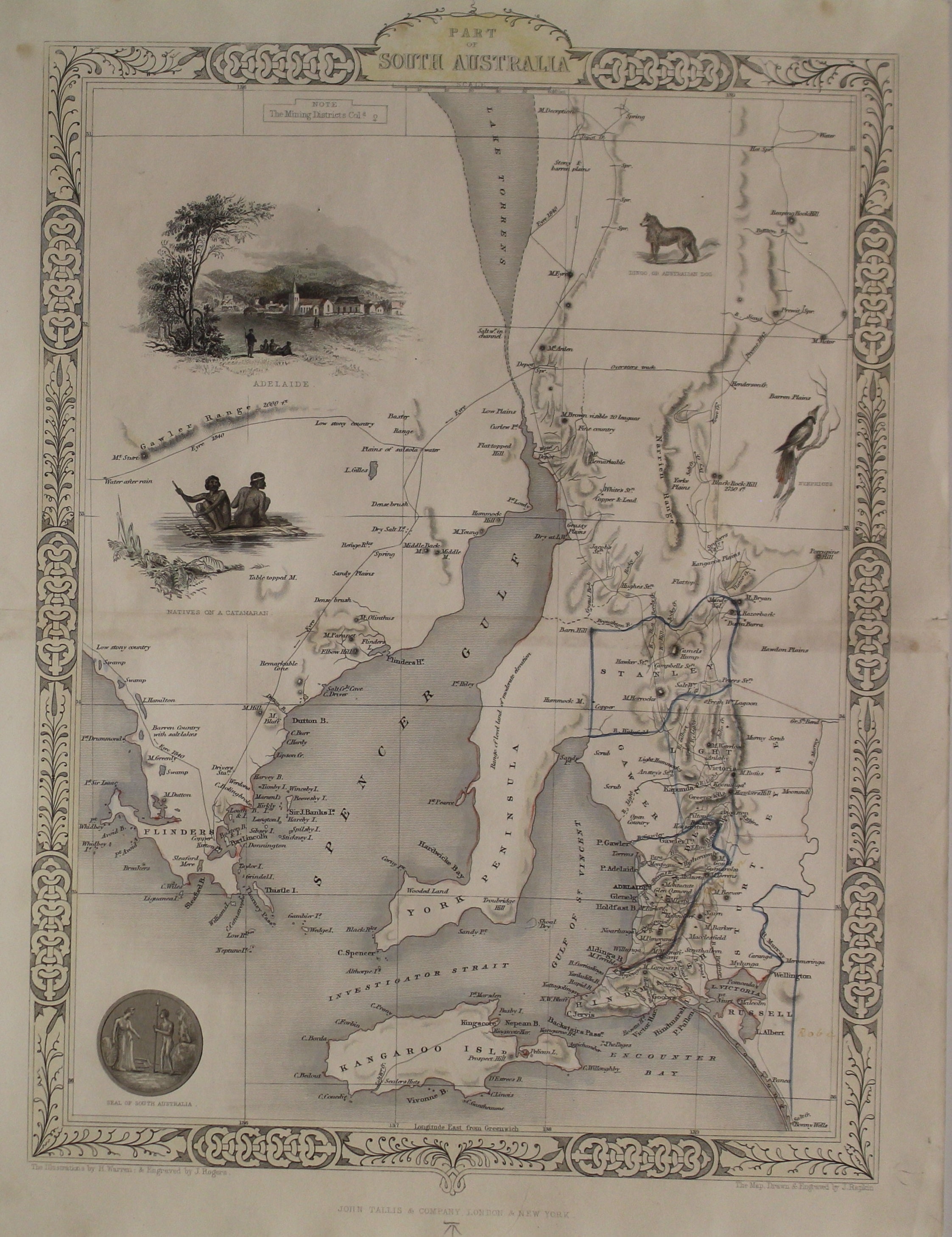
Several historical Australian maps suit offices well, and the best choice depends on the region and date you want to show. The range includes a Tallis map of Australia, a Cassini map showing Captain Cook's discoveries, a Tallis map of Victoria and Port Phillip, and a Tallis map of Van Diemen's Island (Tasmania).
The Tallis Australia reproduction, dated 1851, is a hand-coloured steel engraving with a decorative border. It sells for $120.00 and measures 270 x 350mm.
The Cassini map, dated c1801 and based on a copperplate engraving, incorporates Cook's charting of the east coast. The hand-coloured version is $250.00, with a paper size of 455 x 650mm.
The Tallis Victoria and Port Phillip map, dated 1851, shows the region as "Australia Felix" and records the year Victoria separated from New South Wales. It is available uncoloured for $50.00.
The Tallis Van Diemen's Island map, also dated 1851, is a reproduction at 250 x 320mm and sells for $120.00.
You can browse the Tallis map of Australia reproduction to compare the full-continent option against the state maps before you decide.
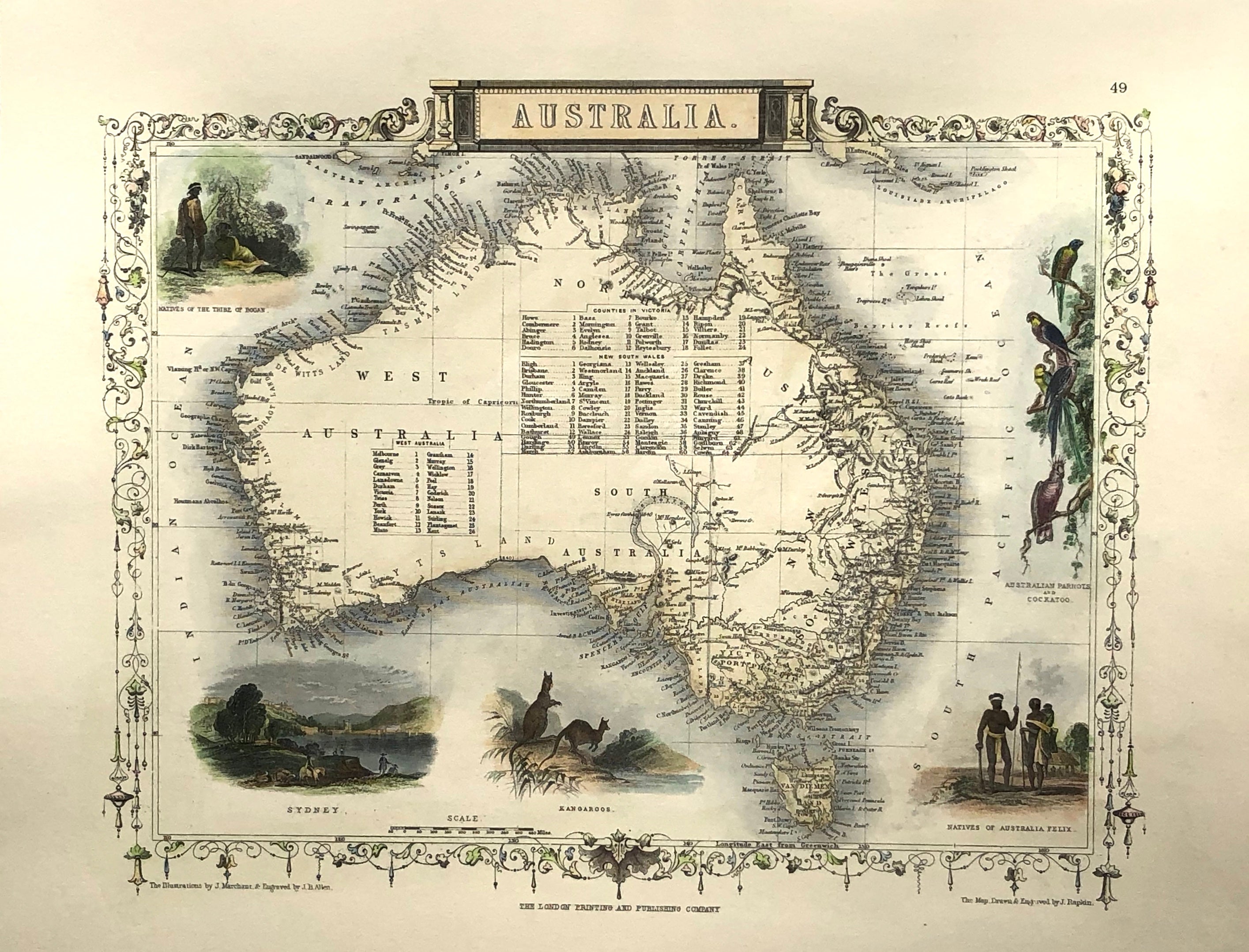
Prices of Tallis and Cassini map reproductions (AUD)
How to Verify Reproduction Rights, Provenance and Print Quality
Verify a reproduction by working through three checks in order: rights status, source provenance, and print quality. Most buyers skip straight to the image and only later discover they cannot confirm what they own. A short written record at purchase saves that problem.
Step 1: Confirm the rights status of the underlying map. Copyright duration in Australia depends on the author's life and the date of publication, so check the current position before assuming a historic map is in the public domain. The complication is the reproduction itself: a modern photograph or scan of an old map can attract its own copyright, and a publisher's cleaned-up digital file may carry terms of use. Ask the seller whether the file is a direct scan of a public-domain original or a redrawn or enhanced version, and whether any licence restricts commercial display. Check the current guidance from an official Australian source on duration and on using historical material before relying on any summary.
Step 2: Trace the source reference. A credible listing names the original publication, the cartographer or engraver, and the date. For example, a listing should state that the image comes from an 1851 Tallis atlas plate, not merely that it is "a vintage map of Australia". Where possible, cross-check the title and date against a library catalogue or a digitised collection before you buy. If the seller cannot name the source, treat the provenance as unverified.
Step 3: Assess print quality from evidence, not adjectives. Ask for a close-up photograph of the engraved lines and the paper surface, and confirm whether colour is hand-applied or printed, because hand-colouring varies between copies.
Use this checklist before paying:
- Technique stated: steel engraving, copperplate engraving, or digital print.
- Source cited: original publication, cartographer, and date.
- Both dimensions given: image size and paper size, in millimetres.
- Colour method stated: hand-coloured, printed colour, or uncoloured.
- Rights confirmed: public-domain original, and any licence terms for the reproduction file.
- Condition described: any fading, foxing, or trim noted.
Watch out: Listings that use words like "original", "antique", or "period" without naming the technique and date can blur the line between an original and a reproduction. Ask directly, in writing, and keep the reply with your invoice.
For office use, also confirm that the seller permits display in a commercial setting, since a licence attached to a particular digital file may restrict this. Record the seller's confirmation so a future facilities or brand review can see the basis for the purchase.
Sizing, Framing and Layout for Office Walls
Size the map to the wall and the viewing distance first, then choose the frame and hanging method. Office walls differ from home walls: viewers are often seated, sightlines cross desks and partitions, and lighting is usually fixed. Work through the following in order.
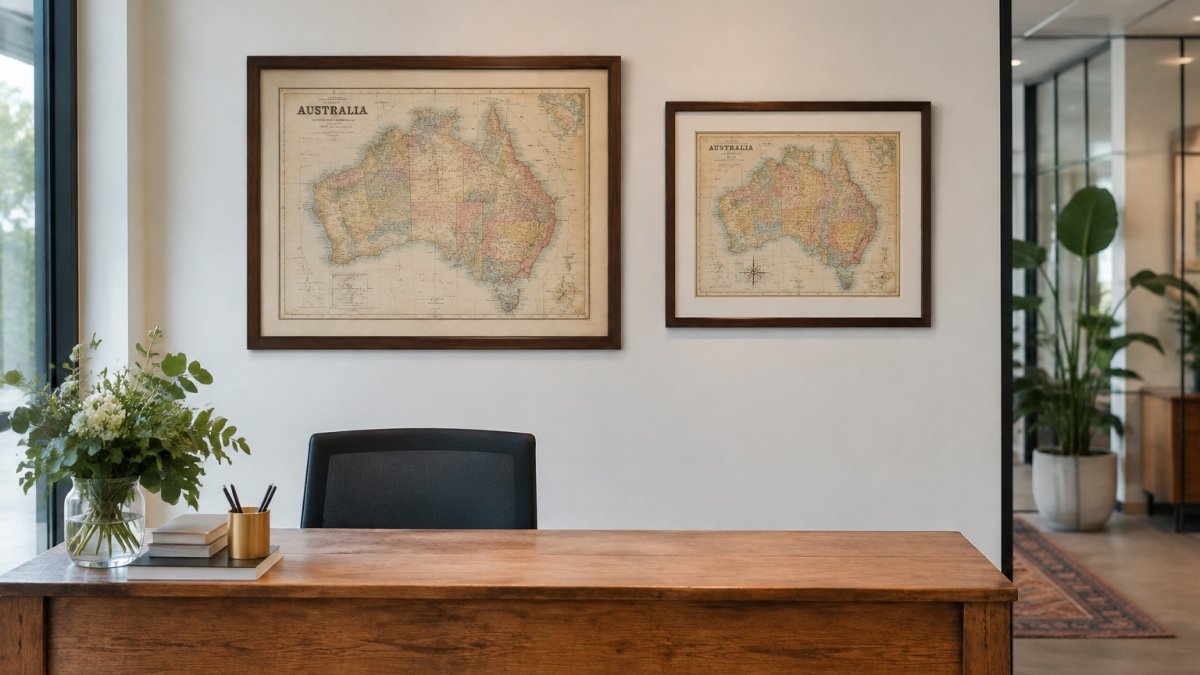
1. Set the viewing distance. A comfortable rule is that the map's diagonal should be roughly one-quarter to one-third of the typical viewing distance.
2. Match the map to the wall section. For a single map, aim for roughly two-thirds of the width of the wall section it occupies, measured between fixed obstructions such as door frames, columns, or joinery.
3. Set the height for seated and standing viewers. Hang the centre of a single map at about 145cm from the floor for standing viewers.
4. Control glare and light. Paper and glazed prints fade and reflect. Avoid placing a map where direct afternoon sun falls on it, and avoid positioning it opposite a window where glare will wash out the image for seated viewers.
5. Choose the frame and mount for the setting. Black or natural timber frames suit most professional interiors. Use a wider mount for smaller maps so the image has breathing room, and keep mount proportions consistent across a group.
6. Specify the hanging system. Plasterboard walls in offices often need wall plugs or a French cleat for heavier framed pieces. For groups, set out the frames on the floor first and mark the centres with a laser level or a spirit level and pencil.
A worked example: a 2.4-metre reception wall with a desk in front. A single 455 x 650mm framed map centred at 145cm occupies about a quarter of the wall width, so it reads as a feature without dominating.
Watch out: Hanging a group by eye without marking a centre line is the most common cause of a set that looks uneven once seated viewers see it from across the room. Mark the line first, then hang to it.
Print, Material and Framing Comparison
The print technique, paper and frame each change how a map looks and how well it lasts. The table below summarises the main options for office use.
| Option | Look | Best for | Trade-off |
|---|---|---|---|
| Hand-coloured steel engraving | Warm, decorative, detailed | Reception areas, feature walls | Costs more; colour varies slightly |
| Uncoloured reproduction | Clean, neutral, understated | Minimalist or bright offices | Less visual warmth |
| Copperplate reproduction | Fine lines, technical feel | Boardrooms, study-style spaces | Smaller image sizes |
| Framed with glazing | Protected, polished | High-traffic or sunlit spaces | Reflection; heavier to hang |
| Unframed or mounted | Flexible, lighter | Rotating displays | Needs careful handling |
Pros of hand-coloured prints: strong visual interest and a sense of age. Cons: colour may differ slightly from the illustration, so set expectations. Pros of uncoloured prints: blend into a neutral scheme and cost less. Cons: they can look plain on a large wall.
Avoid hanging any map where direct afternoon sun falls on it.
Budgeting for a Multi-Map Office Collection and Booking Your First Print
Plan the budget before you buy, so the collection stays consistent in style and cost. A practical starting point is one feature map and one or two supporting maps.
Using the listed prices, a sensible first collection could look like this:
- Feature piece: Tallis Australia reproduction at $120.00
- Supporting state map: Tallis Victoria and Port Phillip, uncoloured, at $50.00
- Second supporting piece: Tallis Van Diemen's Island at $120.00
- Total: $290.00 before framing
Add framing costs separately, because they vary with size and finish. Budget for glazing and a professional mount on the feature piece.
If you want a more significant centrepiece, the Cassini c1801 map with later hand-colouring is $250.00 and works well as a boardroom anchor. Build the rest of the collection around it.
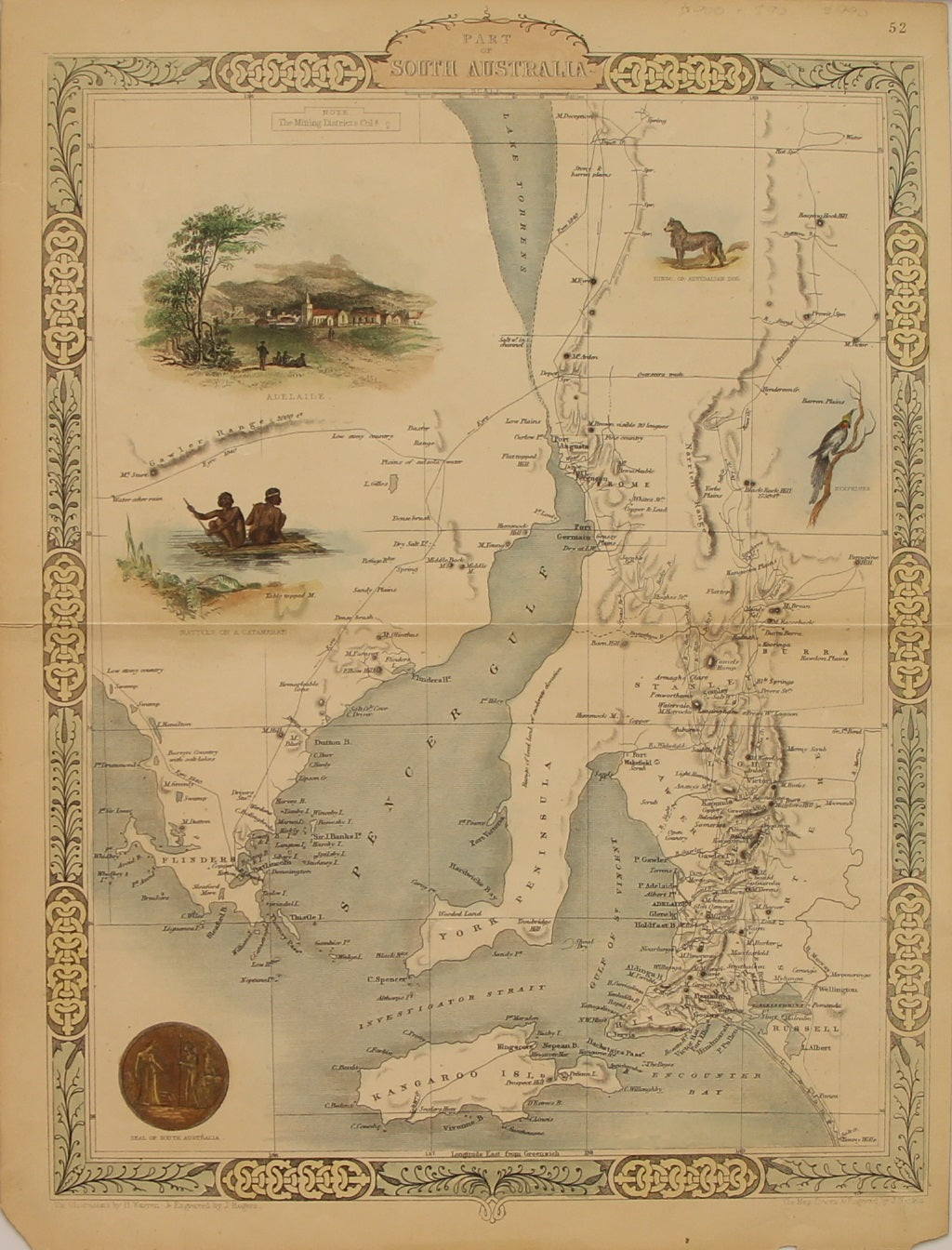
Start by choosing one map that suits the room, then add pieces that share a palette or theme over time. Browse the state and regional maps to see how the Tallis Victoria and Port Phillip and South Australia reproductions compare before you place your first order.
Frequently Asked Questions
How can you tell whether a vintage map is an original or a reproduction?
Check the listing for the date, engraver, publisher and technique. Original 19th century maps were typically steel or copperplate engravings, and reproductions are usually described as such. Look at the paper size against the image size, and check whether the colouring is described as later hand-coloured. Check that the listing states clearly whether a piece is an original or a reproduction.
Are reproductions of old maps suitable for collecting?
Yes, reproductions are a practical starting point for collecting vintage Australian maps. They let you build a themed collection covering states, regions or exploration routes at a fraction of the cost of originals. For example, the Tallis Victoria and Port Phillip reproduction is listed at $50.00 AUD, while the Tallis Tasmania reproduction is listed at $120.00 AUD. Keep the reproduction label on each piece and store a record of its date and technique with your collection notes.
What frame works best for a vintage map reproduction in an office?
A simple timber or black metal frame with a wide off-white mount suits most vintage maps, because it lets the decorative borders and vignettes stand out without competing with the office decor. Use UV-filtering glazing where the wall receives direct sunlight, since prolonged light exposure fades hand-coloured areas. Choose a frame that is slightly larger than the print size listed in the product details, so the mount sits evenly around the map.
Where can you find vintage Australian map reproductions for an office?
Antiquarian Print Shop offers a curated range of Australian map reproductions, including the Cassini c1801 hand-coloured map of Australia and Papua New Guinea at $250.00 AUD, the Tallis Australia map at $120.00 AUD, and the Tallis Victoria and Port Phillip map at $50.00 AUD. Compare the paper size, image size, technique and condition of each listing before ordering, and check whether colouring has been added, as this changes the look of the map on your wall.