
Custom Sizing for Original Antique Art: A Complete Guide
Table of Contents
- Why Custom Sizing Matters for Original Antique Art
- How to Measure Antique Paper for Framing
- Understanding Aspect Ratio and Resolution for Large-Format Printing
- Standard vs. Custom Art Dimensions: What Works Best
- Archival Framing for Antique Prints
- Antique Print Restoration Services and When to Use Them
- Visualizing Your Custom-Sized Art Before Ordering
- Shipping and Handling Oversized Antique Art
- Frequently Asked Questions
Last Updated: September 25, 2026
Why Custom Sizing Matters for Original Antique Art
Custom sizing for original antique art transforms how you display treasured pieces, making the difference between a piece that feels lost on your wall and one that commands attention.
Antique prints rarely match standard frame sizes. Forcing a small print into an oversized frame looks wrong, and cropping to fit standard dimensions destroys the piece's integrity.
Custom sizing lets you display your antique art exactly as intended, respecting the original while adapting it to your space and increasing visual impact.
Custom sizing protects your art by eliminating awkward matting that invites acid migration and foxing, allowing archival framing to work properly.
How to Measure Antique Paper for Framing
Accurate measurement is the foundation of successful custom sizing for original antique art.
Using the Masking Tape Method
The masking tape method gives you the clearest picture of your antique print's true dimensions without risk of damage.
Lay your antique print face-up on a clean, flat surface. Use low-tack masking tape to secure the corners gently, holding the print steady without stressing the paper.
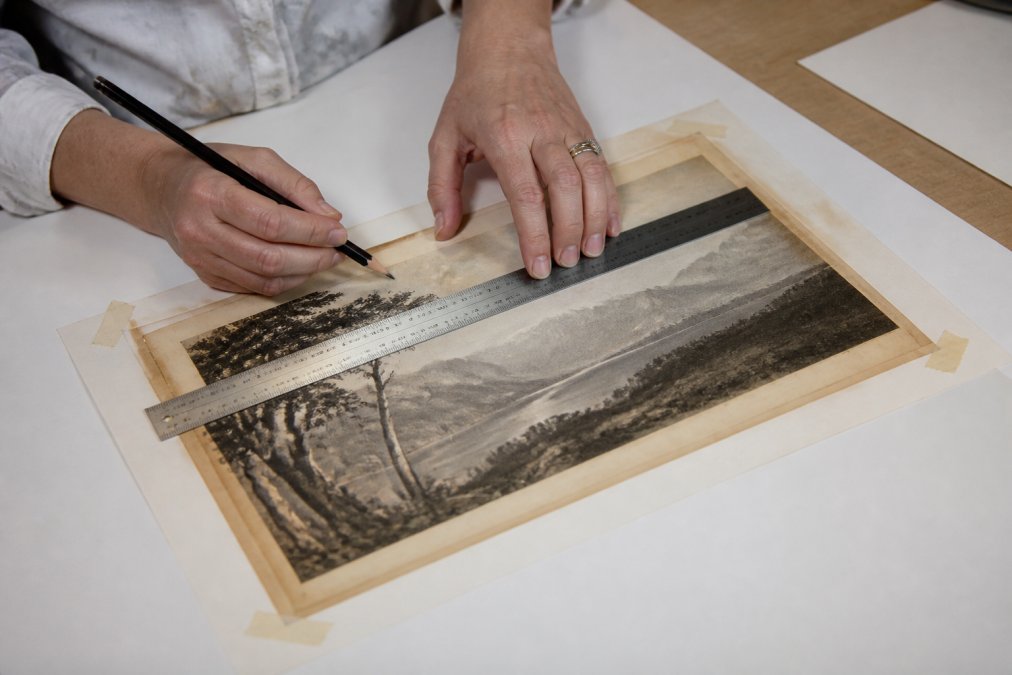
Use a metal ruler along each edge of the print, recording measurements to the nearest millimetre for top, bottom, left, and right sides.
Measure multiple times; a 2 mm error becomes obvious when framing.
Recording Dimensions and Aspect Ratio
Record measurements as width × height with units (e.g., 245 mm × 310 mm) to prevent confusion.
Aspect ratio, the mathematical relationship between width and height, determines how your print will look when enlarged. A 245 mm × 310 mm print has an aspect ratio of roughly 0.79:1.
Maintaining the original aspect ratio keeps proportions honest; changing it stretches or squashes the image, distorting the artist's composition.
Calculate aspect ratio by dividing width by height (245 ÷ 310 = 0.79).
Understanding Aspect Ratio and Resolution for Large-Format Printing
Large-format printing demands higher resolution. Resolution (DPI or PPI) determines print quality at size; enlargement amplifies resolution shortfalls.
How DPI Affects Print Quality at Different Sizes
A sharp 100 mm × 150 mm print may show pixelation when enlarged to 400 mm × 600 mm if the original file lacks sufficient pixel data.
Resolution Requirements by Print Size
- Under 300 mm: 150-200 DPI acceptable
- 300-600 mm: 300 DPI standard
- 600-1,200 mm: 300 DPI minimum; 400-600 DPI preferable
- Over 1,200 mm: 400-600 DPI recommended
Aspect Ratio Preservation During Enlargement
When you custom size your art, maintaining the original aspect ratio keeps proportions honest. For antique prints, the artist's proportional choices are part of the work's integrity. If your wall space doesn't match the original ratio, either crop the image or add margin space. For valuable or historically significant pieces, margin space is preferable as it respects the original work.
Upscaling and Interpolation: When It Works and When It Doesn't
Upscaling enlarges low-resolution files using software algorithms, but results vary. Upscaling works acceptably only when enlarging by 50-100%; a 3,000-pixel file can become 4,500-6,000 pixels with minimal degradation. For antique art, start with the highest resolution available. A professional scan costs far less than a blurry enlarged print.
Standard vs. Custom Art Dimensions: What Works Best
Standard frame sizes are economical and widely available, but rarely suit antique art perfectly. The decision between standard and custom sizing depends on cost, timeline, and the piece's significance.
The Cost-Benefit Calculation
Standard framing is generally more economical than custom framing. Archival upgrades to standard framing can narrow the cost gap. The decision rule for custom sizing often depends on the value of your antique print.
Timeline and Availability
Standard frames are available immediately; custom frames take 2-4 weeks. Timeline pressure often leads to poor choices. If you have time, custom sizing is worth the wait.
Aspect Ratio Matching and Composition Integrity
The strongest reason to choose custom sizing is aspect ratio preservation. Standard frames come in fixed proportions (4:3, 16:9, or square), rarely matching antique prints. For rare or historically significant pieces, aspect ratio preservation is non-negotiable. For decorative prints, aspect ratio matters less.
When Standard Sizing Works Best
Standard dimensions work well when:
- Your antique print happens to match a common size (rare, but it happens)
- You're working with a tight budget and the piece is decorative rather than valuable
- You want the piece framed quickly
- The print's original proportions aren't sacred to you
- You're creating a gallery wall with intentionally mixed proportions (a deliberate design choice)
- You're building a collection of affordable prints where consistency matters more than individual precision
When Custom Sizing Becomes Essential
Custom sizing for original antique art becomes essential when:
- Your print's dimensions fall between standard sizes (most antique prints do)
- The wall space demands specific proportions for visual balance
- You want to preserve the exact aspect ratio of the original
- The piece is rare, historically significant, or valuable (over £200)
- You're creating a cohesive gallery wall where each piece must fit a predetermined layout
- The print is fragile or in delicate condition, requiring archival framing that standard options don't provide
- You're displaying a museum-quality piece that deserves museum-quality presentation
The Mixed Approach: Strategic Combinations
Many collectors use both standard and custom sizing strategically: standard frames for affordable decorative prints, custom sizing for rare or valuable pieces. The key is intentionality, vary frame styles, mat colours, or spacing to show the mix is curated.
Archival Framing for Antique Prints
Archival framing protects your investment by using only acid-free materials. Proper archival framing includes acid-free mat and backing boards, lignin-free adhesives, UV-protective glass, and spacers. A £200 original print can be destroyed by a £30 acid mat in 10 years. When you order custom sizing for original antique art, always specify archival framing and ask your framer for acid-free certification documentation.
Antique Print Restoration Services and When to Use Them
Restoration can address surface dirt, foxing, minor creases, and faded colours, but cannot remove major stains, reverse severe acid damage, or restore missing sections. The decision to restore depends on the print's value and condition. For most collectors, prevention through proper framing and storage matters more than restoration.
Visualizing Your Custom-Sized Art Before Ordering
Ordering custom sizing for original antique art is a commitment. You want confidence before you order. Visualization tools eliminate the guesswork.
Shipping and Handling Oversized Antique Art
Oversized custom-sized prints demand careful shipping. Standard shipping methods can damage fragile paper.
| Shipping Method | Best For | Protection Level | Cost |
|---|---|---|---|
| Standard mail | Lightweight prints | Basic | Low |
| Registered post | Valuable unframed prints | Medium | Medium |
| Courier with tracking | Framed pieces | High | High |
| Climate-controlled courier | Rare originals | Maximum | Maximum |
Frequently Asked Questions
Can you trim original antique art to fit a custom frame?
Trimming original antique art is not recommended and can permanently damage its value and authenticity. Original prints, especially rare botanical or fashion illustrations, should be custom sized through framing and matting rather than cutting. Archival framing for antique prints uses acid-free matting, window mats, and mounting techniques that preserve the entire piece without alteration. If your wall space requires a specific dimension, work with a professional framer to find a matting solution that complements your layout while keeping the artwork intact.
What are the risks of resizing original antique lithographs?
Resizing original antique lithographs through cropping, trimming, or stretching can reduce their historical and investment value significantly. Lithographs are delicate and often feature maker's marks, signatures, or edition numbers at the edges that collectors value. Physical alteration also risks tearing the paper or exposing it to environmental damage. Instead, use custom matting, frame sizing, and wall placement to achieve visual balance. If the print's current dimensions don't suit your space, consider a reproduction in your desired size, or explore archival framing solutions that preserve the original while enhancing its presentation.
How do I determine the correct frame size for an antique etching?
Start by measuring your antique etching precisely using a metal ruler and recording both dimensions in millimetres. Consider the aspect ratio, whether the print is portrait, landscape, or square, as this affects how it balances on your wall. Apply design principles like the 70/30 rule (where art occupies 70% of wall space with 30% breathing room) to choose an appropriate frame size. A professional framer can advise on matting options that add visual impact without cropping the original. The frame itself should complement the artwork's period and style while ensuring the mat protects the print from direct contact with glass.
Should I use custom matting instead of resizing antique art?
Custom matting is the preferred approach for preserving original antique art while achieving the visual impact you want. A quality mat in acid-free materials creates a border that draws focus to the print, controls how much of the wall space it occupies, and protects the paper from dust and moisture. Window matting allows you to position the artwork within the frame to hide any damage or foxing at the edges, while preserving the entire original. This approach maintains the artwork's authenticity and investment value far better than cropping or resizing, and it gives you flexibility to adjust the visual scale through frame and mat choices.