
9 Famous Vintage Botanical Artists Who Shaped Plant Illustration
Last Updated: October 25, 2026
Quick Summary
Vintage botanical artists were trained naturalists and skilled draughtsmen working primarily between the 16th and early 20th centuries, with the golden age falling between 1700 and 1900. Famous figures like Basilius Besler, William Curtis, Henry Andrews, and Sir John Hill merged scientific observation with artistic beauty to document plant discoveries and establish the visual language of plant science.
- Basilius Besler's Hortus Eystettensis, published in 1613, contained 367 hand-coloured plates depicting over 1,000 plant varieties and became the template for all botanical illustration that followed.
- William Curtis founded Curtis's Botanical Magazine in 1787, which became the standard-bearer for botanical illustration in Britain and allowed new discoveries to be documented and circulated regularly.
- Sir John Hill's The Vegetable System, published between 1770 and 1775, comprised 26 volumes containing 1,544 engraved plates documenting plant life cycles and internal anatomy.
- Rosa Catherine Fiveash illustrated 32 of the 45 published chromolithographic plates in The Forest Flora of South Australia during the 1880s and 1890s, though her contributions were often uncredited.
- Printing techniques evolved from copperplate engraving through lithography to chromolithography, with each method creating distinct visual characteristics that help identify and date vintage botanical prints.
Table of Contents
- Defining Vintage Botanical Art and Its Historical Span
- The Pioneer: Basilius Besler and Early Scientific Plant Documentation
- History of Botanical Illustration From Herbals to Fine Art
- Famous Botanical Illustrators Who Defined the Victorian Era
- Women Botanical Artists and Their Overlooked Contributions
- Techniques Behind Vintage Botanical Prints: Engraving to Chromolithography
- How to Identify Antique Botanical Prints and Verify Authenticity
- Building Your Collection of Vintage Botanical Artwork
- Frequently Asked Questions
Defining Vintage Botanical Art and Its Historical Span
Vintage botanical art refers to plant illustrations created primarily between the 16th and early 20th centuries, when scientific observation and artistic beauty merged. These works document the botanical discoveries that transformed plant classification, and vintage botanical artists were building the visual language of plant science itself, not just creating pretty pictures.
The span runs roughly from the Renaissance through the 1920s, though the golden age many collectors pursue falls between 1700 and 1900. During this window, botanical prints evolved from crude woodcuts to sophisticated chromolithographs capturing leaf texture, flower anatomy, and colour with stunning fidelity.
At Antiquarian Print Shop, we've curated works spanning this spectrum. The artists behind them were trained naturalists, skilled draughtsmen, and often publishers in their own right.
The Pioneer: Basilius Besler and Early Scientific Plant Documentation
Basilius Besler stands at the threshold of modern botanical illustration. Working in Nuremberg during the early 1600s, Besler was a pharmacist and botanist who understood plants not as decorative subjects but as specimens worthy of precise, life-scale documentation.
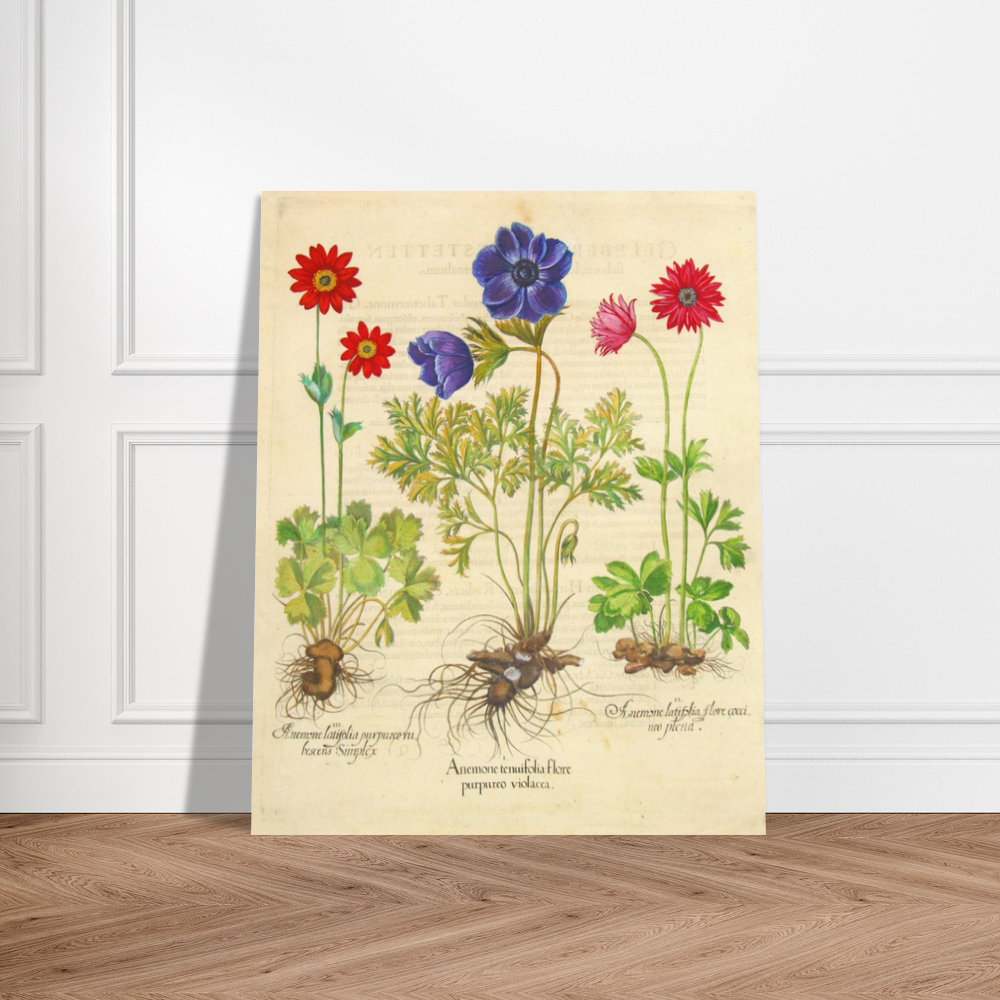
Besler spent 16 years documenting the Prince-Bishop's garden, with drawings translated into copperplate engravings by artisans led by Wolfgang Kilian. The result: 367 hand-coloured plates depicting over 1,000 plant varieties arranged by season, with Besler insisting on depicting plants at actual size as objects of both scientific and aesthetic value.
The Hortus Eystettensis proved that scientific accuracy and artistic beauty weren't opposing forces, shaping every botanical artist who followed. You can examine original Besler prints from the 1613 first edition, such as the Botanicals, Besler Basilus, Cyclamen Roma, Spica Vulgaris Flore Albo and Caruleo, c1613, which showcases his method of combining scientific precision with refined artistic composition.

History of Botanical Illustration From Herbals to Fine Art
Before Besler, botanical illustration served a purely functional purpose. Early herbals relied on crude woodcuts that bore little resemblance to actual specimens, distorted by the medium and the carver's skill.
The shift came gradually. As exotic plants arrived from the Americas, Asia, and Africa, collectors demanded more accurate documentation. Engraving replaced woodcut because copper plates held finer detail, and hand-colouring became standard because colour was essential for identification.
The Victorian era amplified this trend. As amateur gardening became fashionable among the middle class, publishers flooded the market with affordable botanical prints by artists like William Curtis and Henry Andrews, and botanical illustration became something collectors sought for their homes, not just their reference libraries.
Famous Botanical Illustrators Who Defined the Victorian Era
Henry Andrews: Blending Accuracy with Artistic Appeal
Henry Andrews (1794-1830) represents the moment when botanical illustration became accessible to ordinary people. Working in London during a period of explosive interest in horticulture, Andrews was unusual: he was simultaneously artist, engraver, colourist, and publisher, where most practitioners specialised in one skill.
His first major publication, The Botanist's Repository, appeared between 1797 and 1812 in ten volumes. It was groundbreaking not for scientific innovation but for affordability, serving Britain's amateur gardeners who wanted accurate plant illustrations but couldn't afford massive folios.
What distinguished Andrews was his commitment to artistic appeal without sacrificing accuracy. Where some publishers prioritised dry scientific description, Andrews' flowers were arranged with an eye to balance and visual interest. You can see this balance in works like the Botanical, Andrews Henry, Erica Oblique, Copperplate Engraving, 1797, where scientific detail meets refined artistic presentation.

William Curtis: Founder of Botanical Magazine
William Curtis (1746-1799) founded Curtis's Botanical Magazine in 1787, which became the standard-bearer for botanical illustration in Britain and beyond. Unlike the massive folios that preceded it, it was a periodical, meaning new discoveries could be documented and circulated regularly rather than waiting for a complete folio.
Curtis understood that botanical illustration served two audiences: botanists and gardeners wanted accuracy, while collectors and aesthetes wanted beauty. View authentic examples of Curtis's Flora Londinensis engravings to see how he balanced these competing demands. His hand-coloured copper engravings threaded this needle, combining scientific precision with visual refinement.
The Botanical Magazine became the model for disseminating botanical knowledge to an educated public, and Curtis's vision influenced every botanical publisher who followed. Examine the Botanical, Curtis William, Botanic Garden Lambeth Marsh, 1794 to see how Curtis balanced meticulous botanical detail with compositional grace.

Sir John Hill: Documenting Plant Structure and Life
Sir John Hill (c. 1714-1775) approached botanical illustration with an obsessive commitment to documenting not just what plants looked like, but how they functioned. His The Vegetable System, published between 1770 and 1775, comprised 26 volumes containing 1,544 engraved plates.
Hill's innovation was structural. Rather than depicting flowers in bloom, he documented the entire life cycle: roots, stems, leaves, flowers, seeds, and fruit, including cross-sections of internal anatomy. His plates were tools for understanding plant biology, not merely records of appearance.
Hill's work established the template for comprehensive botanical documentation, and every major botanical work that followed adopted his systematic approach to showing plant structure. The Botanical, Hill, Sir John, Distaff Thistle, The Vegetable System. London: 1770-1775 exemplifies his method: a single plant rendered in meticulous detail, showing structure, anatomy, and botanical relationships.
Women Botanical Artists and Their Overlooked Contributions
The history of botanical illustration is often told as a story of male naturalists and male artists, distorting the record.
Rosa Catherine Fiveash (1854-1938) represents the calibre of talent among women botanical artists. Working in South Australia in the 1880s and 1890s, she illustrated The Forest Flora of South Australia, contributing 32 of the 45 published chromolithographic plates.
The barriers were structural: academies excluded women and publishers preferred crediting men. Yet women found ways in through family connections, private training, and persistence, often working as illustrators for naturalist husbands or fathers. Recovering these stories requires looking beyond credited names to the hands behind unsigned or misattributed work.
Botanicals, Besler Basilus, Cyclamen Roma, Spica Vulgaris Flore Albo →
Techniques Behind Vintage Botanical Prints: Engraving to Chromolithography
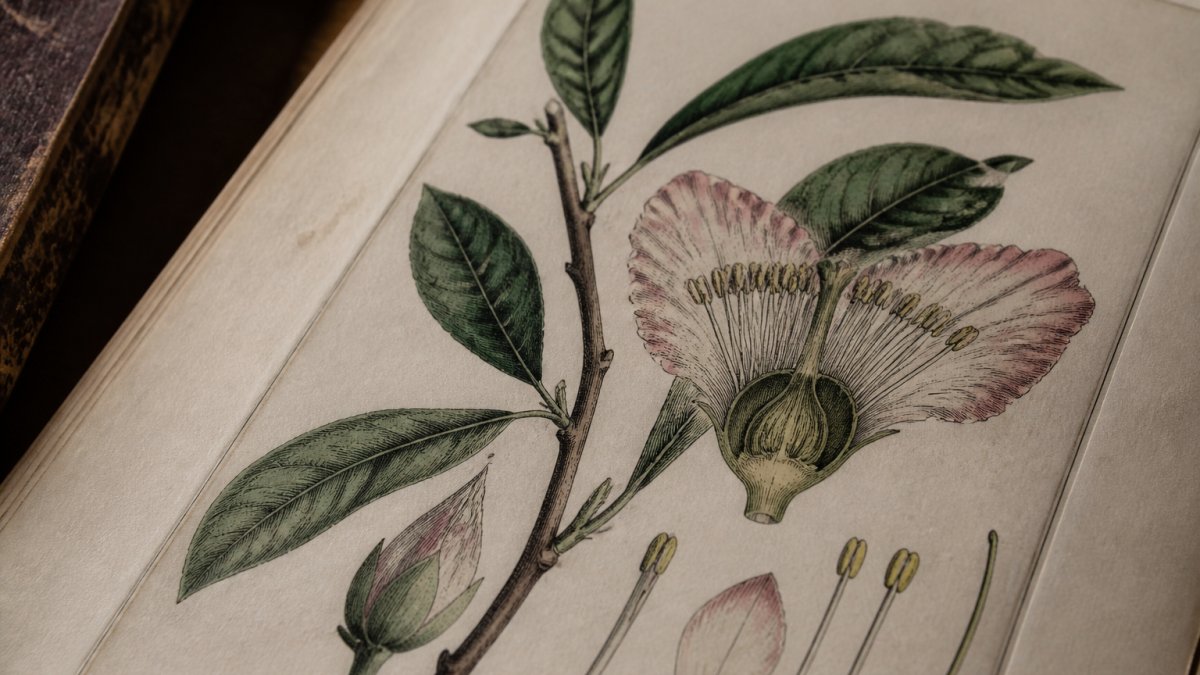
The visual character of a botanical print depends entirely on its production method, which explains why prints from different periods look so distinct and why certain methods remain more prized by collectors.
Copperplate engraving dominated botanical illustration from the 1600s through the 1800s.
Lithography, invented in the late 1700s, offered a different aesthetic. The artist drew directly onto a smooth stone with a greasy crayon, then the stone was chemically treated so ink adhered only to drawn areas.
Chromolithography, colour lithography, emerged in the mid-1800s and transformed the field. Instead of hand-colouring individual prints, multiple stones were each inked with a different colour and printed sequentially, building up a vibrant, consistent full-colour image.
Nature printing involved pressing actual plant specimens onto soft metal plates to create direct impressions.
Each method left its mark: early engravings possess a formal, precise quality; lithographs are softer and more expressive; chromolithographs are vivid and decorative.
How to Identify Antique Botanical Prints and Verify Authenticity
Identifying genuine antique botanical prints requires attention to several factors. Antique papers have a distinctive weight, texture, and slight discolouration modern papers cannot replicate. Deckled (irregular, feathered) edges are typical of handmade papers used before the 1850s.
Printing technique tells a story. Hold the print to light and look for the characteristic indentation of copperplate engraving, which created a slight embossing as it was pressed against paper.
Colouring method matters. Hand-coloured prints show slight variations from copy to copy, since the colourist's hand was never perfectly consistent.
Signature and publication information provide crucial context. Most antique botanical prints include the artist's name, the engraver's name (if different), the publisher, and the date.
Condition matters for both authenticity and value. Margins should show age-appropriate discolouration and handling marks. Severe damage may indicate heavy use or poor storage but doesn't necessarily mean a print is inauthentic.
Building Your Collection of Vintage Botanical Artwork
Starting a collection of vintage botanical prints requires clarity about your goals. Are you collecting for aesthetic pleasure, a particular artist or period, or as an investment?
Aesthetic collectors focus on visual impact, building a collection around a colour palette or theme, all ferns, all roses, all plants from a particular region. Visit our collection of vintage botanical prints to explore options matching your interior aesthetic.
Investment-focused collectors seek rarity, condition, and historical significance.
Regardless of your approach, invest in proper storage and framing. Acid-free matting and UV-protective glass preserve prints far longer than standard framing.
| Collection Focus | Best Starting Point | Key Consideration |
|---|---|---|
| Aesthetic/Interior Design | Prints matching your colour palette or theme | Visual impact and room scale |
| Artist Specialist | Complete works of one artist across publications | Rarity of different editions |
| Plant/Botanical Focus | Species documented across multiple artists | Comparative illustration techniques |
| Investment/Rarity | Early hand-coloured engravings, first editions | Condition, provenance, scarcity |
The vintage botanical print market has matured significantly. Prices reflect both rarity and demand. Original hand-coloured Besler engravings from the 1613 Hortus Eystettensis can reach $6,000 AUD or more.
Quality reproductions have become increasingly sophisticated, with high-resolution digital scanning and modern printing capturing the visual character of originals with impressive fidelity.
Building a collection of vintage botanical art connects you to a rich history where science and beauty merged.
Frequently Asked Questions
Who are the most famous vintage botanical artists?
Basilius Besler, Henry Andrews, William Curtis, and Sir John Hill are among the most celebrated vintage botanical artists. Besler's Hortus Eystettensis (1613) is considered the earliest pictorial record of a botanical garden and set the standard for flower folios for centuries. Andrews blended scientific accuracy with artistic appeal in his Botanist's Repository (1797-1812), whilst Curtis founded the influential Botanical Magazine. Each contributed distinct methods to plant illustration that shaped the field.
What techniques did famous botanical illustrators use to create their prints?
Vintage botanical artists employed several techniques: copperplate engraving, where designs were incised into copper plates and hand-coloured afterward; chromolithography, which allowed colour printing without hand-colouring; and nature printing, a process that pressed actual plant specimens onto lead plates to capture precise detail. Henry Andrews worked as artist, engraver, colourist, and publisher, a rare combination that elevated the quality of his work. Each method required skilled craftspeople and contributed to the scientific accuracy and aesthetic appeal of the final prints.
How can you identify an antique botanical print and verify it is authentic?
Authentic vintage botanical prints typically show signs of age: foxing (brown spots from paper oxidation), slight discolouration, and wear consistent with their stated period. Examine the paper weight and texture, 18th and 19th-century prints used handmade paper noticeably thicker than modern stock. Check for the artist's or engraver's signature, often found in a corner or margin. Copperplate engravings display fine line work visible under magnification, whilst chromolithographs show layered colour registration. Provenance documentation and condition reports from reputable dealers add confidence to authenticity claims.
Why were women botanical artists underrepresented in the history of botanical illustration?
Women botanical artists like Rosa Catherine Fiveash faced systemic barriers: they were rarely credited formally, often worked anonymously or under family names, and had limited access to formal training and professional societies. Fiveash, described as the foremost botanical artist of her day, illustrated 32 of 45 plates for The Forest Flora of South Australia (1882-1890) but received minimal recognition. Many women trained privately or at design schools rather than through traditional apprenticeships. Rediscovering and celebrating their contributions reveals a richer, more inclusive history of botanical illustration than conventional accounts suggest.