
How to Identify Authentic Antique Prints
Table of Contents
- Understanding Original Prints vs Reproductions
- How to Tell If a Print Is an Original
- Identifying Printmaking Techniques to Verify Authenticity
- Antique Print Paper Identification and Aging
- Signatures, Attribution, and Edition Numbers
- Researching Antique Print Provenance
- Safe Handling and Inspection Checklist
- When to Seek Expert Authentication
- Frequently Asked Questions
Last Updated: October 11, 2026
Understanding Original Prints vs Reproductions
The difference between an original print and a reproduction can mean thousands of dollars.

An original print is created directly from an artist's hand-drawn design transferred onto a plate or stone, then printed using traditional methods like copperplate engraving, lithography, or woodcutting.
A reproduction is a modern copy made from a photograph or scan of an original, printed using offset lithography or digital printing.
The key distinction: originals show the artist's direct hand; reproductions show a photographer's or scanner's interpretation. This difference becomes visible under close examination.
Here's what separates them:
- Originals have visible plate marks (the indented edge where the printing plate pressed into paper)
- Originals show ink variations and hand-applied colour that differ slightly from print to print
- Reproductions have uniform, perfectly consistent colour and no plate marks
- Reproductions often show halftone dots under magnification (a telltale sign of photographic reproduction)
How to Tell If a Print Is an Original
Determining authenticity requires examining multiple physical clues. No single test proves it alone, but together they build a compelling case.
Plate marks and impression depth
Plate marks are the most reliable single indicator of an original print. When a metal or wood plate is pressed into paper under intense pressure, it leaves a raised or indented border around the image that cannot be faked without specialized equipment.
To check for plate marks:
- Hold the print at an angle under strong light
- Look at the edges of the printed image
- Run your finger gently along the edge (don't press hard)
- You should feel a subtle ridge or depression where the plate pressed into the paper
Reproductions never have plate marks because they're printed on flat presses without the required pressure. A print claiming to be original but lacking a plate mark should raise immediate suspicion. Original prints show deeper, more pronounced impressions than reproductions, with paper that appears slightly embossed in ways modern printing cannot replicate.

Paper texture and hand-laid characteristics
Original prints were made on hand-laid paper, which has a distinctly different feel and appearance than modern paper.
Hand-laid paper has visible characteristics:
- Uneven fibre distribution visible when held to light
- A slightly textured surface (not smooth like modern paper)
- Deckled edges (rough, uneven edges) or cut edges that show wear
- Thickness that varies slightly across the sheet
- A warm, natural colour (often cream or off-white, not bright white)
Modern reproductions use machine-made paper, which is uniformly smooth, perfectly white, and consistent in thickness. Hold the print to bright light: hand-laid paper shows irregular fibre patterns, while machine-made paper is uniform. This simple test eliminates many reproductions immediately.
Original prints show subtle wear patterns from natural aging. Reproductions on new paper look pristine, which is suspicious for a print claiming to be centuries old.
Identifying Printmaking Techniques to Verify Authenticity
Different printmaking techniques leave distinctive marks that are nearly impossible to fake convincingly.

Engraving and copperplate marks
Copperplate engraving creates distinctive parallel lines and burr marks. When an engraver cuts into a copper plate with a burin, they create grooves that hold ink.
Engravings show slight variations in line pressure from print to print, a sign of hand-pulling. Modern reproductions show perfectly uniform lines. In genuine engravings, cross-hatching is meticulously precise; in reproductions, it appears fuzzy or broken under magnification.
Lithograph and stone-print characteristics
Lithographs are created on stone using a chemical process, not by cutting into metal. They show softer, less precise lines than engravings, varied ink coverage, no burr marks, a grainy appearance from the stone's surface, and hand-applied colour variations if hand-coloured.
Lithographs have ink sitting on the paper's surface rather than pressed deep into it. Under magnification, look for the stone's texture and faint marks. Reproductions won't show this because they're printed from smooth metal plates or digital files.
Etching, woodcut, and screen-print identification
Woodcuts are the oldest printmaking technique. A design is carved into a wooden block; the raised areas hold ink. They show bold, high-contrast images with visible wood grain, strong line work, irregular edges from hand-carving, and variations between impressions.
Screen prints are a more modern technique but can be original antique prints if created before 1950. They show uniform, flat colour areas, visible dot or line patterns from the screen mesh, clean colour edges, and no plate marks.
Antique Print Paper Identification and Aging
Paper tells the story of a print's age. Understanding paper characteristics is crucial for authentication.
Watermarks and paper sizing
Watermarks are designs embedded in paper during manufacture. Hold the print to bright light to see faint marks that identify the papermaker and date the paper. Use watermark identification guides (many museums publish these) and cross-reference with known paper mills.
Paper sizing refers to a coating applied to control ink absorption. Original antique prints often show uneven sizing from age; the paper may be slightly brittle or absorbent in spots. Reproductions have uniform sizing throughout.
Natural aging: foxing, discoloration, and wear
Foxing is the brown or rust-coloured spots that appear on aged paper, caused by iron impurities reacting with moisture and oxygen. Genuine foxing appears random and organic, spreading throughout the paper in irregular patterns. Artificially applied foxing looks too uniform or appears only in certain areas.
Discoloration from age appears as overall yellowing or browning, especially at edges, as paper oxidises. A print claiming to be from 1750 but showing no discoloration should be questioned. Wear patterns show how the print has been handled.
Map, Speed John, Montgomery Shire, c1610 →
Signatures, Attribution, and Edition Numbers
An artist's signature is your key to identifying who created the print and when. Signatures appear in various locations: the margin below the image, on the plate itself, or written in ink by hand.
Authentic signatures show:
- Consistent handwriting across multiple prints (if you can compare)
- Ink that matches the printing technique used
- Placement that's consistent with the artist's known practice
- Age-appropriate materials (old ink, not modern pen)
Forged signatures often look too perfect or too shaky.
Edition numbers indicate how many prints were pulled from a plate. A print marked "5/100" means it's the fifth impression from a run of 100.
Limited editions are more valuable than large runs. A print from a run of 50 is rarer than one from 500. However, edition numbers can be faked.
Publisher information also appears on many antique prints. The publisher's name, location, and date are printed on the plate or margin.
Researching Antique Print Provenance
Provenance is the documented history of ownership. Strong provenance proves a print is genuine and increases its value significantly.
To research provenance:
- Check auction house records and sales catalogues
- Search museum collections and online databases
- Look for collection marks or stamps on the reverse (collectors often stamped their prints)
- Find reference books specific to the artist or subject
- Contact dealers and experts who specialise in the artist's work
Museums often publish their collections online. If your print matches a museum's documented example, that's powerful evidence of authenticity. Cross-reference the print's characteristics with the museum's documentation.
Auction records provide detailed information about prints that have sold. You can often find photographs, condition reports, and provenance statements. These records are invaluable for authentication.
Specialist reference books document known prints by artist, date, and edition.
Safe Handling and Inspection Checklist
Proper handling protects your print and allows thorough inspection without damage.
When examining an antique print:
- Wash and dry your hands before handling
- Wear cotton gloves to avoid skin oils transferring to the paper
- Support the print with both hands, never hold it by one corner
- Lay it flat on a clean surface for inspection
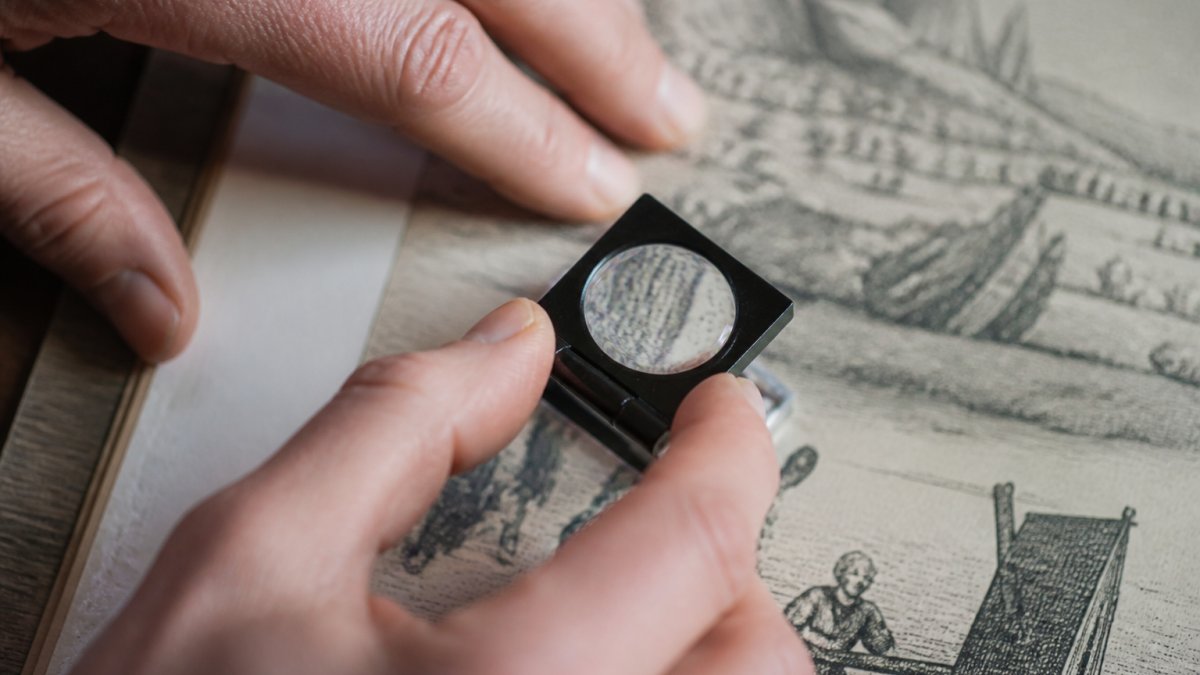
- Use a magnifying loupe (10x magnification) to examine details
- Never use tape, adhesive, or pressure to clean the print
- Avoid direct sunlight during inspection (it fades prints)
- Store in acid-free paper and archival-quality folders
- Keep in a cool, dry environment (stable temperature and humidity)
When using magnification:
- Examine the paper surface for texture and hand-laid characteristics
- Look for halftone dots (which indicate a reproduction)
- Study the ink lines for the technique used
- Check for plate marks by viewing the edges at an angle
- Inspect the signature for consistency and age-appropriate materials
Document your findings in writing. Photograph the print under consistent lighting. Keep records of your inspection, including any marks, signatures, or unusual characteristics you discover.
When to Seek Expert Authentication
Some prints require professional authentication. If you're uncertain after your own inspection, or if the print is valuable, consult an expert.
Seek expert authentication when:
- The print is expensive or potentially valuable
- You're unable to verify the artist's identity
- The signature appears questionable or inconsistent
- The provenance is unclear or undocumented
- The print shows signs of damage or restoration
- You're considering purchasing it as an investment
Experts use advanced techniques unavailable to collectors:
- Spectral imaging to reveal hidden signatures or marks
- Paper analysis to determine exact age and origin
- Ink analysis to verify printing technique and age
- Comparison with museum standards and reference collections
- Access to historical records and auction documentation
At Antiquarian Print Shop, our team understands the nuances of antique print authentication. We've curated over 1,200 original prints using rigorous verification methods.
For prints you already own, a professional appraisal provides documentation for insurance and investment purposes. This documentation becomes part of your print's provenance, increasing its value and protecting your investment.
Identifying authentic antique prints requires patience and attention to detail. Start with the physical clues: plate marks, paper texture, and printmaking technique. At Antiquarian Print Shop, we're here to help you build a collection of genuine, historically significant artworks. Shop Original Prints and discover pieces that connect you directly to art history.
Frequently Asked Questions
What is the difference between an original print and a reproduction?
An original antique print is created directly from an artist's hand-carved plate, stone, or block using traditional methods such as engraving, lithography, or etching. A reproduction is a modern copy made from a photograph or digital scan of the original. Original prints show physical impressions, unique paper aging, and characteristic marks from the printing plate. Reproductions lack these telltale signs and are typically printed on modern paper using contemporary processes. Examining the plate mark, paper texture, and ink depth with a magnifying loupe reveals whether you hold an authentic original or a later reproduction.
How can you tell if an antique print is original or a reproduction?
Look for a plate mark (a raised edge where the metal plate pressed into the paper), which is almost always present on original prints from engraving or etching. Check the paper itself: authentic antique prints use hand-laid paper with visible fiber texture, often showing foxing (brown spots) or even discoloration from age. Use a magnifying loupe to examine the ink surface; original prints display fine dot patterns or line work consistent with the stated printmaking technique. Reproductions printed digitally show uniform, perfectly smooth surfaces without variation. Compare the signature style with documented examples of the artist's hand. Finally, research the print's provenance through reference catalogues and auction records to verify its documented history.
What should you look for in the paper of an antique print?
Authentic antique print paper has a distinctive hand-laid texture with visible fibre variation, quite different from smooth modern paper. Look for a watermark, which identifies the paper mill and often helps date the print. Natural aging signs include foxing (rust-coloured spots from iron impurities in old paper), yellowing, and slight discoloration, especially along fold lines or margins. The paper should feel substantial and slightly irregular in thickness. Examine the edges: hand-cut or deckled edges suggest genuine age. Modern reproductions use bright white, uniformly smooth paper. Holding the print to light reveals the paper's density; antique papers often show uneven fibre distribution. These characteristics together confirm whether you are examining a period-authentic original or a contemporary reproduction.
When should you ask an expert to authenticate an antique print?
Seek expert authentication when the print's value is substantial enough to justify the cost, when you plan to sell or insure it, or when visual inspection leaves doubt. Experts use techniques beyond magnification, including ultraviolet light examination to detect restoration or forgery, paper analysis to confirm age, and reference to comprehensive catalogues and provenance records. If you cannot locate documented information about the artist, publisher, or print run, an appraiser can research these details. For rare or historically significant pieces, especially those with unclear attribution or unusual condition, professional verification protects your investment and establishes market credibility. Many collectors obtain expert assessment before major purchases to ensure authenticity and condition rating.