
How to Spot Fake Antique Prints: A Collector's Guide
Table of Contents
- Understanding the Difference Between Original and Reproduction Prints
- How to Identify Plate Marks on Prints
- Examining Paper Quality and Texture
- Detecting Digital Dot Matrix Patterns in Prints
- Checking for Manufacturer Marks, Signatures, and Provenance
- Are 19th Century Butterfly Prints Rare and How to Verify Them
- Using Magnification and Chemical Testing to Spot Fakes
- Common Mistakes to Avoid When Authenticating Prints
- Frequently Asked Questions
Last Updated: September 20, 2026
Understanding the Difference Between Original and Reproduction Prints
An original antique print is created directly from a hand-carved plate, stone, or block using traditional methods like etching, engraving, or lithography. A reproduction is a modern reprint made using digital or offset printing. Understanding this distinction is the first step toward learning how to spot fake antique prints and becoming a confident collector.
Key differences to watch for:
- Age of the paper, originals use period-appropriate materials; reproductions use modern paper
- Printing method, originals show hand-pulled characteristics; reproductions show uniform, mechanical patterns
- Ink quality, original inks age differently than modern inks
- Price point, originals command significantly higher prices due to rarity and age
How to Identify Plate Marks on Prints
A plate mark is the indented line created when a printing plate presses into paper under heavy pressure. It's one of the most reliable indicators of an original print, especially for etchings and engravings.
To find a plate mark:
- Hold the print at an angle under strong light
- Look for a subtle ridge or depression around the image border
- Run your finger gently across the edge, you may feel a raised line where the plate pressed in
- Check all four sides; a complete plate mark on all sides is a strong authenticity signal
Examining Paper Quality and Texture
Original antique prints use rag paper, made from cotton or linen fibres, which is thicker, more textured, and slightly irregular compared to modern stock.
Check these paper characteristics:
- Texture, run your hand gently across the back; rag paper has a subtle, fibrous feel
- Colour, original papers often show natural aging (cream, ivory, or light tan tones); bright white suggests modern paper with optical brighteners
- Thickness, originals use heavier stock; reproductions sometimes feel thin
- Watermark, hold the paper to light; original prints often have a maker's watermark visible in the paper itself
Detecting Digital Dot Matrix Patterns in Prints
Modern printing methods create distinctive patterns invisible in hand-pulled originals.
Halftone Dots and Offset Lithography
Offset printing creates tiny dots of colour (cyan, magenta, yellow, and black) that blend optically to form the image, called a halftone or dot matrix pattern.
What to look for under magnification (10x-20x):
- Dots arranged in a regular, geometric grid
- Consistent dot size and spacing across the image
- Dots visible in all coloured areas, especially in solid colours and shadows
- A moiré pattern (wavy lines or interference pattern) may appear if you tilt the print under magnification, this is a signature of offset printing
Inkjet Printing
Inkjet printers create a different pattern. Instead of regular halftone dots, inkjet prints show:
- Irregular, scattered ink droplets rather than geometric dots
- Variable dot size depending on ink saturation
- Visible ink beading on the paper surface, especially in dark areas
- No moiré pattern when tilted
- Ink that sits on top of the paper rather than penetrating (detectable with a magnifying glass and side lighting)
Laser Printing
Laser-printed reproductions occasionally appear in lower-quality fakes:
- Perfectly uniform, tiny dots (smaller than offset halftone dots)
- Ink fused to paper surface (appears shiny or slightly raised)
- No ink penetration into paper fibres
- Sharp, crisp edges on all printed elements with no feathering
Laser prints are identifiable under magnification and feel different to the touch, the toner has a slightly waxy, plastic-like quality.
Hand-Pulled Originals: What You Should See Instead
Hand-pulled originals show fundamentally different ink patterns:
- Continuous ink lines without dots (in etchings and engravings)
- Organic, irregular ink distribution (in lithographs, where ink adheres to stone based on grease and water chemistry)
- Stippling (hand-applied dots in engravings) that varies in size, spacing, and pressure
- Ink that penetrates the paper and cannot be easily smudged
- No regular geometric pattern at any magnification level
Practical Magnification Technique
To check for dot patterns: use a magnifying glass (10x minimum; 20x or 30x is ideal), examine multiple coloured areas, look at image edges where colours transition, tilt under light to see if a moiré pattern emerges (indicates offset printing), and check if ink sits on top or sinks in. If you see any regular dot pattern, the print is modern.
Checking for Manufacturer Marks, Signatures, and Provenance
Original prints often carry identifying marks: the artist's signature, a publisher's mark, or a dealer stamp.
Look for:
- Artist signature, usually in the margin or corner; original signatures are hand-written, not printed
- Publisher or printer mark, a small emblem or text indicating who produced the print
- Dealer stamps, marks from galleries or collectors who owned the print historically
- Edition number, indicates how many copies were printed in that edition
Are 19th Century Butterfly Prints Rare and How to Verify Them
Butterfly prints from the 19th century are genuinely rare, especially hand-coloured originals. Fakes are common because their value justifies the effort to counterfeit them.
Authentic 19th century butterfly prints show specific characteristics:
- Hand-colouring, watercolour or gouache applied by hand after the print was made; shows slight irregularity and colour variation
- Lithographic base, most were printed using stone lithography, a process that creates soft, organic lines
- Paper type, period papers from the 1800s show specific characteristics like rag content and natural ageing
- Plate indentation, lithographed butterfly prints may show subtle plate marks
Using Magnification and Chemical Testing to Spot Fakes
A 10x magnifying glass is the minimum; 20x or higher is better for detailed inspection of ink lines, dot patterns, and paper surface.
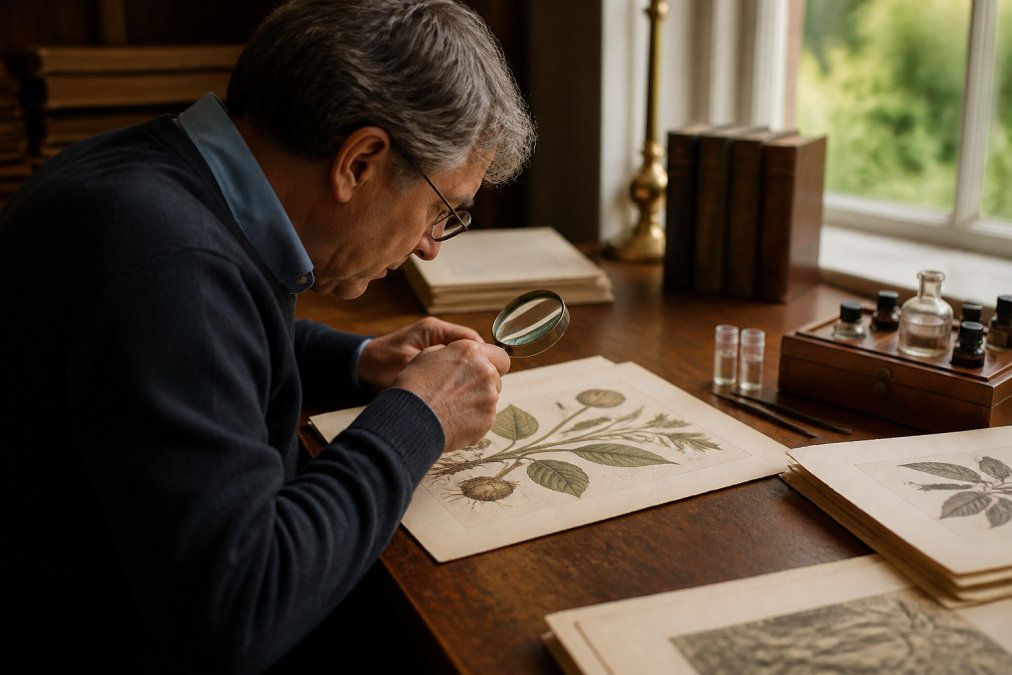
Under magnification, look for:
- Ink saturation and penetration, original inks from hand-pulled prints penetrate into the paper fibres; modern inks (especially inkjet) sit on the surface and can be smudged or lifted with a damp cotton swab
- Line quality and consistency, hand-pulled prints show slight irregularities in line weight and ink density; mechanical reproductions show perfect uniformity across identical strokes
- Stipple patterns, original stippling (hand-applied dots used in engraving and etching) appears organic and variable in size; halftone dots from digital or offset printing are mechanical, evenly spaced, and perfectly regular
- Paper surface texture, rag paper shows visible fibres under magnification; wood pulp paper appears smoother and more uniform
UV Light Testing
What to do: Obtain a long-wave UV lamp (365 nanometres; these are inexpensive and widely available). Darken the room and shine the UV light across the print surface.
What to look for:
- Modern paper glows bright white or blue-white under UV light because manufacturers add optical brighteners (fluorescent compounds) to make paper appear whiter. Period papers from the 17th-19th centuries do not contain these brighteners and will appear dark brown, tan, or only faintly luminescent.
- Modern inks fluoresce differently than period inks. Synthetic aniline dyes (introduced in the mid-1800s) and modern pigments glow distinctly under UV. Original iron gall inks (used in etchings and engravings before 1850) and carbon-based inks show little to no fluorescence.
- Foxing and age spots (iron oxide stains from paper degradation) often glow orange or red under UV light, confirming natural aging rather than artificial staining.
- Hand-applied watercolour or gouache (used to hand-colour prints) may show uneven fluorescence if modern paints were used to touch up an original.
Paper Fibre Analysis
Paper composition is a definitive indicator of age. Original prints use rag paper (made from cotton or linen fibres); modern reproductions typically use wood pulp paper.
Combining Tests for Confidence
No single test is definitive. A print that passes magnification inspection, shows no halftone dots, displays natural fluorescence under UV light, and has rag paper composition is far more likely to be original than one that fails any of these checks. Conversely, a print that glows bright white under UV light and shows perfect halftone dots under magnification is almost certainly modern, regardless of how old it appears to the naked eye.
Common Mistakes to Avoid When Authenticating Prints
Combine multiple checks, plate marks, paper quality, magnification, and provenance, for confidence. One positive sign isn't definitive; one negative sign doesn't disqualify a print.
Common mistakes collectors make:
- Assuming all old-looking paper is authentic, reproductions can be printed on aged or treated paper
- Trusting signatures without verification, signatures can be forged or printed
- Ignoring provenance, documented ownership history is powerful evidence
- Overlooking condition, excessive damage or restoration can indicate a reproduction being passed off as original
- Skipping magnification, the naked eye misses halftone dots and ink uniformity
If uncertain, get professional authentication, which protects your investment.
| Authentication Method | What It Reveals | Difficulty Level |
|---|---|---|
| Plate mark inspection | Whether the print was hand-pulled from a plate | Easy |
| Paper texture examination | Age and material composition of the paper | Easy |
| Magnification inspection | Halftone dots vs. hand-applied ink patterns | Easy |
| UV light testing | Differences in ink age and paper treatment | Moderate |
| Provenance research | Documented ownership history and authenticity | Moderate |
| Professional fibre analysis | Exact paper composition and age | Hard |
Frequently Asked Questions
How can I tell if an antique print is an original or a modern reproduction?
Originals show physical evidence of traditional printmaking: plate marks (indented edges from the printing plate), hand-applied colour variations, and aged paper with natural yellowing or foxing. Reproductions typically lack plate indentation, have uniform colour application, and use modern paper or acidic substrates. Examine the paper under magnification for fibre composition and check for dot matrix patterns, which indicate digital printing rather than traditional etching or lithography.
What role does a magnifying glass play in print authentication?
Magnification reveals the printing technique used. Traditional methods like etching and engraving show fine line work and stippling patterns. Digital reproductions display halftone dot patterns or pixelation under magnification. A 10x magnifier allows you to inspect paper fibre structure, ink saturation depth, and the quality of any hand-colouring. Look for consistent dot spacing (digital) versus irregular mark distribution (hand-made).
Are 19th century butterfly prints rare, and how do I verify authenticity?
Butterfly prints from the 19th century are genuinely rare, especially hand-coloured originals. Verify authenticity by checking for plate marks, examining the paper for period-appropriate rag content, and looking for natural aging signs like foxing and patina.
What physical characteristics distinguish 19th-century prints from digital copies?
Authentic 19th-century prints feature plate marks (indented borders from metal plates), hand-applied colour that varies slightly across the sheet, and rag paper with visible fibre structure. Digital copies show uniform colour, no plate indentation, and modern paper with optical brighteners (visible under UV light). Under magnification, originals display traditional ink techniques (etching lines, stipple marks), while reproductions reveal halftone dots or pixelation patterns characteristic of offset or digital printing.