
How Do You Start Collecting Antique Copperplate Animal Prints?
Last Updated: November 25, 2026
Quick Summary
Start by choosing one focus, such as a single subject, period or publisher, then learn to spot genuine plate-marks and crisp line work. Buy only with close-up photos, verified captions and a written return policy. Antique copperplate animal prints reward a focused, well-documented collection.
- Pick one subject, period or publisher so your collection has clear direction.
- Check for a plate-mark, varied line depth and period-consistent hand colouring.
- Compare paper chain lines or watermarks, and look for a regular halftone dot grid under a loupe.
- Ask sellers for close-up photos, exact sheet and image sizes, and a written return policy.
- Store prints flat or framed away from direct sunlight, in acid-free mounts, with humidity controlled.
Table of Contents
- How Do You Start Collecting Antique Copperplate Animal Prints?
- What Antique Copperplate Animal Prints Are and Which Subjects Collectors Favour
- Copperplate Engraving Identification: How to Tell a Genuine Print from a Reproduction
- How to Authenticate Antique Prints Before You Pay
- Antique Print Condition and Provenance: What Affects Value
- Pricing Breakdown by Era and Condition, and Buying Online Safely
- Building Your First Collection: Where to Start and How to Store Your Prints
- Frequently Asked Questions
Antique copperplate animal prints are among the most rewarding areas of print collecting, and the entry cost is lower than many collectors expect. The approach below covers what to look for, how to tell a genuine engraving from a reproduction, and how to buy with confidence.
How Do You Start Collecting Antique Copperplate Animal Prints?
Antique copperplate animal prints are engravings made by incising an image into a copper plate, inking it, and pressing it onto paper, usually from the eighteenth or nineteenth century. Start with a clear focus: one subject, one period or one publisher gives you a collection with direction rather than a random assortment.
Copperplate engraving produced fine line detail that suited natural history work, which is why animal subjects appear so often in the era's books and portfolios.
What Antique Copperplate Animal Prints Are and Which Subjects Collectors Favour
Many collectors gravitate toward mammals, birds, fish and insects, each drawn from the natural history plates that circulated widely in the period. Mammal plates are popular for their detail and decorative appeal, while bird subjects tend to be strong for framing in living spaces.
Mammals, birds, fish and insects in natural history plates
Natural history plates were often produced as sets, so a single print may belong to a larger series. Check whether a print is a single sheet or part of a book or portfolio, as this affects both its rarity and its value. Insect and fish plates are often more affordable entry points, while large mammal plates usually command higher prices.
Copperplate Engraving Identification: How to Tell a Genuine Print from a Reproduction
Genuine copperplate prints show a plate-mark, the faint impression left by the edge of the copper, and a line quality that is crisp rather than dotted. Reproductions printed by offset or photographic methods usually show a regular halftone dot pattern when examined under magnification.
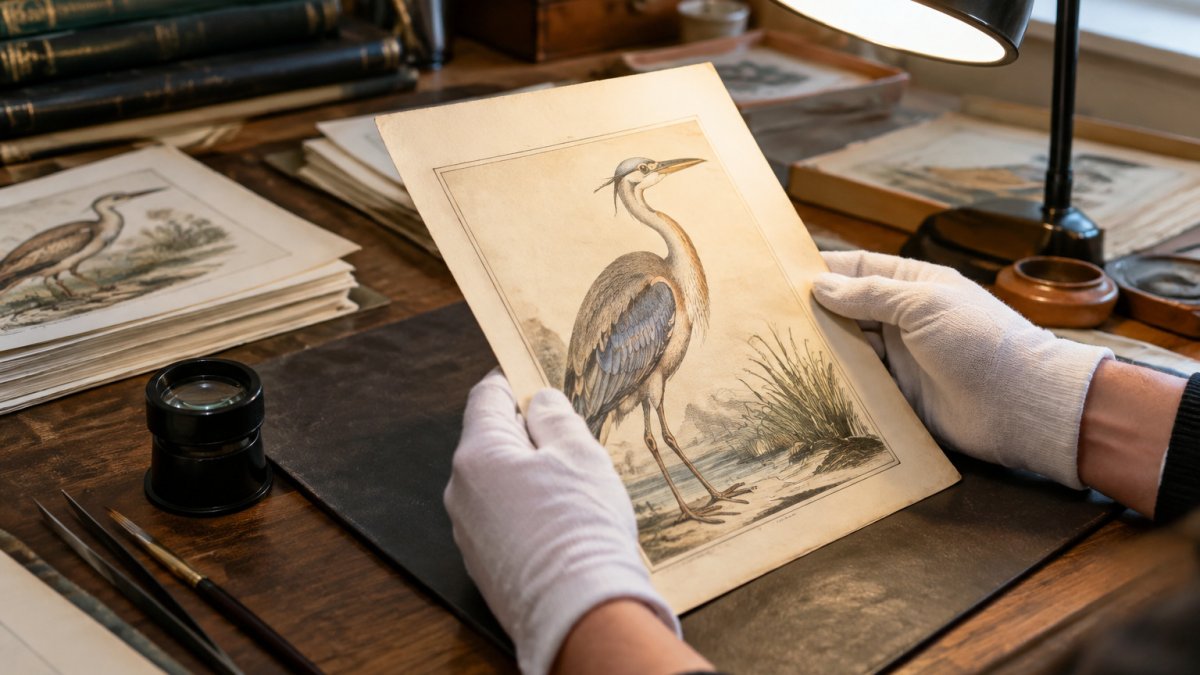
Use a magnifying loupe to inspect the line work. Engraved lines are cut into metal, so they have a slight depth and variation in width. Printed reproductions tend to look flat and uniform. If you are unsure, ask the seller for close-up photographs of the plate-mark and the paper surface before you buy.
How to Authenticate Antique Prints Before You Pay
Authentication is a process of elimination, not a single test. Work through the physical and documentary features of a print before you pay.
Paper. Antique copperplate prints were pulled on laid or wove paper that usually shows chain lines or a watermark when held to a light. Later reproductions are often printed on smooth, bright modern stock. Look at the sheet edges too: a genuine plate from a book may have a binding stub or stitch holes, while a trimmed sheet with no margins has lost evidence. Foxing and toning should sit in the paper, not on top of the image.
Impression. A genuine copperplate print carries a plate-mark, the bevelled indentation where the copper plate pressed into damp paper. Run a fingertip or a raking light across the sheet: you should feel or see a rectangular border slightly outside the image. The printed lines should vary in width and depth because they were cut by hand. Under a loupe, check for the regular halftone dot grid that betrays photographic or offset reproduction.
Inscription. Read the caption line by line. A typical natural history plate names the subject, the artist or draughtsman, the engraver and the publisher, and may carry a plate number or publication date. Cross-check those names against bibliographic references such as the standard natural history catalogues held by major libraries. A caption that is generic, misspelt or printed in a modern sans-serif font is a warning sign, though not proof on its own.
Provenance. Ask for the documented history: prior auction records, dealer invoices, book-breakage notes or a named collection.
Watch out: a visible plate-mark alone does not guarantee authenticity, because some reproductions are embossed to imitate one; always combine it with paper and line-quality checks.
Before paying, request close-up photographs of the plate-mark, the paper surface at an angle, the caption and the sheet edges. Compare the stated dimensions with the image proportions, and ask the seller about its return policy.
Antique Print Condition and Provenance: What Affects Value
Condition has a large effect on value. Look for foxing (brown spotting), tears, trimmed margins, water staining and skilled restoration. Hand colouring, where present, should be consistent with the period and not look recently applied.
Provenance, meaning the documented history of ownership and publication, can add significant value. Prints from a known series or publisher usually carry more interest than unattributed sheets. The condition grades used in listings, such as very good or good, give a useful starting point for comparison.
Pricing Breakdown by Era and Condition, and Buying Online Safely
Price is the sum of several factors, and no single one dominates. The useful habit is to compare like with like: same subject, same publisher, same period, similar condition.
What moves the price. Rarity of the plate and the series matters most, followed by subject appeal, condition, whether the colouring is period hand-colouring, and provenance. Large mammal plates and well-known series usually sit above small insect or fish plates from the same work.
Reading example prices. In the current catalogue, a hand-coloured copperplate of a muricated lizard from John White's natural history work, dated c1789 and in very good condition, is listed at $395.00 AUD. For a comparable listing with full details, see this hand-coloured copperplate listing. A hand-coloured copperplate of rams by Comte de Buffon, also c1789, is listed at $99.00 AUD, and a deer plate from the same series at $180.00 AUD. The spread shows how subject and series rarity separate plates from the same era. Treat these as guideposts, not a price list, and ask for the condition grade and any restoration notes before comparing.
Buying online safely. Work through a short checklist before you commit:
- Request photographs of the full sheet, the plate-mark at a raking angle, the caption and any damage.
- Confirm the exact sheet size and image size in millimetres, and check them against the stated edition.
- Ask whether the colouring is period or later, and whether the print has been trimmed, laid down or restored.
- Read the return policy and the time allowed for inspection; get it in writing.
- Keep the listing, invoice and any condition report together for future valuation or resale.
Watch out: sellers sometimes describe a later reproduction as an 'engraving' without qualification; ask directly whether the print is an original copperplate impression and whether a plate-mark is present.
Comparison of authentic copperplate and reproduction prints:
| Feature | Genuine copperplate print | Reproduction |
|---|---|---|
| Line quality | Crisp, varied depth | Uniform, dot pattern |
| Plate-mark | Visible impression | Usually absent |
| Colouring | Period-consistent hand colour | Printed or uniform |
| Caption | Artist, engraver, publisher | Often missing or generic |
Listed prices of hand-coloured copperplate animal prints (AUD)
Building Your First Collection: Where to Start and How to Store Your Prints
Begin with a small number of prints in one subject area, and expand once you understand how the pieces differ. Store prints flat or framed away from direct sunlight, which causes fading, and keep them in acid-free mounts where possible. Control humidity to avoid foxing and mould.
A practical first step is to choose one natural history series, buy the strongest example within your budget, and document it. Browse our current selection of original prints to see what suits your collecting goals. Documenting an example also means noting its paper, impression, and condition, details that help you spot original art prints as your collection grows.
Frequently Asked Questions
How can you tell if an antique copperplate animal print is original?
Start by examining the plate mark, the raised impression left by the copper plate at the edge of the sheet, and the line quality under magnification. Genuine copperplate engravings show fine, slightly varied lines, while modern reproductions often show uniform dots or a flat, printed surface. Check the paper for age-appropriate laid lines or watermarks, and look for the engraver's and publisher's credits in the plate margin. Where a print is being sold as original, ask the dealer for a written description of its provenance and condition before buying.
How old does a print need to be to be considered antique?
Dealers and collectors generally treat a print as antique when it was made roughly 100 or more years ago, though the term is used loosely in trade. For copperplate animal prints, many collectable examples date from the late eighteenth and nineteenth centuries, such as the c1789 John White lizard engraving or the Comte de Buffon natural history plates from the same period. Age alone does not set value, so check the date, condition and whether the sheet is a period impression.
Does the paper or plate mark help authenticate an antique print?
Yes, both can help. A plate mark is the indented outline left by the edge of the copper plate, and its presence on a sheet is a strong sign of intaglio printing, which is how copperplate engravings were made. The paper should look consistent with its supposed date, and it should not show signs of modern optical brighteners under ultraviolet light. Neither feature proves authenticity alone, so combine them with style, publisher details and provenance before deciding.
What details should collectors check before buying an antique animal print?
Check the subject, artist, engraver and publisher credits, the printed date, the sheet and plate dimensions, and the technique listed, such as hand-coloured copperplate engraving. Assess condition for foxing, tears, stains, trimming and restoration, and ask whether any repairs are visible. Compare the price against similar examples, and confirm the seller's returns policy in case the print does not match its description.