The Story Behind the Print: William Morris and the Pattern That Wouldn't Sit Still
Share
There's a reason a William Morris print never quite looks "old" on a wall, even though the patterns themselves are well over a century old. I think it's because Morris wasn't trying to capture a moment. He was trying to capture how a garden actually grows, tangled, overlapping, alive, and that never goes out of style.
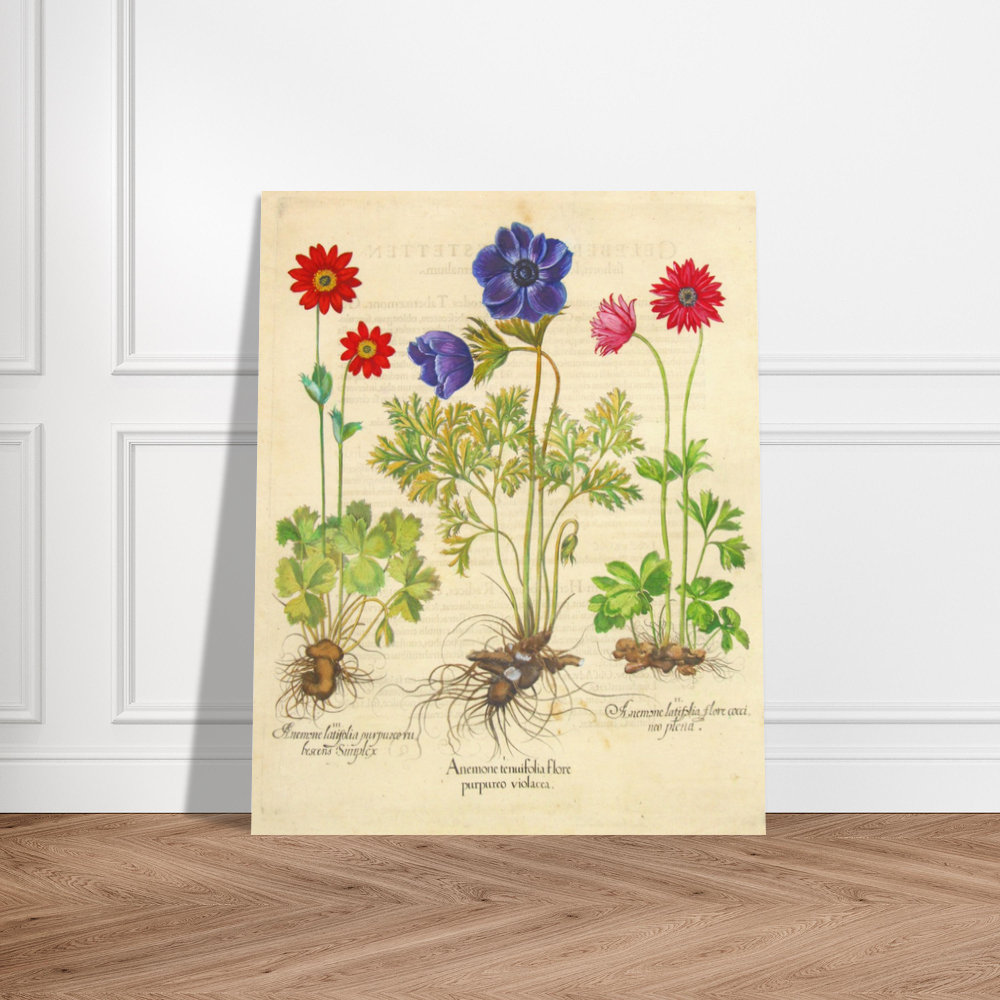
William Morris was born in England in 1834 and became one of the central figures of the Arts and Crafts movement, a reaction against the cheap, mass-produced decoration of the Industrial Revolution. His belief was simple and a little stubborn: "Have nothing in your house that you do not know to be useful, or believe to be beautiful." He meant it. Every pattern he designed, Acanthus, Blue Flowers, Black Thorn, Anemone, was drawn from close observation of real plants, then worked and reworked by hand until the repeat felt less like a grid and more like a living thing spilling across the page.
Morris trained as an architect before turning to textiles and wallpaper, and that structural eye shows. Underneath the tangle of leaves and blooms, his patterns are built on a disciplined, mathematical repeat, which is part of why they still read as balanced rather than chaotic, even at their busiest.
What I love about offering these as framed reproductions is that they were always meant to be lived with, not locked away. Morris designed for walls, for curtains, for the rooms people actually spent their days in. A framed Acanthus or Anemone on your wall today is doing exactly the job he intended it to do a hundred and fifty years ago.
Each of our William Morris framed prints is custom reproduced on museum-quality paper and arrives ready to hang, sturdy wooden frame and all.