
Types of Botanical Art: A Complete Guide
Table of Contents
- What Is Botanical Art?
- Botanical Art Styles and Their Characteristics
- Botanical Art vs Botanical Illustration: Key Differences
- Botanical Drawing Techniques and Media
- Notable Subjects and Historical Development
- Identifying and Collecting Botanical Art
- Frequently Asked Questions
Last Updated: October 18, 2026
What Is Botanical Art?
Botanical art is the visual representation of plants rendered with scientific accuracy and artistic skill, combining meticulous observation of plant structure with aesthetic presentation. Unlike casual nature sketching, it demands precise rendering of botanical features, leaf arrangement, flower structure, root systems, while maintaining compositional beauty.
Botanical art sits at the intersection of two worlds: it serves naturalists and scientists who need accurate plant identification, yet also satisfies collectors and interior designers seeking visually compelling wall art. This dual purpose has shaped its evolution from Renaissance herbals to contemporary practice.
At Antiquarian Print Shop, we've curated over 1,200 authentic original antique prints and reproductions showcasing this tradition, from hand-coloured copperplate engravings of the 17th century through to 19th and early 20th century chromolithographic works.
Botanical Art Styles and Their Characteristics
Several types of botanical art encompass distinct approaches, each shaped by purpose, medium, and historical context. Understanding these styles helps collectors recognise what they're viewing and appreciate each artist's technical choices.
Scientific Documentation
Scientific documentation represents the most rigorous form of botanical art, prioritising accuracy above decorative effect. The artist functions as a visual recorder, capturing the plant's structure, proportions, and identifying characteristics with precision.
This approach emerged during the Renaissance, when botanical study became central to medicine and natural philosophy. Artists worked from living specimens or dried herbarium samples, often including multiple views, front, side, cross-section, to convey complete structural information, demanding both artistic skill and botanical knowledge.
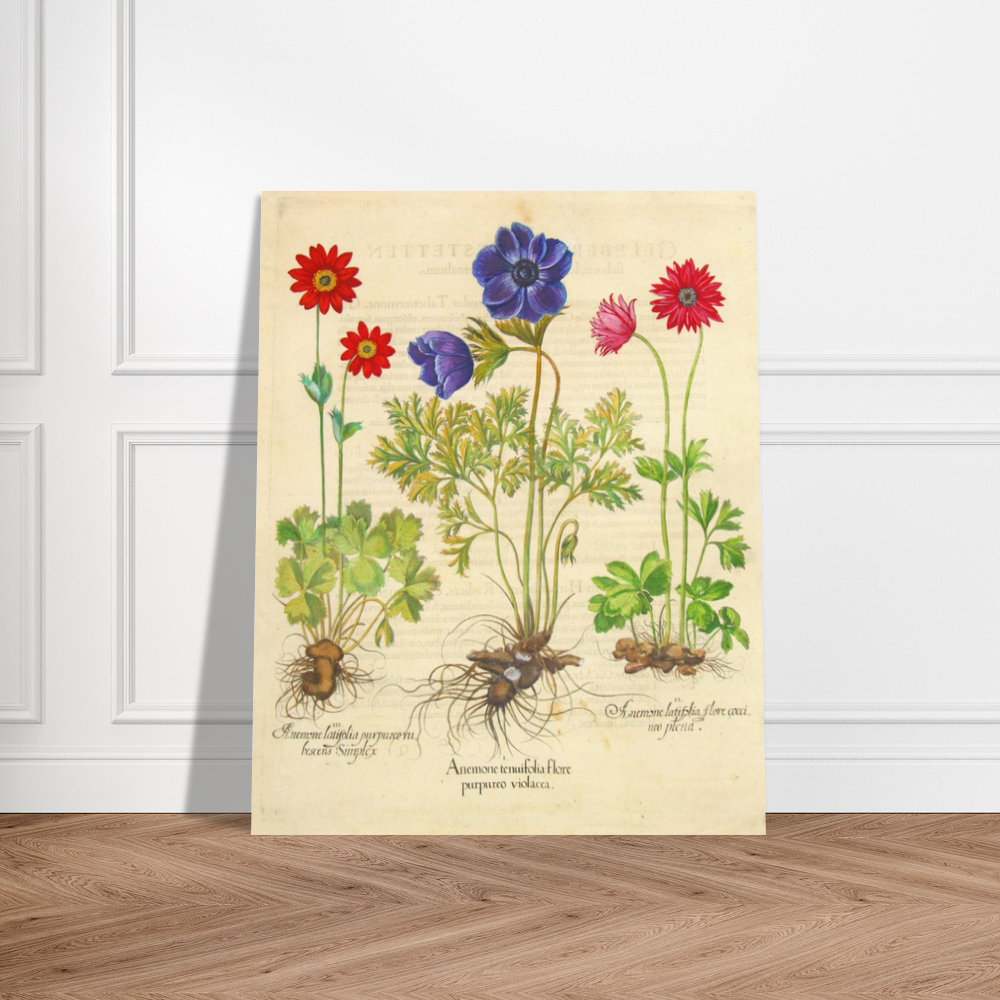
A celebrated example is the Hortus Eystettensis (Garden of Eichstätt), commissioned in the early 1600s by Prince-Bishop Johann Konrad von Gemmingen. Basilius Besler, a pharmacist and botanist, spent 16 years recording the prince's garden through meticulous copperplate engravings. Our collection includes original hand-coloured specimens from this folio, including the Cyclamen Roma and Spica Vulgaris, each priced at $6,000 for authentic 17th-century impressions.

Scientific documentation prioritises completeness over composition: the plant occupies the page in a straightforward arrangement, directing attention to structural detail rather than artistic drama. Yet within these constraints, master artists achieved remarkable visual elegance.
Decorative and Artistic Interpretation
Decorative and artistic interpretation allows greater freedom in composition, colour, and emotional tone, valuing beauty and visual impact alongside botanical accuracy. The plant becomes a subject for aesthetic exploration rather than purely scientific record.
This approach gained prominence during the 18th and 19th centuries, particularly in works for wealthy collectors and drawing rooms rather than laboratories. Artists composed plants within balanced layouts, sometimes grouping specimens, adding insects or birds, or placing plants in landscape settings, while colour became more expressive.
The distinction from scientific documentation is real but not absolute. Decorative works still maintain botanical accuracy, leaf structure and flower anatomy remain true, but the artist subordinates this to compositional harmony, positioning specimens to enhance visual flow rather than maximise clarity.
Chromolithography, which emerged in the 19th century, enabled richer colour saturation and made decorative botanical art more commercially viable. The process involved multiple printing stones, each carrying one colour layer, allowing artists to achieve subtle gradations and luminous effects.
Historical and Contemporary Approaches
Historical botanical art reflects the knowledge, techniques, and aesthetic values of its era: Renaissance works emphasise structural clarity, 18th-century pieces feature ornamental flourishes, and Victorian works showcase printing innovations.
Contemporary botanical art continues these traditions while incorporating modern perspectives. Today's artists have access to colour photography, microscopic detail, and global specimens, yet many choose classical frameworks, watercolour, pencil, engraving, precisely because these methods demand sustained observation and skilled hand execution, blending scientific precision with personal artistic voice.
The contemporary movement has also expanded botanical art's geographic range: while historical Western botanical art concentrated on European and Mediterranean flora, modern practitioners document plants from every continent.
Botanical Art vs Botanical Illustration: Key Differences
The terms "botanical art" and "botanical illustration" are often used interchangeably, yet they describe subtly different practices.
Botanical illustration emphasises communicative clarity above all else. The illustrator's primary goal is to convey botanical information, how to identify a plant, understand its structure, or recognise it in the field.
Botanical art, by contrast, treats the plant as a subject for artistic exploration. While accuracy remains important, the artist may prioritise composition, colour harmony, emotional resonance, or technical virtuosity. A botanical artwork succeeds aesthetically even if viewed by someone with no botanical knowledge; an illustration requires botanical context to fulfil its purpose.
The boundary blurs in practice: a masterfully executed scientific illustration becomes art through skill and vision, while a decorative botanical painting retains enough accuracy to function as documentation.
This difference affects how works are valued and displayed. Illustrations belong in reference materials and educational contexts; artworks belong on gallery walls and in collectors' homes. Antiquarian Print Shop's collection honours both traditions, offering scientific documentation for researchers and collectors alike, and decorative pieces for those seeking botanical beauty in their living spaces.
Botanical Drawing Techniques and Media
The medium an artist chooses fundamentally shapes the final work: different techniques demand different skills and produce distinct visual effects.
Watercolour and Drawing Methods
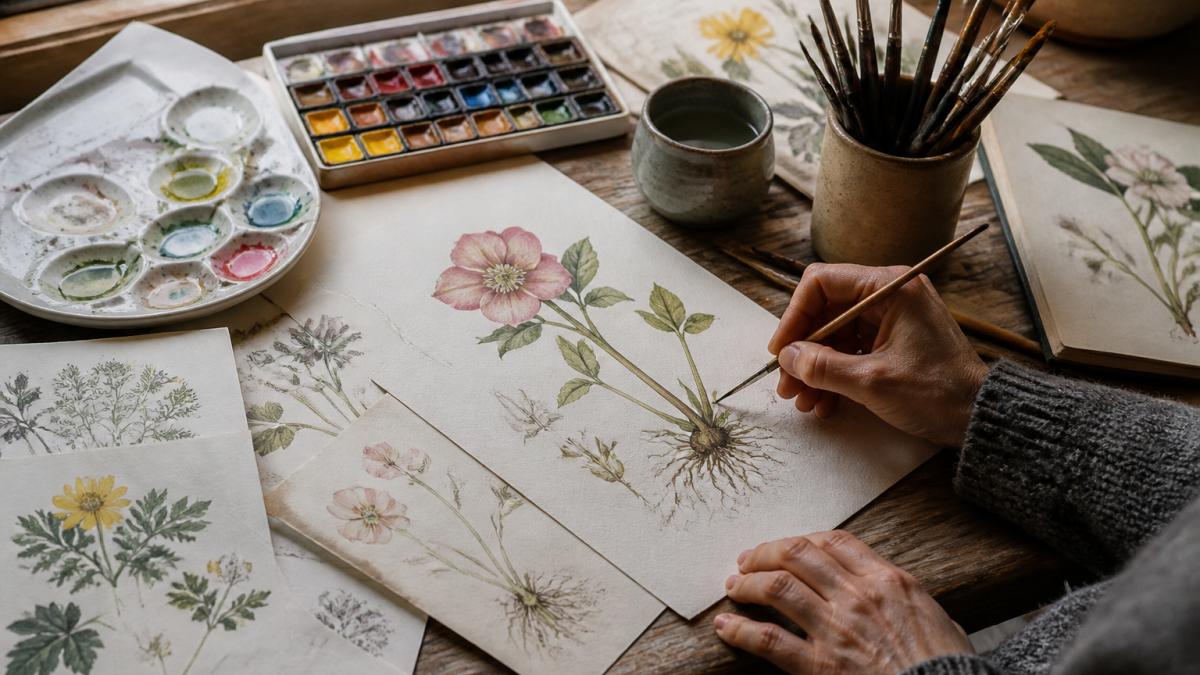
Watercolour emerged as the dominant medium for botanical art by the 18th century and remains central today. Its transparency allows subtle colour layering, building from light washes to deeper tones for luminous effects impossible in opaque media. Corrections are difficult, which rewards careful observation and confident brushwork.
Pencil drawing, often combined with watercolour, provides the structural foundation. Artists begin with precise underdrawing establishing proportions and botanical detail; the visible pencil lines contribute linear elegance, while fine tips render minute structures like leaf venation and stamen arrangement.
The combination of pencil and watercolour creates works of remarkable delicacy: the pencil provides crisp definition, the watercolour adds luminosity and depth. This pairing dominates botanical art from the 18th century onward, appearing in works by William Curtis (Flora Londinensis) and countless later practitioners.

Engraving, Lithography, and Nature Printing
Before watercolour became dominant, copperplate engraving was the primary method for reproducing botanical images.
Botanicals, Besler Basilus, Cyclamen Roma, Spica Vulgaris Flore Albo →
Copperplate engraving produces works of extraordinary precision. The metal surface allows rendering of minute detail; the engraver's tool can create lines finer than any brush. Early modern botanical art owes much of its scientific credibility to engraving's capacity for accurate, reproducible documentation.
Lithography, developed in the late 18th century, offered advantages over engraving. The artist drew directly onto limestone with greasy crayon; the stone was chemically treated so ink adhered only to drawn areas.
Chromolithography, which layered multiple coloured impressions, revolutionised 19th-century botanical publishing. Each colour required a separate stone; the printer carefully registered each layer to build a complete image. This labour-intensive process produced richly coloured results.
Nature printing, a 19th-century innovation, took a radically different approach: the artist pressed the actual plant specimen (or a mould of it) against a printing surface, lead, copper, or photographic plate, creating a direct impression.
Notable Subjects and Historical Development
Certain plants recur throughout botanical art history, becoming iconic subjects through repeated artistic attention. Simultaneously, the practice itself has evolved, shaped by changing purposes, available techniques, and aesthetic values.
Flowers, Foliage, and Specimen Documentation
Flowers dominate botanical art, particularly showy species, tulips, roses, magnolias, lilacs, whose visual drama rewards artistic attention and appeals to both scientists and collectors. The challenge lies in rendering delicate structures: translucent petals, complex stamen arrangements, subtle colour gradations.
Foliage presents different challenges: leaves vary infinitely in shape, venation pattern, and surface texture, so accurate rendering demands close observation of species-identifying characteristics. Historical botanical art often includes multiple leaf views, top surface, underside, cross-section, to convey complete structural information.
Specimen documentation drives much botanical art's composition: a work typically shows the complete plant, often including root system, stem, leaves, flowers, and seed pods, so a botanist can understand its full structure and life cycle. The challenge lies in arranging these elements into a visually coherent composition rather than simply stacking them on the page.
From Renaissance to Modern Practice
The history of types of botanical art tracks the evolving relationship between art, science, and commerce. Renaissance herbals, created as medicine and natural philosophy developed, prioritised accuracy for practical identification, with artists working closely with physicians and apothecaries to render medicinal plants with meticulous precision.
The 17th century saw botanical art reach new heights of sophistication. Works like Besler's Hortus Eystettensis combined scientific rigour with artistic ambition, serving princes and collectors as much as scientists as prestige objects demonstrating a patron's wealth and learning.
The 18th and 19th centuries witnessed democratisation of botanical art: improved printing and growing middle-class wealth created markets beyond elite collectors. Publications like Curtis's Flora Londinensis brought botanical documentation to educated amateurs, and chromolithography made colour reproduction economical, enabling mass production of decorative prints.
Contemporary botanical art continues this tradition while expanding its scope, documenting global flora rather than concentrating on European species and employing traditional techniques alongside contemporary approaches.
Identifying and Collecting Botanical Art
For collectors and enthusiasts, understanding how to identify botanical art types and assess authenticity matters considerably.
Authenticity assessment begins with technique. Original copperplate engravings display slight plate marks (indentations where the metal plate pressed into paper), hand-colouring variations across impressions, and paper aging appropriate to the stated date.
Condition significantly affects value. Original 17th- and 18th-century prints show their age, minor foxing (brown spots from paper degradation), slight colour fading, occasional creasing, yet these marks authenticate rather than diminish value for serious collectors.
Provenance, documented ownership history, adds value and confidence: a print with recorded collection history commands premium pricing, while prints with unknown provenance remain valuable if authenticity is established through technical analysis.
For those beginning to collect, high-quality reproductions offer genuine value. Modern reproductions of masterworks employ archival-quality materials and printing techniques that honour the originals, costing a fraction of an original yet delivering authentic aesthetic experience.
Botanical art endures because it addresses a fundamental human impulse: the desire to understand and celebrate the natural world through visual representation.
Frequently Asked Questions
What are the main types of botanical art?
Botanical art encompasses three primary categories: scientific documentation, which prioritises accurate plant structure for species identification; decorative and artistic interpretation, which emphasises aesthetic beauty and composition; and historical and contemporary approaches, which reflect evolving artistic movements from Renaissance florilegia to modern botanical studies. Each type serves distinct purposes, from herbals and floras to fine art collections and interior decoration.
What is the difference between botanical art and botanical illustration?
Botanical illustration is a specific discipline focused on scientific accuracy and plant identification, typically created for educational or taxonomic purposes. Botanical art is broader, encompassing both scientific work and artistic expression where aesthetic interpretation plays an equal or greater role. While all botanical illustrations are technically botanical art, not all botanical art prioritises the scientific precision required for botanical illustration.
What techniques are used to create botanical art?
Traditional techniques include watercolour painting, detailed drawing with pencil or ink, and printmaking methods such as copperplate engraving, lithography, and nature printing. Copperplate engraving, used in historic works like the 17th-century Hortus Eystettensis, involves hand-colouring printed plates. Nature printing, developed in the 18th century, uses actual plant specimens pressed onto metal plates to create direct impressions, while chromolithography allows for vibrant multi-colour botanical prints.
How can you identify a botanical print?
Authentic botanical prints typically feature detailed depictions of plant structure, often with Latin nomenclature and seasonal or lifecycle documentation. Look for characteristics such as hand-colouring on copperplate engravings, precise leaf and flower detail, and publication marks indicating date and artist. Original antique pieces show age-appropriate paper condition, while reproductions are printed on modern paper. Examination of the printing technique, engraving lines, lithographic texture, or nature printing impressions, helps confirm authenticity and method.
What makes a botanical illustration scientifically accurate?
Scientific accuracy requires faithful representation of plant structure, including correct proportions, leaf arrangement, flower anatomy, and reproductive organs. The work should depict the specimen in actual size or with a clear scale reference. Accurate botanical illustrations often include multiple views, such as full plant, cross-sections, and detail studies, to aid species identification. Latin naming conventions and proper documentation of the specimen's provenance strengthen scientific credibility.
What is the difference between botanical art and floral art?
Botanical art emphasises scientific accuracy, plant structure, and species documentation, prioritising educational and taxonomic value. Floral art prioritises decorative beauty, emotional expression, and aesthetic arrangement, often featuring flowers in stylised compositions without regard for botanical precision. Floral art may combine multiple species in imaginative arrangements; botanical art typically depicts individual specimens or related plants from a specific location or collection, as seen in historical florilegia and garden chronicles.