
Antique Print Restoration Tips for Collectors
Table of Contents
- Assessing the Condition of Your Antique Print
- How to Clean Antique Prints Without Damage
- Removing Foxing from Prints: Risks and Reality
- Repairing Tears and Missing Paper
- How to Store Antique Prints for Long-Term Preservation
- Archival Framing for Prints: Protecting Your Collection
- When to Seek Professional Conservation
- Frequently Asked Questions
Last Updated: October 15, 2026
Assessing the Condition of Your Antique Print
Before you attempt any antique print restoration work, you need to understand exactly what you're dealing with. Identifying the printing technique and spotting damage early can mean the difference between saving a piece and causing irreversible harm.
Identifying paper type and printing technique
Paper type matters because different papers respond differently to cleaning and repair. Antique prints sit on anything from laid paper (you'll see visible lines when you hold it to light) to wove paper (smooth and uniform). Some prints use handmade papers that are far more fragile than modern machine-made stock.
Printing technique is equally critical. A lithograph created from a stone is fundamentally different from a copperplate engraving. Woodcuts, etchings, and engravings each have distinct characteristics:
- Lithographs have ink sitting on the surface; they're vulnerable to water and aggressive rubbing
- Copperplate engravings have ink pressed into the paper; they're more strong but still need care
- Woodcuts show visible grain patterns and can be surprisingly durable
- Hand-coloured prints may have pigments that fade or run when exposed to moisture
You can often find this information on the reverse of the print or in documentation from the seller. At Antiquarian Print Shop, we provide detailed technical information with every original antique print so you know exactly what you own.
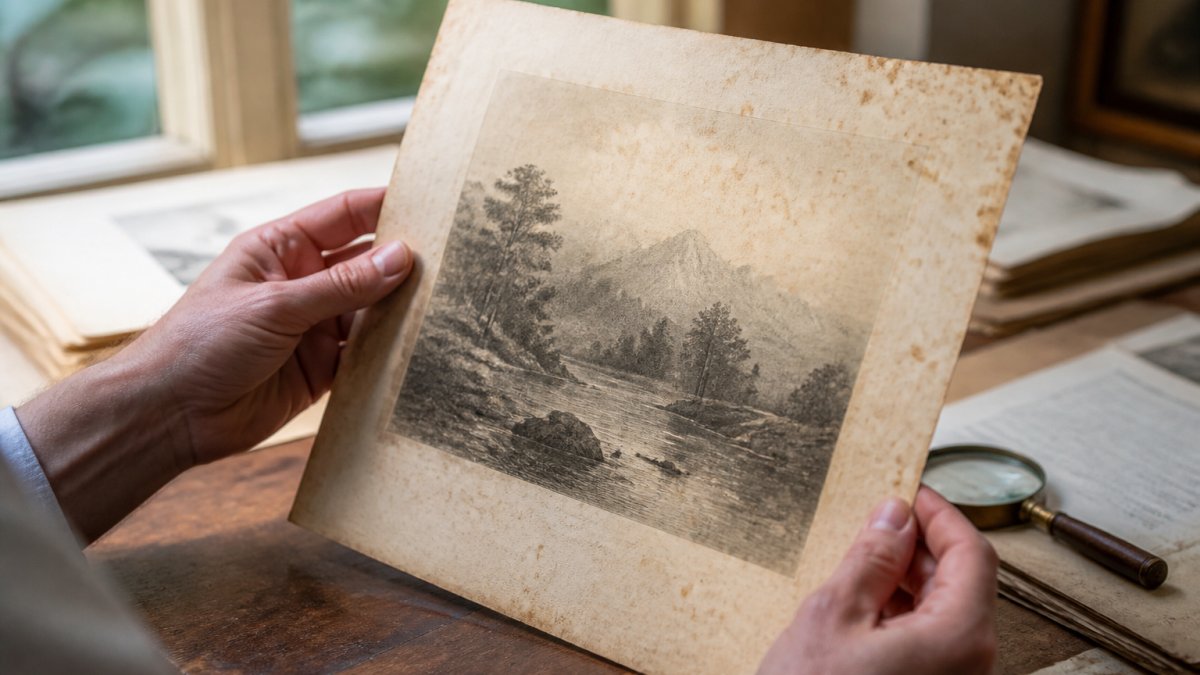
Spotting common damage: tears, foxing, and discoloration
Learn to recognise the most common problems before they worsen.
Foxing is the brownish spots you see on old paper.
Tears and missing paper range from tiny edge damage to significant losses. Small tears along the edges are often safe to repair yourself.
Discoloration can come from many sources: exposure to light, acid in the paper itself, contact with acidic mounting materials, or environmental pollution.
Water damage and stains signal past exposure to moisture.
Document the condition with photographs taken in natural light. This creates a baseline so you can track whether damage is spreading or stable.
How to Clean Antique Prints Without Damage
Cleaning an antique print feels straightforward until you realise how easily it can go wrong. The safest approach is to do as little as possible and stop the moment you're uncertain.
Removing surface dirt and dust safely
Start with the gentlest method: a soft brush and gravity.
Use a natural-hair brush (soft bristles, never synthetic) or a clean soft cloth. Work horizontally over a clean surface, letting dust fall away naturally.
For stubborn dust trapped in the paper texture, a soft eraser designed for art (not a standard pencil eraser) can help. Test it on an inconspicuous corner first.
Never use a vacuum cleaner on an unframed print. The suction can damage fragile paper.
Compressed air can work for prints in frames, but hold the can upright and use short bursts from a distance.
When to avoid water and solvents
This is where most DIY attempts fail.
Water is deceptively dangerous. Even distilled water can cause foxing to spread, dissolve sizing in the paper, or activate old adhesives. If a print has ever been wet, water treatment risks triggering mould or permanent staining.
Avoid water entirely if:
- The print shows any foxing
- It has hand-applied colour or watercolour elements
- It's mounted on acidic backing board
- You don't know the paper's composition
- The print has been stored in damp conditions
Organic solvents (acetone, turpentine, alcohol) can dissolve inks, strip sizing, or damage varnish coatings. Unless you're a trained conservator, these should stay in the professional's toolkit.
If a print is genuinely dirty and gentle brushing hasn't helped, stop and consult a professional. A few pounds of dirt is far less damaging than a failed cleaning attempt.
Removing Foxing from Prints: Risks and Reality
Foxing looks treatable. It's tempting to think a simple chemical wash will restore the print to its original appearance. The reality is far more complicated.
Foxing occurs because iron compounds in the paper have oxidised over decades. Some conservators can reduce foxing using specialised bleaching techniques, but these treatments carry real risks.
Many foxed prints are best left alone. The foxing has stabilised. Attempting removal might cause more visible damage than leaving it as is.
A professional conservator can assess whether your specific print is a candidate for foxing treatment.
Repairing Tears and Missing Paper
Not all damage requires professional help, but knowing where the line is critical.
When DIY repair is safe; when to stop
Safe to repair yourself:
- Small edge tears (under 5 centimetres)
- Tears along the margin, away from the printed image
- Loose corners where the print has separated from mounting board
- Minor creases that haven't broken the paper fibres
Stop immediately if:
- The tear runs through the printed image
- The print has missing sections of paper
- The tear is jagged or the edges are damaged
- The paper feels brittle or powdery
- You're unsure about the paper's age or composition
For small edge tears, you can use Japanese tissue paper and wheat paste (a reversible adhesive favoured by conservators). Apply a thin strip of tissue along the tear on the reverse side. This stabilises the tear without affecting the front of the print.
Never use modern tape, glue, or adhesive. These are permanent and will damage the print's value and condition irreversibly.
Animals: Brodtman, Karl Joseph, Kangaroo & Philanger, Rare, Lithograph, c1830 →
If a tear runs into the printed area or if paper is missing, professional repair is your only option. A conservator can inpaint missing areas or carefully reattach torn sections using reversible techniques that preserve the print's integrity.
How to Store Antique Prints for Long-Term Preservation
Storage conditions are where most damage happens. Temperature swings, humidity fluctuations, and contact with acidic materials degrade prints far faster than display ever will.
Environment, handling, and protective materials
Temperature and humidity are your primary concerns. Antique prints thrive in stable conditions: around 18-21 degrees Celsius and 40-50% relative humidity.
Fluctuating humidity is worse than consistently high humidity.
Protective materials matter enormously. Store prints in acid-free boxes, acid-free folders, and acid-free tissue paper.
Never store prints in plastic sleeves or bags. Plastic traps moisture and can stick to the print's surface.
Handling is simpler than most people think. Wash your hands before touching prints. Oils from your skin can cause permanent marks.
Keep prints away from direct sunlight, fluorescent lights, and heat sources. UV exposure fades inks and discolours paper irreversibly.
Archival Framing for Prints: Protecting Your Collection
Framing is your print's primary line of defence against environmental damage. Poor framing choices can cause more harm than decades of storage.
Choosing acid-free materials and UV-protective glass
Every material that touches the print must be acid-free. This includes the mat board, backing board, adhesives, and tape.
Mat board should be 100% cotton rag or museum-quality acid-free board.
Backing board serves the same purpose. Use acid-free board, not cardboard.
Adhesives and tape must be reversible. Never use modern glues or pressure-sensitive tape.
Glass or acrylic matters more than most people realise. Standard glass offers no UV protection.
Avoid non-glare glass. The coating can interact with the print's surface and cause permanent marks.
A properly framed antique print can hang safely for decades. A poorly framed one will deteriorate visibly within years.
When to Seek Professional Conservation
Some damage is beyond repair at home. Knowing when to call a conservator saves prints and money.
Red flags that signal professional help is needed
Seek professional conservation if:
- The print has mould, mildew, or musty smell
- Water damage is visible or suspected
- Large tears or missing sections exist
- The print is extremely old, rare, or valuable
- Foxing is extensive or spreading rapidly
- The print has been previously repaired with modern adhesives
- Colours are fading or the print shows signs of chemical degradation
- You're uncertain about the paper type or printing technique
A conservator's assessment alone is worth the cost. They can identify problems you might miss and recommend treatment only if it's genuinely beneficial.
Questions to ask a conservator; understanding costs and timelines
Ask these questions before committing:
- What is your assessment of the print's condition?
- What treatment do you recommend, and why?
- What are the risks of treatment versus leaving it untreated?
- How long will the work take?
- What will it cost?
- Can you provide references from previous clients?
- Will you document the treatment process?
- Are your materials and techniques reversible?
Professional conservation isn't cheap. A significant antique print might cost $300-$800 AUD or more for thorough treatment. For rare or valuable pieces, this is a sound investment.
Ask for a written estimate and timeline before work begins. Reputable conservators will provide detailed documentation of what was done and what materials were used.
Treatment timelines vary. Simple cleaning might take weeks. Complex repairs can take months. Plan accordingly if the print is needed for a specific date.
Antique print restoration requires patience and honesty about your own skill level.
At Antiquarian Print Shop, we help collectors understand their prints through detailed condition reports and technical documentation. Our curated collection of over 1,200 authentic original antique prints, from rare botanical and bird illustrations to historic maps and engravings, comes with the information you need to care for them properly.

| Damage Type | DIY Safe? | Best Action | When to Stop |
|---|---|---|---|
| Surface dust | Yes | Soft brush, gravity | If paper darkens |
| Small edge tears | Yes | Japanese tissue + wheat paste | Tears near image |
| Foxing spots | No | Professional assessment | Any chemical treatment |
| Water damage | No | Professional conservator | Immediately |
| Missing paper | No | Professional inpainting | Any attempt |
| Discoloration | No | Professional evaluation | Before treatment |
Frequently Asked Questions
How should you clean an antique print without damaging it?
Start by assessing the print's condition and paper type. For surface dust, use a soft brush or cloth with gentle, light strokes, never rub. Avoid water and solvents unless the print is sturdy and you're confident in the technique. Most collectors should skip water baths entirely and instead consult a professional conservator. Moisture can cause foxing to spread, ink to bleed, and paper fibres to weaken. When in doubt, leave it to an expert.
Can foxing or stains be removed from an antique print?
Foxing, those brown spots caused by oxidation and humidity, is extremely difficult to remove safely at home. Commercial bleaching treatments risk damaging the paper and ink permanently. Stains vary by cause: water stains, mould, or age-related discoloration each require different approaches. Professional conservators have specialised solvents and techniques, but even then, reversibility is not guaranteed. For valuable prints, preservation as-is is often wiser than attempted removal.
How should antique prints be stored to prevent damage?
Store prints flat in a cool, dry place with stable humidity (around 45-55%) and temperature (15-21°C). Use acid-free paper, boards, and boxes. Keep prints away from direct sunlight, heat sources, and damp areas. Never store in basements or attics where humidity fluctuates. Handle with clean, dry hands and avoid touching the printed surface. Acid from old paper and adhesives can migrate to nearby items, so store prints separately from other materials. Check periodically for signs of mould or pest damage.
What is archival framing and why does it matter for antique prints?
Archival framing uses acid-free mats, boards, and adhesives to protect prints from chemical deterioration. UV-protective glass blocks harmful light that causes fading and discoloration. Proper matting keeps the print away from glass, preventing moisture and mould. Reversible mounting methods allow future conservators to remove the print without damage. For valuable or rare prints, such as the hand-coloured lithographs and copperplate engravings in our collection, archival framing is essential to preserve condition and investment value over decades.
The difference between a print that survives intact and one that deteriorates comes down to one decision: knowing when to act and when to wait. Proper storage, gentle handling, and archival framing protect your collection far more effectively than any restoration attempt. When damage does occur, the question isn't whether you can fix it yourself, it's whether a professional conservator should. That's the decision that preserves both the print and its value.