
Preserving Original Antique Paper Prints: A Guide
Table of Contents
- Understanding Your Antique Print Before You Touch It
- Cleaning Antique Prints Safely: What You Can and Cannot Do
- How to Store Antique Prints to Prevent Damage
- Risks of Storing Antique Prints in Basements and Other Damp Spaces
- Archival Framing for Antique Prints: Doing It Without Damage
- Repairing Tears, Foxing, and Losses: When to Call a Conservator
- Conclusion: Caring for Your Antique Paper Prints Long-Term
- Frequently Asked Questions
Last Updated: October 13, 2026
Understanding Your Antique Print Before You Touch It
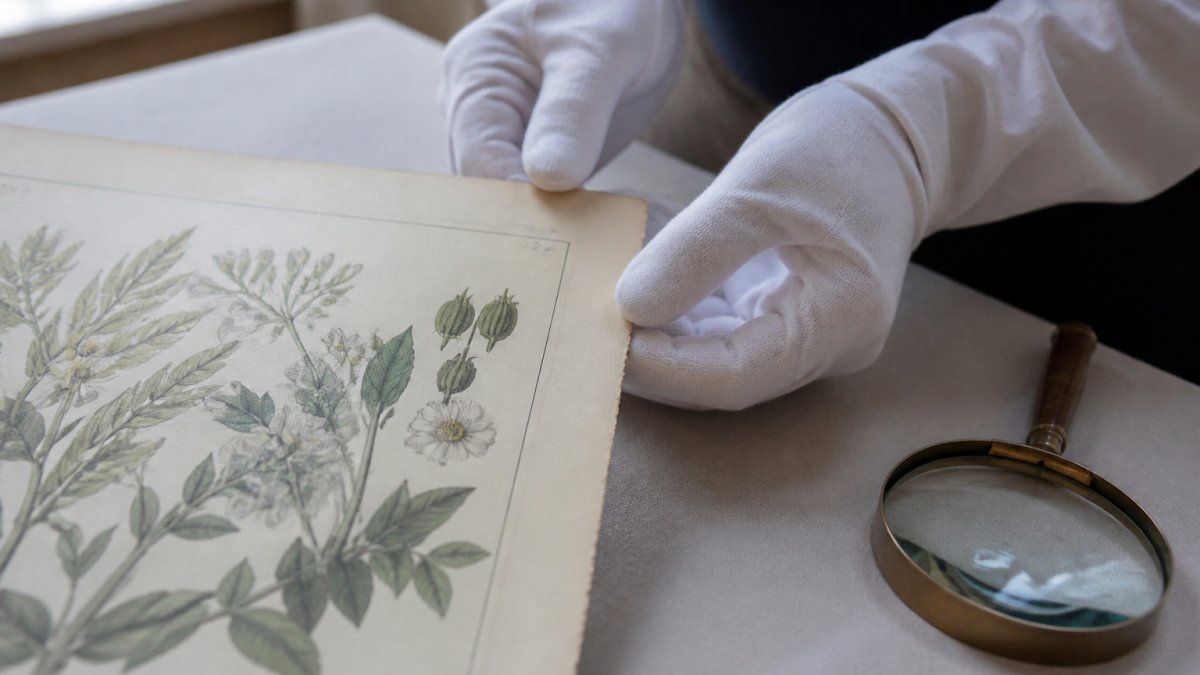
Preserving original antique paper prints starts with looking, not cleaning. Identify what you own before you touch it. A print from 1650 and one from 1850 can look similar on the wall but need very different care.
Identifying Print Media and Paper Support
Print media is the ink and colour on the page. Paper support is the sheet underneath. Both decide what you can safely do.
Hand-coloured engravings, like our 1667 Bartoli copperplate engraving of Trajan's Column, often have watercolour that lifts at the first sign of moisture. Later lithographs may use inks that flake when rubbed.

Check these points before any treatment:
- Hold the print at an angle to catch the light
- Look for plate marks (a pressed border from the printing plate)
- Note whether colour sits neatly inside lines or bleeds past them
- Feel the sheet edges for brittleness or softness
Assessing Paper Condition and Damage
Condition assessment means recording what is wrong before you change anything. Work under bright, even light and write it down.
Look for:
- Foxing (small brown spots, often a sign of past damp)
- Tears, losses, and creases along edges or folds
- Discolouration and overall yellowing
- Mold (dark patches, musty smell)
- Acidity (paper that feels brittle and snaps rather than bends)
Photograph the print before you start. It protects your memory of the original state.
Cleaning Antique Prints Safely: What You Can and Cannot Do
Cleaning antique prints safely means doing less than you think. Surface dirt removal is the only step most owners should attempt alone. Everything beyond that, washing, aqueous treatment, stain reduction, is conservator territory, and the reason is mechanical, not merely cautious.
Why Water Is Rarely the Answer at Home
Paper is a mat of cellulose fibres held together by hydrogen bonding. When paper gets wet, those bonds loosen, the sheet swells, and it becomes temporarily weak. On a modern book page that is manageable. On a 200-year-old print it is not, because the paper has already lost strength to acid hydrolysis and oxidation. Add water and you also risk:
- Ink migration, iron gall ink, hand-colouring, and many 19th-century lithographic inks are water-soluble to some degree.
- Tideline staining, a stain that is only partly dissolved can be pulled outward and set as a hard brown ring.
- Foxing activation, the iron and fungal residues behind foxing spots can bloom rather than clear.
- Cockling, uneven drying leaves the sheet buckled, and flattening it again is its own treatment.
The Only Home Treatment Worth Doing
Surface cleaning is low-risk when done properly. Work on a clean, dry surface in bright, even light.
- Wash your hands and wear clean cotton gloves. Oils from bare hands transfer to paper permanently.
- Lay the print flat. Support any tear or weak edge with a sheet of acid-free tissue underneath.
- Use a soft, clean brush, a hake or a large soft cosmetic brush, and lift dirt from the centre outward.
- Work in one direction only. Never scrub back and forth, and never press the bristles into the sheet.
- Stop the moment the paper looks stressed, the surface starts to pill, or you see colour on the brush.
For loose surface dust on a robust engraving, a conservator-grade vinyl eraser crumb can be rolled gently across the surface. Do not use a block eraser, a pencil eraser, or a rubber eraser, they abrade the paper and leave residue that stains over time.
What Not to Attempt
Do not use water, solvents, bleach, lemon juice, vinegar, bicarbonate of soda, erasers, or household cleaners. Do not iron a print. Do not press it between books. Do not tape, glue, or dry-mount anything. Such aggressive interventions risk permanent structural damage, a principle that remains equally vital when caring for antique books.
DIY or Professional? A Quick Decision Guide
Before you touch the print, run it through this filter. If any line is true, stop and consult a conservator.
| Situation | Home treatment | Professional treatment |
|---|---|---|
| Loose surface dust on a sturdy engraving | Yes, soft brush | Not needed |
| Hand-coloured print with any moisture risk | No | Yes |
| Iron gall ink, or ink that smudges when breathed on | No | Yes |
| Foxing, tidelines, or overall yellowing | No | Yes |
| Active mold or musty smell | No | Yes |
| Tears, losses, or deep creases | No | Yes |
| Photographic print, or anything with a glossy surface | No | Yes |
| High-value or signed print | No | Yes |
Print-Specific Sensitivity
The medium decides the risk. A copperplate engraving on laid paper is comparatively robust, the ink sits in the incised line and the paper is often rag-based.
If in doubt, photograph the print, note the condition, and get a professional opinion before doing anything. The cost of an assessment is almost always less than the cost of reversing a failed home treatment.
How to Store Antique Prints to Prevent Damage
How to store antique prints matters more than any treatment. Most damage we see comes from storage, not handling.
Use archival materials only:
- Acid-free folders and boxes
- Interleaving tissue between prints
- Flat storage, never rolled
- A cool, dark, dry space with steady conditions
Keep prints away from direct sunlight, which fades inks and yellows paper. Store them flat and unstacked where possible, and check them twice a year for new spots or smells.
Risks of Storing Antique Prints in Basements and Other Damp Spaces
The risks of storing antique prints in basements are serious and often invisible at first. Basements, garages, and attics swing in temperature and humidity, and that is what destroys paper.
Antiquities, Bartoli Pietro Santi, Classical Relief, Trajan's Column, Plate 2 →
Damp air causes:
- Mold growth that stains and eats paper fibers
- Foxing spots that spread across the sheet
- Warping, cockling, and buckling
- Brittle paper that cracks at the slightest bend
Once mold takes hold, it can spread to your whole collection. For guidance on safe environmental conditions, the Australian Institute for the Conservation of Cultural Material publishes practical advice for paper collections.
Archival Framing for Antique Prints: Doing It Without Damage
Archival framing for antique prints protects the work and keeps every step reversible. Reversibility means you can undo the framing later without harming the print.
Insist on these materials:
- Acid-free mount board and backing
- UV-filtering glass to slow fading
- A spacer so the print never touches the glass
- Hinges made from Japanese paper and starch paste
Never let a framer dry-mount, glue, or trim your print. Dry mounting is permanent and destroys value. Ask questions before you hand over an antique, and walk away if the answer is "we always do it this way."
Repairing Tears, Foxing, and Losses: When to Call a Conservator
Repairing tears, foxing, and losses is conservator work, not a home project. A professional can mend tears with Japanese paper, fill losses, reduce stains, and stabilise acidity using reversible methods. But the ethics and limits of restoration matter as much as the techniques, and understanding them will change what you ask for and what you expect.
What Conservation Actually Involves
A paper conservator works through a sequence, and each step is documented and reversible where possible:
- Condition report and photographic record before anything is touched.
- Surface cleaning with soft brushes and conservation-grade eraser crumbs.
- Aqueous treatment, washing in deionised water, sometimes with a buffered solution, to remove degradation products and reduce acidity.
- Stain reduction using controlled bleaching or localised chemical treatment, always with the paper's strength and ink solubility in mind.
- Deacidification to neutralise acid and leave an alkaline reserve, slowing future degradation.
- Repair of tears and losses with Japanese paper, kozo, gampi, or a toned tissue, adhered with wheat starch paste or a comparable reversible adhesive.
The Ethics: Reversibility and Minimal Intervention
The guiding principle is minimal intervention. A conservator should do the least required to stabilise the print, and every added material should be removable later without harming the original.
A good conservator will also tell you when doing nothing is the better choice. Sometimes a stain is stable, a tear is not worsening, and the risk of treatment outweighs the benefit.
Realistic Outcomes: What Treatment Can and Cannot Fix
Restoration is not reversal. Set expectations before work begins.
- Foxing can often be reduced but rarely eliminated completely. Some spots leave a faint shadow.
- Tidelines and water stains usually improve significantly but may not disappear.
- Overall yellowing can be reduced by washing, but the paper will not return to its original whiteness.
- Fading of inks and colours is generally irreversible. No treatment brings back lost pigment.
- Paper strength can be improved by lining, but the original fibres are not restored.
- Losses can be filled and toned to blend, but the fill is not original material and will always be detectable on close inspection.
- Tears can be mended so they are nearly invisible from the front, but the repair remains a repair.
When to Call a Conservator
Call a conservator when you see:
- Active mold or a musty smell
- Ink that smudges or flakes
- Large tears, missing corners, or deep creases
- Stains that have spread since you bought the print
- Any print of significant value, or any print with hand-colouring, iron gall ink, or photographic media
Questions to Ask Before Work Begins
- What will you do, step by step?
- Is every treatment reversible?
- What are the risks and expected outcomes?
- Will you provide a written condition report and treatment proposal?
- Are you accredited, and can you show comparable work?
For works of art on paper, the Australian Institute for the Conservation of Cultural Material maintains a directory of accredited professionals. Ask for a conservator who specialises in works on paper, not a general framer or restorer.
Conclusion: Caring for Your Antique Paper Prints Long-Term
Preserving original antique paper prints comes down to three habits: handle less, store better, and call a professional when in doubt. Most of the damage we see was avoidable, and almost all of it came from damp storage or well-meaning home repairs.
If you would rather start with a print that arrives ready to care for, browse our curated collection of original antique prints, including hand-coloured botanical engravings and early maps.
Frequently Asked Questions
How should you store antique paper prints to prevent damage?
Store antique paper prints flat in acid-free folders or boxes, away from light, heat, and moisture. Interleave with archival tissue, keep them in a cool, dry room with stable humidity, and avoid attics or basements. If framing, use archival materials and UV-filtering glass. Handle with clean, dry hands or cotton gloves, and support the paper fully to prevent creasing.
Can sunlight damage antique prints?
Yes. Ultraviolet light fades inks and discolours paper fibres, and the damage is irreversible. Keep prints out of direct sun and use UV-filtering glass in frames. Rotate displayed pieces every few months to limit cumulative exposure, and store the rest in darkness. Even indirect daylight adds up over years, so treat light exposure as a budget you spend slowly.
When should an antique print be assessed by a paper conservator?
Seek a conservator if you see active mould, extensive foxing, brittle or flaking paper, large tears, or previous repairs that are failing. Also consult before any washing, chemical treatment, or lining. A conservator can assess condition, advise on reversibility, and carry out treatment that protects both the print's value and its long-term stability.
How do you prevent mould on old paper prints?
Mould needs damp conditions, so keep relative humidity between 40% and 50% and ensure good air circulation. Never store prints against external walls, in basements, or in sealed plastic. If mould appears, isolate the print, wear a mask, and consult a conservator. Surface mould can sometimes be removed, but staining and fibre damage are often permanent.
Caring for a fragile antique print can feel risky when you are not sure what you are handling. Antiquarian Print Shop offers over 1,200 authentic original prints, each documented with its date, technique, and condition, plus reproductions and custom sizing for awkward wall spaces. Every piece is chosen by curator Iris Windsor and shipped ready to display. Shop original prints and start your collection with confidence.