
Best Antique Print Shops for Collectors: 2026 Guide
Table of Contents
- What Makes a Great Antique Print Shop for Collectors
- How to Identify Original Antique Prints
- Historical Maps of Victoria for Sale: What Collectors Should Know
- Best Practices for Framing Antique Prints
- Care and Preservation: Protecting Your Investment
- Where to Find Authentic Antique Prints: A Curator's Selection
- Conclusion: Building a Collection That Lasts
- Frequently Asked Questions
Last Updated: September 16, 2026
What Makes a Great Antique Print Shop for Collectors
The best antique print shops for collectors verify authenticity before a print reaches the shelf, document condition and provenance honestly, and price on real market evidence. Antiquarian Print Shop, founded by curator Iris Windsor, built its catalogue of more than 1,200 original and reproduction prints around that discipline.
- Specialist dealers focus on one era or technique, such as 16th to 20th-century lithographs or copperplate engravings.
- Generalist galleries carry mixed stock across maps, botanical illustration, and natural history.
- Reproduction studios sell modern reprints of historical works, which is a legitimate market as long as it is labelled clearly.
How to Identify Original Antique Prints
An original antique print is a sheet pulled from the plate at or near publication, on period paper, not a later photographic or digital copy. Most beginners lose money not because they cannot see the difference, but because they do not know the order in which to check.
A Beginner's Authentication Checklist
- Look at the paper first, not the image. Pre-19th-century paper is usually laid paper, with faint chain lines visible under raking light; machine-made wove paper becomes common from the late 18th century. A uniformly smooth, bright white sheet is often a modern reproduction.
- Hunt for the watermark. Hold the sheet against a light source. Watermarks, names, dates, crests, or figures, are woven into the paper during manufacture and are very hard to fake. One matching the supposed publication date is strong corroboration.
- Find the plate mark. In intaglio methods such as engraving and etching, the press drives the paper into the recessed lines of the copper plate, leaving a rectangular indentation around the image. Lithographs and woodcuts generally lack one, so its absence is not automatically a red flag, but its presence on an intaglio print is a good sign.
- Assess the impression. Early impressions pulled from a fresh plate are crisp and dark. As the plate wears, lines soften and thin. A print described as an early state should show strong, clean lines; a weak, grey impression may be a late pull or a reproduction.
- Examine the colouring. Early hand colouring sits within the printed lines, looks slightly uneven, and occasionally crosses a border. Later colouring bleeds past the border or uses pigments too saturated for the period; modern digital colour is flat and uniform.
- Read the text and typography. Publisher names, plate numbers, and dates should match the claimed edition. Misspellings, anachronistic fonts, or a publisher that did not exist at the stated date are immediate warnings.
- Inspect the verso. Text on the back, collector's marks, dealer labels, and offsetting from facing pages all add evidence.
- Ask for provenance in writing. Documented ownership history is the single strongest signal of authenticity. A print with a known source, such as a specific edition of a named atlas, is far easier to verify than a loose sheet of unknown origin.
Understanding Editions and Provenance
Editions matter because the same image can be printed for decades, and value varies sharply between states. Robert Morden's county maps were first published in Camden's Britannia in 1695 and reissued in 1722, 1753, and 1772. Collectors distinguish them by small clues: the 1722 Lincolnshire map has a horse watermark in a three-inch circle, while earlier states carry different place-name spellings.
How Authentication Affects Value
Authentication is the foundation of valuation. Four factors drive price:
- Rarity. A first state, a scarce edition, or a print from a short run commands a premium. Common later reissues of the same image can trade for a fraction of the original.
- Condition. Foxing, staining, trimmed margins, and repaired tears all reduce value. A print in fine condition can be worth several times the same image in poor condition.
- Artist and engraver. Named artists and engravers with established markets are easier to value and easier to resell. Anonymous plates are harder to price and slower to move.
- Subject demand. Australian colonial maps, botanical plates, and natural history subjects with local relevance tend to hold stronger demand than generic European topography.
Historical Maps of Victoria for Sale: What Collectors Should Know
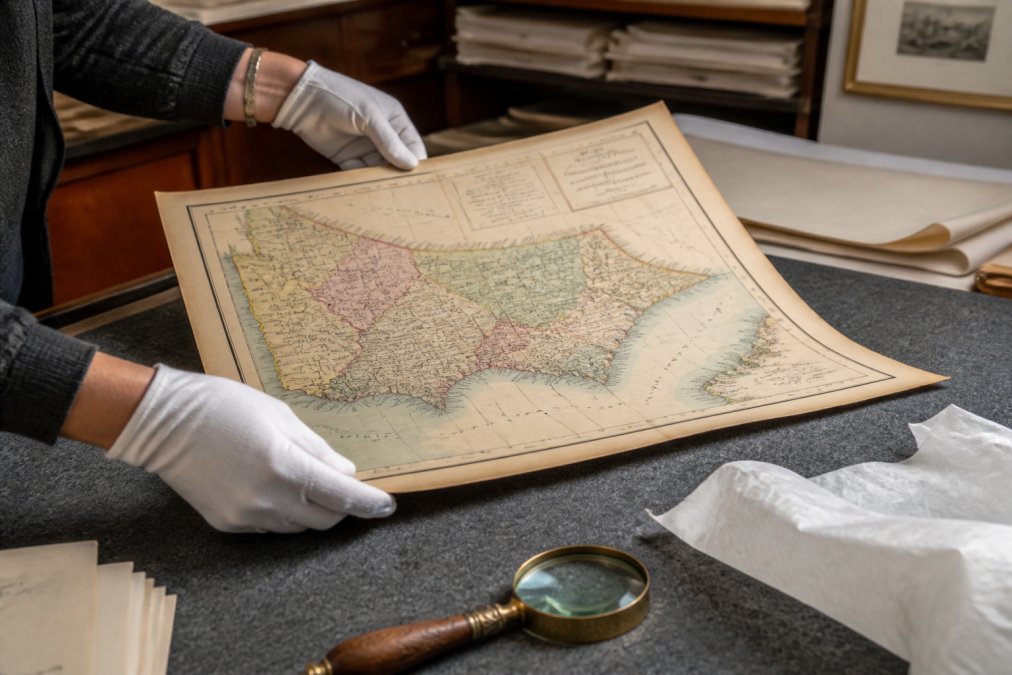
Historical maps of Victoria for sale attract strong demand because the colony's story is unusually compressed. Victoria separated from New South Wales in July 1851, the same year the gold rush began, and the population tripled within two decades. Maps from that window capture a place changing faster than cartographers could record.
Best Practices for Framing Antique Prints
Framing is where collectors do the most accidental damage. The wrong materials can stain, fade, or chemically burn a print within a few years, often irreversibly.
Choosing the Right Materials
Use archival framing: acid-free mounting board, UV-filtering glazing, and hinges made from Japanese tissue and wheat starch paste. Never dry-mount a print, and never trim it to fit a standard frame.
| Framing Element | Recommended | Avoid | Why It Matters |
|---|---|---|---|
| Mount board | Acid-free, cotton rag | Standard cardboard | Cardboard acids burn the paper |
| Glazing | UV-filtering glass or acrylic | Plain glass in direct sun | Prevents ink and colour fade |
| Hinges | Japanese tissue, starch paste | Pressure-sensitive tape | Tape stains and cannot be reversed |
| Backing | Archival foam board | Sealed hardboard | Allows the paper to breathe |
Dry-mounting fuses a print permanently to a board. It cannot be undone, and it instantly removes the piece from the investment-grade market. If a framer suggests it for speed, walk away.
Care and Preservation: Protecting Your Investment
Paper conservation is mostly about controlling the environment. Foxing, fading, and embrittlement are cumulative and largely irreversible, so the goal is prevention rather than repair.
The Four Threats to Antique Paper
- Light. Ultraviolet and visible light break down paper fibres and fade inks and hand colouring. Damage is cumulative and irreversible; even indirect daylight fades a print over years.
- Humidity and moisture. Paper absorbs and releases moisture with the air. Repeated swings cause cockling; sustained damp encourages mould and accelerates foxing. Damp walls and bathrooms are the worst locations.
- Heat and pollution. Radiators, fireplaces, and direct sun dry paper out and make it brittle. Airborne pollutants, including cooking fumes and tobacco smoke, stain the surface over time.
- Physical handling. Oils from fingers, pressure from stacking, and careless lifting by a corner all cause permanent damage. Tears and creases rarely come out cleanly.
Foxing: What It Is and What to Do
Foxing is the small brown spotting that develops on older paper, associated with moisture, metallic impurities, and microbial activity, and it worsens in humid conditions. Light foxing is common and not automatically a defect, but heavy or active foxing affects value and can spread.
Storing Unframed Prints
Most collectors end up with more unframed prints than wall space, and storage is where damage quietly accumulates:
Map, Speed John, Montgomery Shire, c1610 →
- Store flat, not rolled. Rolling stresses the paper and makes prints hard to flatten later.
- Use acid-free folders and interleave each print with archival tissue so surfaces do not rub.
- Keep folders in a dark, dry cupboard with stable temperature. Avoid garages, attics, and basements where humidity swings are largest.
- Handle with clean, dry hands or cotton gloves, and support the sheet from underneath with both hands rather than lifting by a corner.
- Keep a written record of what you own, including condition notes and provenance, to track changes over time.
Displaying Prints Safely
If a print goes on the wall, the framing decisions above do most of the work, but placement matters. Keep prints off walls in direct sun, away from radiators and air-conditioning vents, and out of bathrooms and kitchens where moisture and fumes are highest. Rotate pieces if you want to display more than you can safely hang, a print that spends half the year in dark storage lasts noticeably longer.
When to Call a Conservator
Some problems are beyond home care. Tears, losses, heavy staining, active mould, and severe foxing all warrant professional attention. A paper conservator can wash, deacidify, and repair damage using reversible materials, but the work is skilled and priced accordingly. For a valuable print, the cost is usually justified; for a low-value decorative piece, it may not be.
Where to Find Authentic Antique Prints: A Curator's Selection
Authentic antique prints come from dealers who can demonstrate where a piece came from, how it was made, and its condition. Hold every seller to that standard.
Some pieces worth studying in that collection:
- Map, Speed John, Montgomery Shire, c1610, $1,800.00, a first-edition John Speed county map with hand colouring and an inset town plan of Montgomery.
- Map, Morden Robert, County Map, Lincolnshire, c1722, $1,500.00, identifiable by its horse watermark and printed on thick paper.
- Map, Tallis John, Victoria and Port Phillip c1851, Original, $750.00, a scarce steel engraving marking the year of separation and the gold rush.
- Map, Tallis John, Van Diemen's Island of Tasmania, c1851, $750.00, with vignettes of Hobart and the thylacine.
- Map, William Blackwood and Sons, China and Japan, #29, c1873, $195.00, an accessible entry point into 19th-century lithographed cartography.
Authentication comes down to four checks: paper texture and watermark, plate mark, period-appropriate colouring, and documented provenance. A dealer who can speak to all four is worth your business.


Conclusion: Building a Collection That Lasts
Building a collection that holds its value comes down to patience and proof. Buy from dealers who document condition and provenance, frame with archival materials from day one, and treat every purchase as a long-term hold rather than a quick flip.
Frequently Asked Questions
Are antique prints worth anything?
Value depends on rarity, artist, condition, and demand. Original antique prints by renowned cartographers like John Speed or Robert Morden can sell for hundreds to thousands. For example, a c1610 John Speed map is priced at $1,800, while a c1873 lithograph by William Blackwood and Sons starts around $195. Condition, provenance, and whether it's a first edition significantly affect worth. Always request a condition report and verify authenticity before buying.
How can I tell if an antique print is original or a reproduction?
Look for plate marks (indentations from the printing press), paper texture, and signs of ageing like foxing. Original etchings and engravings often have a distinct plate mark, while reproductions are usually flat. Check for hand-colouring that matches the period and examine the paper under light for watermarks or chain lines. Consult a specialist dealer or use a UV light to spot modern inks. When in doubt, ask for provenance documentation.
What is the best way to frame an antique print?
Use archival materials: acid-free mounting, UV-filtering glass, and a mat that prevents the print from touching the glass. Avoid trimming or dry-mounting, which devalues the piece. Choose a frame that complements the print's era without overpowering it. For valuable originals, consider conservation framing with a reversible backing. This protects against light, moisture, and physical damage while preserving the print's condition.
How should I store and preserve antique paper prints?
Store prints flat in acid-free folders or archival sleeves, away from direct sunlight, heat, and humidity. Ideal conditions are 18-22°C with 45-55% relative humidity. Avoid attics and basements. If framing, use UV glass and rotate displays to limit light exposure. Handle with clean cotton gloves and support the paper from below. Regular condition checks help catch foxing or tears early.
Where can I find historical maps of Victoria for sale?
Specialist antique print shops and online galleries often carry original maps like the 1851 John Tallis map of Victoria and Port Phillip, priced around $750. Look for dealers who provide provenance, condition reports, and secure international delivery. Authentic maps from the 19th century are increasingly rare, so work with a reputable seller who specialises in Australian cartography and offers returns or guarantees.