
High Quality Antique Art Reproductions: A Buyer's Guide
Table of Contents
- What Defines High Quality Antique Art Reproductions
- Authentic Antique vs Reproduction Art: How to Tell the Difference
- Museum Quality Giclée Prints and Traditional Printing Methods
- Materials That Matter: Canvas, Paper, and Inks
- Custom Framing for Antique Prints: Protecting Your Investment
- Styling Antique Art Reproductions in Your Home
- Caring for Your Antique Art Reproductions
- Frequently Asked Questions
Last Updated: September 21, 2026
What Defines High Quality Antique Art Reproductions
High quality antique art reproductions combine artistic fidelity with modern printing techniques to deliver museum-quality results at accessible prices, honouring the original whilst remaining affordable and practical for contemporary homes.
Museum quality reproductions depend on three factors: printing method, materials, and artistic detail. A reproduction capturing subtle texture and colour accuracy, whether a John Gould bird illustration or John Tallis map, transforms a wall from ordinary to curated.

Museum quality reproductions use pigment-based inks and archival paper that resist yellowing and fading, respecting the original's artistic technique whether hand-finished colouring or lithographic grain.
Authentic Antique vs Reproduction Art: How to Tell the Difference
The choice between an original and high-quality reproduction depends on budget, investment intentions, and priorities.
Authentic antique prints carry provenance and documented history. Original John Gould bird prints feature scientific accuracy and hand-finished colouring from 19th-century artisans, commanding higher prices due to rarity, investment potential, and historical connection.

Reproductions use modern printing technology applied to high-resolution scans, lacking rarity and investment appreciation but delivering exceptional visual fidelity at a fraction of the cost. Museum quality matte paper reproductions can be visually indistinguishable from originals when framed properly.
Verifying Reproduction Quality: What to Ask and What to Look For
Quality varies dramatically based on production standards. Request specific documentation from the seller:
Ink Specification. Request written confirmation of pigment-based inks (not dye-based). Pigment-based inks resist fading 100+ years with archival substrates; dye-based fade within 5-10 years. Ask for ink manufacturer name and lightfastness ratings (Category I or II indicate 100+ years stability).
Paper or Canvas Certification. Verify acid-free, lignin-free substrates meeting ISO 9706 standards. Request substrate manufacturer and weight (200-310 gsm for fine art paper; cheap reproductions use 80 gsm that yellows within years).
Resolution and Scanning Source. High-quality reproductions use 300 dpi+ scans from verified originals (museum, documented private collection, or published facsimile). Poor-quality scans show pixelation or colour inaccuracy. Reputable sellers identify the source institution.
Certificates of Authenticity. Ethical sellers provide documentation confirming source artwork, artist, creation date, reproduction method, artist biography, and original artwork location. This transforms a generic print into a contextualised, verifiable piece.
Colour Accuracy Testing. Premium sellers offer colour-matched reproductions calibrated to the original in controlled museum lighting (5000K). Colour-matched reproductions cost more but ensure fidelity to the artist's intent.
The Practical Difference
For home furnishing without five-figure costs, reproductions work well if you verify material specifications. For long-term investment collections, originals justify the cost. Many collectors combine both: originals as anchors, reproductions to fill walls.
| Aspect | Original Antique Print | High-Quality Reproduction |
|---|---|---|
| Age & Rarity | 100+ years old, limited supply | Modern print, unlimited copies |
| Investment Value | Appreciates over time | Minimal appreciation potential |
| Cost | $500-$5,000+ | $50-$120 |
| Provenance | Documented history | Scan of verified original with documentation |
| Visual Impact | Authentic period patina | Clean, vibrant colours |
| Durability | Requires specialist care | Archival materials resist fading 100+ years |
| Verification | Auction records, dealer authentication | Archival material documentation, source documentation |
| Best For | Serious collectors, investment | Home décor, accessibility, curated collections |
Museum Quality Giclée Prints and Traditional Printing Methods
Giclée (French for "to spray") refers to inkjet printing that sprays pigment-based inks onto paper with extraordinary precision. Understanding this term separates genuine museum quality from marketing hype.
Museum quality giclée prints use archival pigment-based inks (not dye-based). Pigment particles sit on the surface, preserving colour vibrancy. Combined with archival-grade paper, giclée reproductions last 100+ years without significant fading.
Giclée isn't the only valid method. Traditional lithography, engraving, and hand-colouring produce equally valid reproductions. John Gould's bird prints, originally created through lithography with hand-finished colouring, achieved subtle texture and colour depth that modern printing struggles to replicate perfectly.
Antiquarian Print Shop respects both methods. John Gould reproductions use museum quality matte paper capturing scientific accuracy and vivid hand-finished colouring. John Tallis map reproductions use steel engraving techniques honouring original cartographic artistry.
Materials That Matter: Canvas, Paper, and Inks
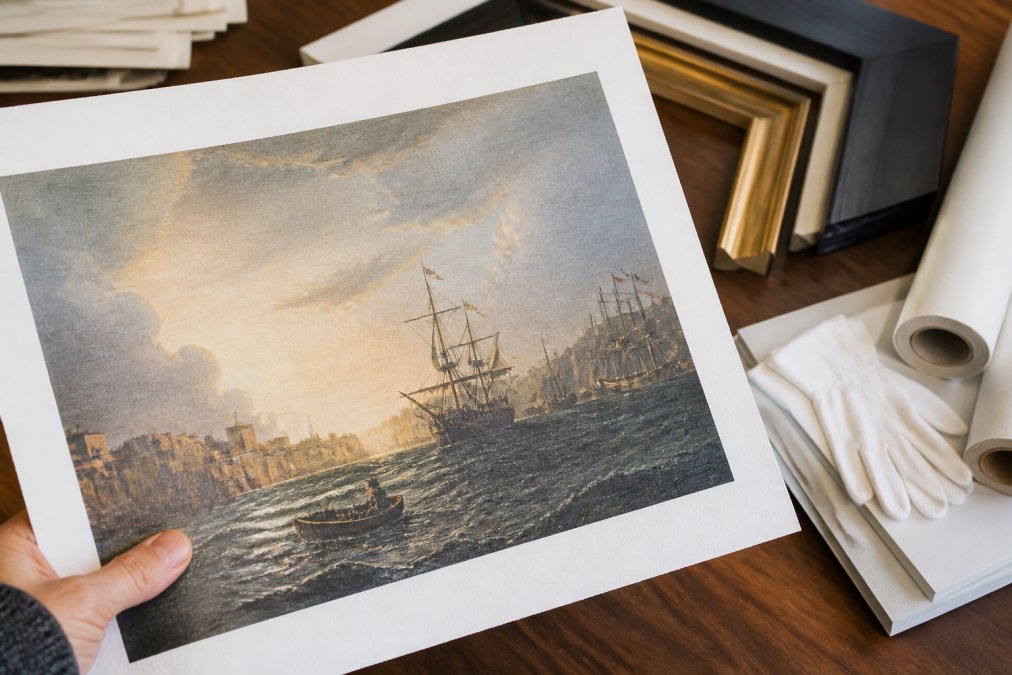
Paper choice fundamentally changes how a reproduction looks and performs. Neither is universally better; the choice depends on the artwork and aesthetic preference.
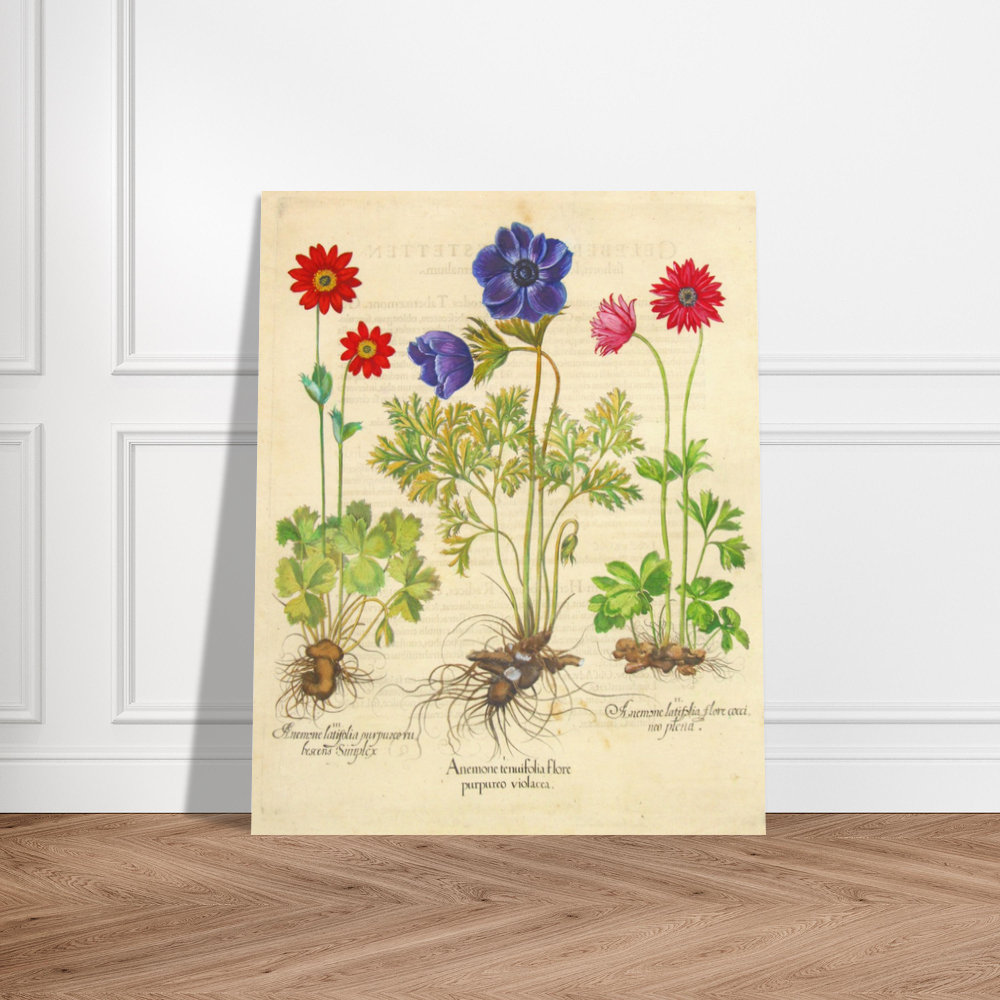
Archival matte paper delivers exceptional colour accuracy and refined appearance, reducing glare and creating gallery-like presentation. Collectors prefer paper for botanical illustrations, maps, and engravings where fine detail matters. Paper is lighter, easier to frame, and more affordable.
Inks determine longevity more than substrate. Pigment-based inks resist fading 100+ years with archival materials; dye-based fade within 5-10 years.
Antiquarian Print Shop John Gould reproductions use museum quality matte paper ensuring vivid hand-finished colouring and scientific accuracy remain vibrant for decades. Tallis map reproductions employ steel engraving techniques on archival paper maintaining decorative borders and vignettes.
Custom Framing for Antique Prints: Protecting Your Investment
Proper framing is conservation, protecting reproductions from light damage, moisture, and wear whilst enhancing visual impact.
Bird, Gould, John, Trogon Ambiguus →
Acid-free matting is non-negotiable; standard cardboard causes yellowing and deterioration. Archival matting costs more but protects for a century. UV-protective glass reduces fading 99% but costs roughly twice as much as standard glass.
Never use adhesive or tape directly on valuable prints. Archival conservation hinges use reversible adhesive, standard in museums, allowing future removal without harm.
Frame selection should complement the artwork. Ornate frames suit portraiture and botanical illustrations; simple frames suit maps and engravings. Wood frames age beautifully and feel more authentic than metal for antique reproductions.
For museum quality reproductions like Antiquarian Print Shop John Gould prints at $50 each, basic framing (acid-free mat, standard glass, simple frame) costs $80-$150, doubling total cost.
Styling Antique Art Reproductions in Your Home
Strategic placement transforms a print from wall decoration into a focal point. Thoughtful curation allows building a gallery-quality collection on a realistic budget.
Scale, Placement, and Visual Hierarchy
Artwork should occupy 50-75% of wall space. A 60 × 90 cm print works above a sofa or console table. Multiple smaller prints create visual interest when grouped in a gallery arrangement.
Above a fireplace, a single large print commands attention. Along hallways, smaller prints (30 × 40 cm) spaced 10-15 cm apart create rhythm. In bedrooms, prints at eye level when lying down (120-150 cm from floor) feel intimate.
Antique reproductions feature muted, historically accurate palettes, ochres, indigos, sepia tones, complementing most interiors. Place John Gould prints against neutral walls. Pair Tallis maps with warm wood furniture. If walls are patterned, choose reproductions echoing the existing palette.
Warm, diffuse lighting (2700K) flatters antique aesthetics and reduces glare. Avoid direct sunlight. A picture light adds elegance and protection. Position reproductions on walls receiving indirect natural light only.
Building a Curated Collection on a Budget
Strategic purchasing and thoughtful curation allow building a museum-quality collection for modest outlay.
Define Your Theme. Collections feel intentional when sharing a common thread: botanical illustrations from a single naturalist (e.g., John Gould), regional maps from a specific cartographer (e.g., John Tallis), or a historical period. A themed collection of 6-8 prints tells a coherent story and costs less because reproductions within focused categories are more affordable.
Start Small and Expand. Begin with 2-3 anchor pieces ($60-$100 each) and add smaller companion pieces ($30-$50 each) over time. This spreads cost and allows testing arrangements. A single large botanical print costs $80-$120 framed; adding two smaller prints creates a gallery effect for under $250 total.
Mix Frame Styles Strategically. Mixed framing (varying styles in complementary colours) costs less per piece and creates visual interest. Maintain cohesion through colour palette (warm woods, cool metals) or frame width (all 3-5 cm frames).
Use Series and Collections. Sellers offer discounts for multiple prints from the same series. A single John Gould print costs $50.
Prioritise Framing Investment Strategically. Anchor pieces justify archival framing with UV glass and acid-free matting ($100-$180 per frame). Smaller companion pieces use simpler framing ($60-$100). This tiered approach reduces overall costs by 30-40% whilst protecting valuable pieces.
Seasonal Rotation. Purchase gradually and rotate seasonally.
Grouping and Arrangement Patterns
Grouping creates narrative and visual impact. Mix sizes and frame styles for visual interest whilst maintaining cohesion through subject matter or colour palette.
Caring for Your Antique Art Reproductions
Proper care extends the life of your reproduction indefinitely. Most damage comes from light exposure, moisture, and handling rather than age itself.
Frequently Asked Questions
What is the difference between a giclée print and a standard art reproduction?
Giclée prints use pigment-based inks sprayed onto fine art paper, creating museum quality results with exceptional colour accuracy and longevity. Standard reproductions often use cheaper printing methods that fade faster and lack the depth of colour.
How do I know if an antique art reproduction is actually high quality?
Look for museum quality materials: acid-free paper, and hand-finished details that match the original. Examine the colour accuracy and texture. Reputable sellers provide information about the materials used, distinguishing authentic antique reproductions from mass-produced alternatives.
Are high quality art reproductions worth buying as an investment?
High quality reproductions of iconic works hold value differently than originals. They're more valuable as long-term home decor assets and tangible connections to art history than as speculative investments, but quality matters significantly for retention of value.
What should I do to protect an antique art reproduction from fading and damage?
Frame with UV-protective glass to block harmful light, use acid-free matting and backing, and avoid direct sunlight or humidity fluctuations. Hang reproductions away from damp areas like bathrooms. Store unframed prints flat in archival boxes. Dust gently with a soft brush, never with water or chemicals.