
Antiquarian Print Shop
Ethnology, Anthropology & Ethnology, Blackie & Son, Mongolian Race, c1880
Ethnology, Anthropology & Ethnology, Blackie & Son, Mongolian Race, c1880
Couldn't load pickup availability
Anthropology & Ethnology
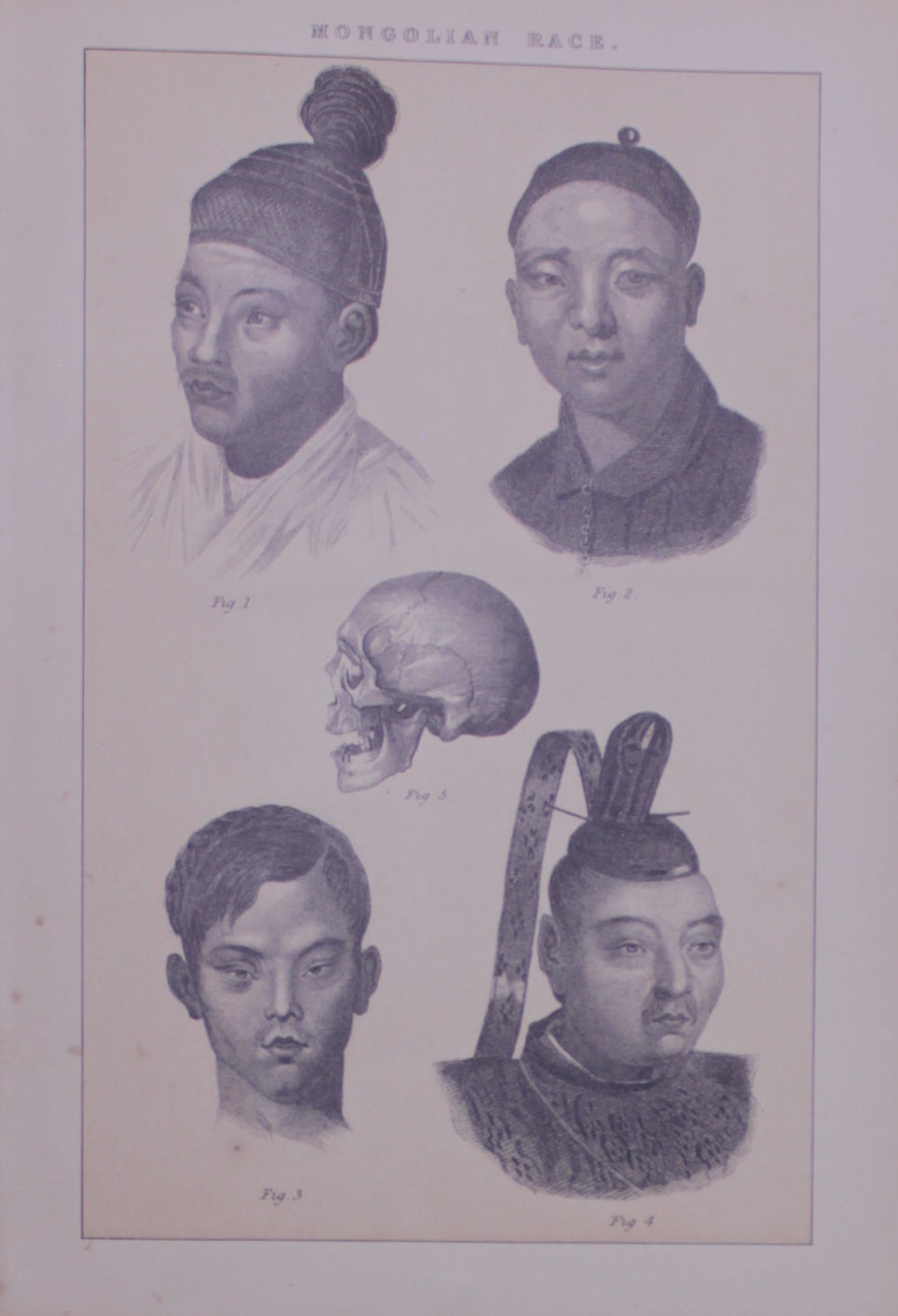
HUMAN RACE- MONGOLIAN.
FIG. 1.- South East of Asia Branch. A Man of the Island of Correa, from a Plate in M. Siebold's Work on Japan
FIG. 2. -Chinese. A Chinese of Macao, from a Portrait painted by Danloux.
FIG. 3. Siamese. Portrait of one of two twins exhibited in Europe in 1830; painted in Paris.
FIG. 4. -Japanese.
After a Portrait by M. Siebold.
Date: c1880
Publisher: Blackie & Son, London, Glasgow, Edinburgh, and Dublin
Paper Size: 250 x 170mm
Condition: Good
Technique: Lithograph
Price: $50
Description:
THE MONGOLOID NATIONS.
To this race belong the Polynesian and Asiatic Malays, the people of South-eastern and Eastern Asia, the Tibetese, some of the Himalayan tribes, all the Northern Asiatics, with their kinsmen in Northern Europe, and lastly the aboriginal population of America. The common characteristics of this widely spread race are long straight hair, circular in section; the almost complete absence of beard and body hair; skin dark-colored, varying from leather-yellow to deep brown, sometimes inclining to red; prominent cheek-bones, and eyes in general set obliquely. The various members of the Mongoloid race may be classed under the following subdivisions.
1. The Malay race, comprising the Asiatic Malays and the Polynesian or Pacific Malays. The former include, besides the Malays of the peninsula of Malacca, of Sumatra, the Sunda Islands, Java, &c., also the Dyaks of Borneo, the Battas of Sumatra, the Tagals and Bisayas of the Philippines, the Macassars and Bugs of Celebes, and lastly the inhabitants of Madagascar. The Polynesians include the New Zealanders, the natives of the Sandwich Islands, and those of the Marquesas, the Samoan group, the Friendly Islands, &c. No race belonging to the Malay stock has black skin, that of the Asiatic Malays is of a yellow hue; among the latter obliquity of the eyes is common. The Asiatic Malays are said to be taciturn, cruel, and revengeful, but dignified and polished in manners. They have long since adopted Islamism.
As regards natural abilities Wallace rates the Malays below the Papuans.
- Southern Asiatics with monosyllabic languages. This group comprises the Chinese, Indo-Chinese (Burmese, Siamese, Anamese, &c.), Tibetese, &c. They have all straight black hair, little beard or body hair, usually yellow skin, and oblique eyes. As is well known, a great portion of this family has attained a high degree of civilization, and is highly distinguished for inventiveness.
- Koreans and Japanese. These nations might be classed with the previous group, yet they display some well-marked peculiarities, and their languages are considerably different in structure. The Japanese received their civilization from the Chinese, but have made many advances themselves; and, very different from the Chinese, they have shown themselves ready to adopt what is valuable in European civilization.
- Northern Mongoloids of the Old World. These comprise the Tungus, true Mongols, Turks, Finns, and Samoieds, all much resembling the Chinese and Indo-Chinese group in physical characters, but living generally by hunting, fishing, and cattle-breeding. To the Tungus belong the Manchoos, who conquered China and established a dynasty there. The Mongols (or Tartars) include the Kalmucks, Buriats, &c.
Among the Turks are classed Uigurs, Usbecks, Osmanlis, Turcomans, Yakuts, Nogaians, Kirghis, &c. The Osmanlis are the Turks of European Turkey. The Finns comprise, besides the true Finns and the Lapps of Northern Europe, the Magyars or Hungarians, and the Bulgarians. The Samoieds are nearly allied to the Finns.
5. Northern Nations of doubtful position. The Yenisei Ostiaks, the Ainos of Yesso, the inhabitants of Saghalien, &c. The Yenisei Ostiaks form a small tribe on the Upper Yenisei and are quite distinct from the Ostiaks on the Oh. The Ainos are the oldest inhabitants of the Japanese islands. They are remarkable for their general hairiness, especially in the midst of smooth-skinned races, though they do not exceed Europeans in this respect.
6. The Behring's Nations. These are North Asiatic and American tribes, which for the most part inhabit the shores of Behring's Straits, or have migrated from that region.
The Esquimaux, or Eskimo, are the most important. They have oblique eyes, and broad, flat faces, and are of rather a low stature; their intelligence is decidedly good.
7. The American Aborigines. There can be little doubt that the original inhabitants of America crossed over from Asia, and the Mongol race is the only one with which they can be allied. Mongolian features are clearly marked among the natives of various parts of America, although generally, the nose is more prominent and the faceless flat. The color varies, a reddish copper colour being very prevalent. The great bulk of the American aborigines may be classed as hunting tribes. In North America they are now sadly diminished in numbers; among them, we may mention the Sioux (to which belong the Assineboins) and the Apaches.
The Caribs live in Central America, and in the north of South America. The Guarani (Gourani) are scattered over a great part of South America. At the time of the Spanish conquest, American civilization had reached a high pitch in Mexico and Peru.
Share