

Antiquarian Print Shop
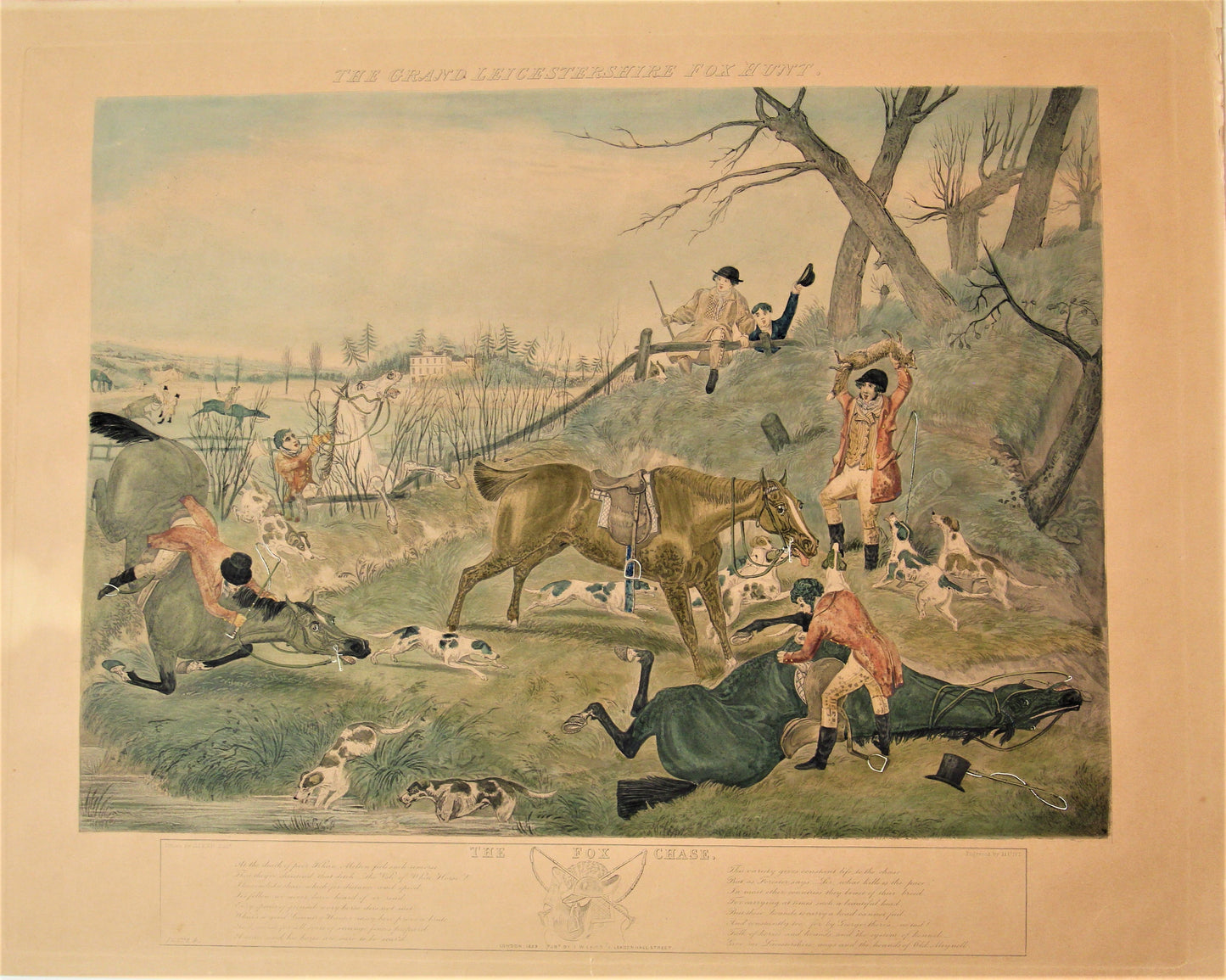
Sporting, Equestrian, Alken John, The Grand Leicestershire Fox Hunt, Set of 4 plates, 1839
Sporting, Equestrian, Alken John, The Grand Leicestershire Fox Hunt, Set of 4 plates, 1839
Couldn't load pickup availability
Series of Four Aquatints
The Grand Leicestershire Fox Hunt
The Fox Chase in the oblong cartouche
Date: 1839
Artist: Alken Henry
Engraver: Hunt
Publisher: Laird IW
Paper Size: 490 x 610mm
Print Size: 450 x 570mm
Plate1:450 x 570mm, Plate 2:450 x 570mm, Plate 3:450 x 570mm, Plate 4:450 x 570mm
Condition: Paper condition good though darkened with age. Some watermarks visible on Plates 2 and 3
Technique: Aquatint
Price: Set of 4 for $1,000
Description: Aquatint, hand-coloured and varnished in places
Provenance: The Fox Chase, set of 4 plates
Oblong Cartouche on each plate
In the Centre of cartouche is a colophon comprised of crossed whips, fox’s brush, saddle, stirrups and huntsman’s cap.
Description of each plate in cartouche
Biography
Alken Henry 1785 – 1851
Alken was born on 12 October 1785 in Soho, Westminster, and baptised on 6 November at St James's Church, Piccadilly. He was the third son of Samuel Alken, a sporting artist. Two of his brothers were George and Samuel Alken the Younger, also an artist. In 1789, the Alken family moved from Soho to 2, Francis Street East, Bedford Square.
Young Henry first studied under his father and then with the miniature painter John Thomas Barber Beaumont (1774–1841), also known as J. T. Barber.
In 1801, Alken sent a miniature portrait of Miss Gubbins to the Royal Academy Exhibition. He exhibited a second miniature at the Royal Academy before abandoning miniature painting and taking on painting and illustrating.
Early in his career, he painted sporting subjects under the name of "Ben Tally-O". Alken married Maria Gordon on 14 October 1809 at St Clement’s Church, Ipswich. On 22 August of the following year later the couple's first son was baptised. Alken went on to father five children, of whom two were artists, Samuel Henry, also a sporting artist, known as Henry Alken junior, and Sefferien junior.
From about 1816 onwards Alken "produced an unending stream of paintings, drawings and engravings of every type of field and other sporting activity," and his soft-ground etchings were often coloured by hand. When Alken was 26, he and his young family lived over a shop in Haymarket that belonged to print publisher Thomas McLean of the "Repository of Wit and Humour." McLean paid Alken a daily wage of thirty shillings, considered a good income at the time.
Alken died in April 1851 and was buried in Highgate cemetery. Although fairly affluent for most of his career, he fell on hard times towards the end of his life and was buried at his daughter's expense.
To learn more about the History of English Sport click here
Share