
Identifying Early 19th Century Etchings: A Collector's Guide
Table of Contents
- Understanding Printmaking Techniques: Etching, Engraving, and Lithography
- How to Identify Authentic Early 19th Century Etchings
- Antique Etching Plate Mark Identification and What It Reveals
- Paper Quality, Watermarks, and Condition Assessment
- How to Spot a Fake Antique Print: Detection Methods
- Original Etching versus Reproduction: Key Differences
- Hand-Coloured versus Printed Colour in Early 19th Century Prints
- Provenance, Authentication, and Standardised Condition Reporting
- Frequently Asked Questions
Last Updated: October 2, 2026
Understanding Printmaking Techniques: Etching, Engraving, and Lithography
Identifying early 19th century etchings requires understanding the fundamental techniques that distinguish them from other printmaking methods. The difference between etching, engraving, and lithography determines authenticity, value, and condition assessment for collectors.
Etching is an intaglio process where acid eats into a metal plate (usually copper) to create the image. The artist draws through a protective ground, exposing the metal beneath, then submerges the plate in acid. This creates recessed lines that hold ink. Engraving, another intaglio method, uses a burin tool to physically cut lines into the plate, a more laborious process that produces sharper, more precise lines. Lithography, by contrast, relies on the principle that oil and water don't mix. An image is drawn on a limestone surface with a greasy substance, then chemically treated so ink adheres only to the drawn areas.
Intaglio Methods: Etching and Engraving
Etching produces softer, organic line quality with irregular edges visible under magnification, while engraving produces uniform, V-shaped grooves with crisp, controlled lines. Early 19th century prints often combined both techniques.
Copperplate engraving dominated natural history illustration in the early 1800s. William Home Lizars' engravings for *The Recent Conchology of Great Britain and Ireland* (c. 1827) exemplify the technique, with precise line work creating depth and texture impossible with etching alone.

Relief and Surface Techniques: Lithography and Woodcutting
Lithography, which emerged in the 1790s, prints ink from a flat surface rather than recessed lines, producing softer edges, more uniform ink coverage, and subtle variations in ink density that reveal the stone's grain.
How to Identify Authentic Early 19th Century Etchings
Authenticity hinges on specific physical characteristics that reproductions struggle to replicate convincingly.
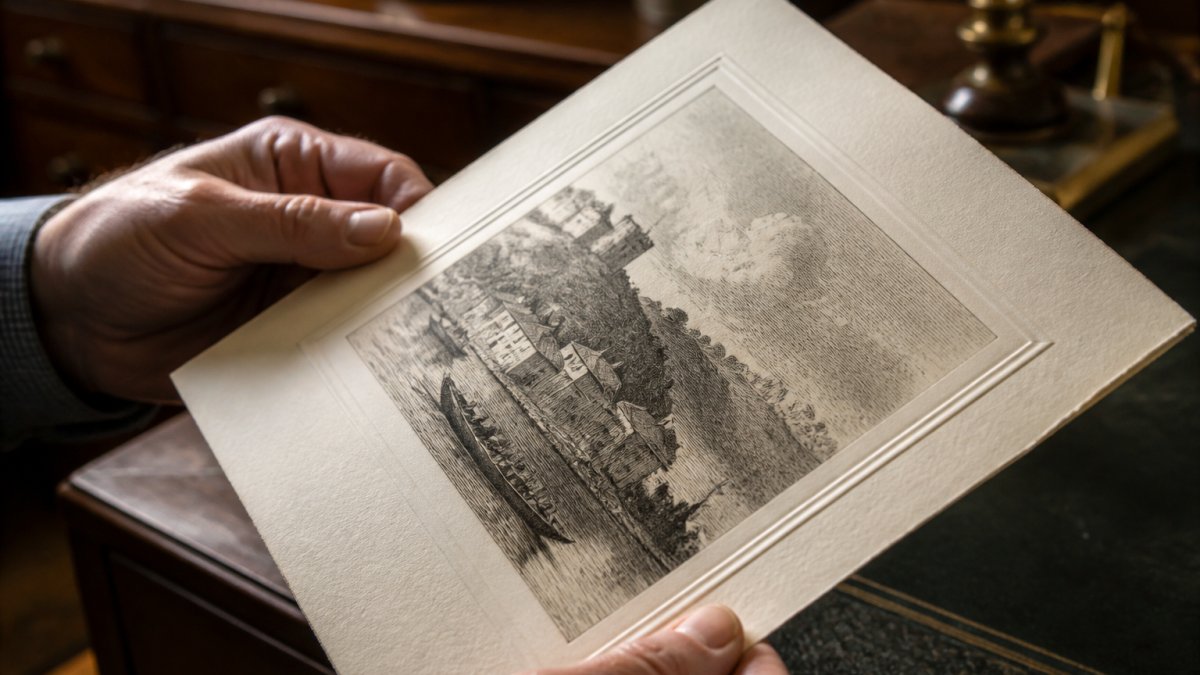
The first checkpoint is the plate mark: the embossed edge created when the metal plate pressed into paper under the enormous pressure of the printing press. This three-dimensional raised border is nearly impossible to fake without the original plate. Run your fingertip across the verso (back) of the print; you'll feel the depression that corresponds to the plate's edge. Modern reproductions printed on flat presses lack this tactile evidence.
Plate Tone and Ink Characteristics
Plate tone is the subtle film of ink left on the copper plate surface after wiping, deliberately retained by master printers to create atmospheric effects. Visible as a faint grey or brown haze, particularly in backgrounds, it's a reliable sign of skilled early 19th century printing.
Early 19th century printing inks were oil-based with specific mineral pigments.
Microscopic Analysis of Ink and Burr
Under magnification, examine the burr, the raised metal edge created by the engraving tool. Early impressions show sharp, crisp burr; later impressions show flattened burr as it wears with each printing.
Antique Etching Plate Mark Identification and What It Reveals
The plate mark is your most reliable authentication tool, the embossed edge where the metal plate pressed into dampened paper under the printing press.
Paper Quality, Watermarks, and Condition Assessment
The finest early 19th century prints used handmade rag paper with distinctive texture and weight that machine-made paper, introduced commercially in the 1850s, cannot match.
Laid Paper versus Wove Paper
Laid paper shows visible parallel lines when held to light, marks left by the papermaker's wire screen. Laid paper was standard for fine prints through the early 19th century. Wove paper, which shows no visible lines, became more common after the 1820s.
Seashells, Brown Captain Thomas, Bivalve Shells, Plate XLIX, 1827 →
Foxing, Mat Burn, and Age Indicators
Foxing, brown spots on aged paper, involves iron impurities, humidity, and fungal activity. Authentic foxing appears randomly distributed; uniform foxing suggests artificial aging.
How to Spot a Fake Antique Print: Detection Methods
Reproductions range from honest modern facsimiles to sophisticated forgeries. The most common fakes are 20th century reproductions printed on aged or artificially aged paper.
Digital Forgery Detection Techniques
Digital printing leaves detectable signatures despite producing visually convincing reproductions.
Original Etching versus Reproduction: Key Differences
An original print is pulled directly from the plate created by the artist or under their supervision. A reproduction is a later copy made from the original.
Hand-Coloured versus Printed Colour in Early 19th Century Prints
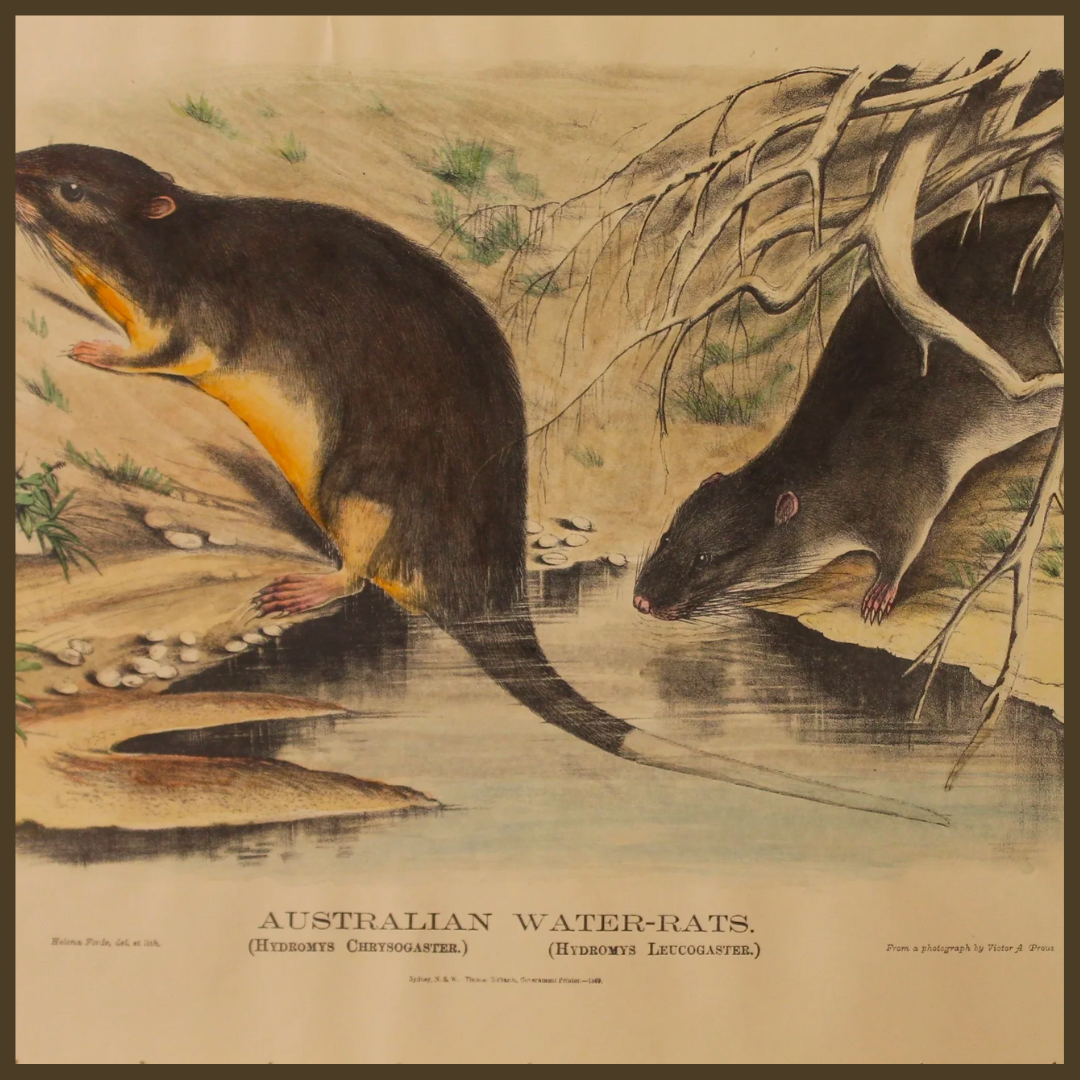
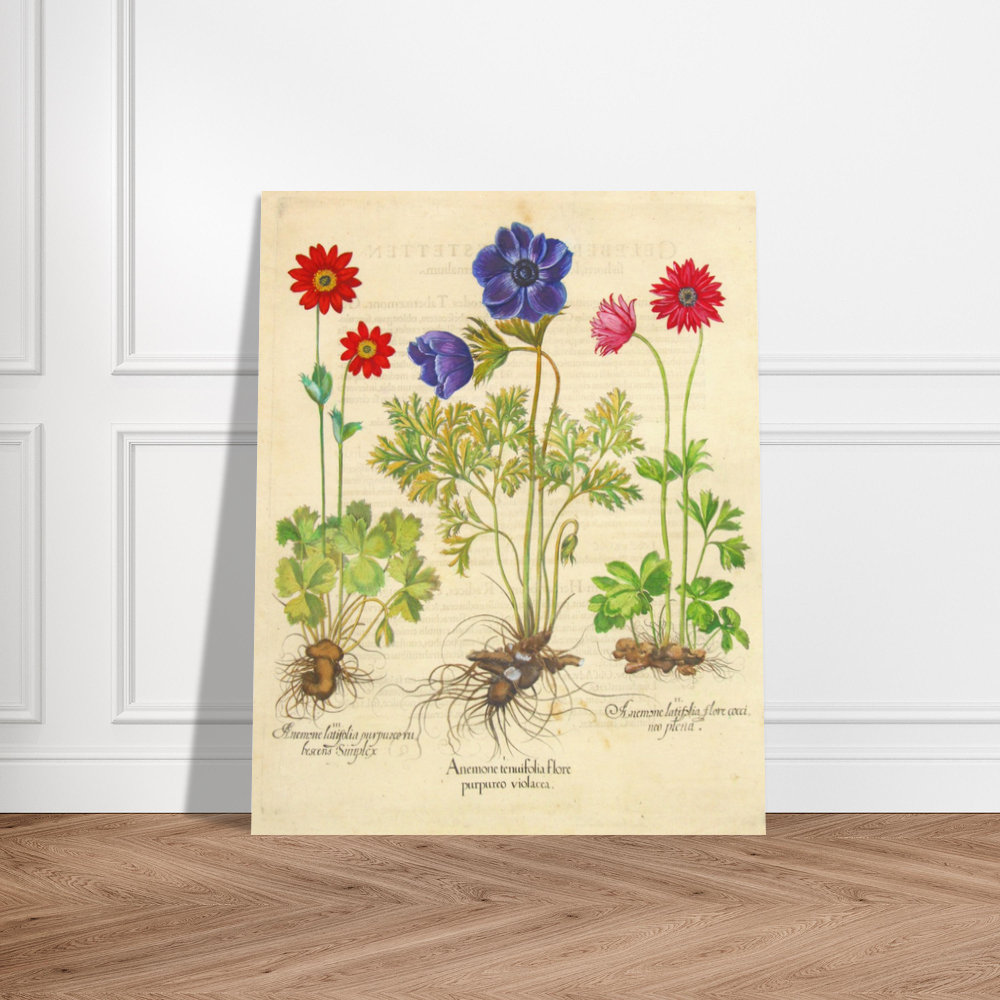
Hand-colouring was the standard method for adding colour to prints through the early 19th century. Artists employed teams of colourists who applied watercolour by hand, often following printed outlines. This labour-intensive process created variation between copies, no two hand-coloured prints are identical. Printed colour, by contrast, produces consistent results across all impressions.
Provenance, Authentication, and Standardised Condition Reporting
Provenance, the documented ownership history, is the gold standard for authentication. A print with a clear chain of ownership from a known collector or institution carries substantially more credibility than an orphaned piece. Collector's marks (stamps or signatures on the verso) provide evidence of provenance. These marks, when they belong to known collectors, add authentication value.
Common condition issues include:
| Condition Issue | Appearance | Impact on Value |
|---|---|---|
| Foxing | Brown spots scattered across paper | Moderate reduction; expected in aged prints |
| Mat burn | Darker stain where mat contacted print | Minor reduction; indicates display history |
| Creasing | Visible fold lines in paper | Significant reduction; suggests mishandling |
| Margin loss | Paper edge trimmed away | Major reduction; affects plate mark visibility |
| Staining | Discolouration from water or other contact | Significant reduction; suggests poor storage |
| Fading | Colour loss, particularly in hand-colouring | Moderate reduction; expected in aged prints |
Frequently Asked Questions
How can you tell if an etching is original?
Original etchings display several defining characteristics: a visible platemark (the raised edge created when the copper plate pressed into paper), consistent ink tone with natural plate tone variation, and evidence of hand-colouring with period-appropriate pigments. Examine the paper under magnification for burr marks left by the etcher's needle, and check the verso for collector's marks or provenance notes. Reproductions lack the platemark's dimensional quality and show uniform, printed colour rather than hand-applied pigment.
What is the difference between an etching and a reproduction?
An original etching is pulled directly from an acid-etched copper plate, creating unique impressions with slight variations between prints. Each impression bears a platemark and shows individual characteristics like plate wear and ink variation. A reproduction is a modern copy created photographically or digitally, printed on a flat surface without a platemark, with uniform colour and no evidence of hand-work. Original etchings from the early 19th century command higher prices and hold investment value; reproductions are affordable alternatives for collectors without authentication concerns.
How do I identify a plate mark on an antique etching?
The platemark appears as a raised, embossed rectangular border around the printed image. Run your finger across the edge of the print, you'll feel the three-dimensional ridge where the copper plate compressed the paper fibres. Tilt the print under light to see the shadow cast by this raised edge. On the verso (back), you may see an indentation corresponding to the platemark. This physical characteristic is impossible to replicate in reproductions and is one of the most reliable indicators of an authentic intaglio print like an etching or engraving.
How can you spot a fake antique print?
Examine the paper for anachronistic characteristics: modern laid paper patterns, bleached-white fibres, or uniform thickness uncommon before 1850. Check for printed colour that appears flat and consistent rather than hand-applied with visible brushstrokes. Look for signs of digital manipulation under magnification, pixelation, uniform dot patterns, or ink that sits on the surface rather than embedding in paper fibres. Verify provenance through auction records, museum catalogues, or reputable dealer documentation. Posthumous prints and later editions should be clearly labelled; if unmarked, they may be misrepresented as first impressions.
Are early 19th-century etchings valuable?
Yes, authentic early 19th-century etchings hold significant investment potential, particularly those by recognised artists or from rare first editions. Natural history etchings, such as those by William Home Lizars, are highly sought by collectors. Rarity, condition, provenance, and artist reputation determine value. Original hand-coloured etchings typically appreciate over time, while later impressions and reproductions hold modest value. Professional appraisal is recommended for significant purchases to verify authenticity and establish market value.
What should I look for in paper quality when identifying 19th-century etchings?
Authentic early 19th-century etchings were printed on laid paper or wove paper with visible watermarks indicating the papermaker and often the date. Hold the print to light to see the watermark clearly. Laid paper shows parallel lines from the papermaking process; wove paper appears more uniform. The paper should feel slightly textured, not glossy. Foxing (brown spots from oxidation) and mat burn (darker edges from framing) are natural aging signs. Modern reproductions often use bright white, uniform paper without watermarks or period-appropriate texture, making them easily distinguishable from originals.
Do 19th-century etchings require professional appraisal?
Professional appraisal is advisable for valuable acquisitions, particularly if you plan to insure the print or establish provenance for investment purposes. A qualified appraiser can verify authenticity, assess condition, identify the artist and edition, and provide documentation for insurance and resale. For less expensive pieces or reproductions, careful personal examination using the techniques outlined here, checking for platemark, paper quality, hand-colouring, and provenance, may suffice. Reputable dealers like Antiquarian Print Shop provide detailed condition reports with each original print, supporting your confidence in the purchase.