
Choosing Antique Architectural Prints for Classic Home Design
Last Updated: November 15, 2026
Quick Summary
Choosing antique architectural prints for classic home design means matching the print's subject and era to your home's period features, such as window shape, cornice profile and fireplace surround. Buy originals with a visible plate mark where budget allows, and frame them archivally so the paper is never trimmed or taped down.
- Identify your home's era first, then choose prints recording the same kind of building or ornament.
- Original prints show a plate mark and laid paper texture; reproductions are modern copies.
- Hang artwork so its width is roughly two-thirds the width of the furniture below it.
- Use acid-free mount board and keep glass from touching the paper to prevent damage.
- Space gallery wall frames 5-8 cm apart and keep the group's centre around 145-155 cm from the floor.
Table of Contents
- Why Antique Architectural Prints Suit Classic Homes
- Matching Subject Matter to Your Home's Architectural Era
- Original Antique Prints vs Reproductions: What You Are Actually Buying
- Antique Print Condition and Authenticity: What to Check Before You Buy
- Sizing and Placement: Getting Scale and Proportion Right
- How to Frame Antique Prints Without Causing Harm
- Planning an Architectural Prints Gallery Wall
- Building Your Collection with Antiquarian Print Shop
- Frequently Asked Questions
Why Antique Architectural Prints Suit Classic Homes
Antique architectural prints are original engravings, etchings and lithographs that record buildings, ornament and design, and they suit classic homes because they share the same visual language as period architecture. A house with cornices, architraves and deep skirting boards suits wall art that speaks the same dialect.
That is the throughline of this guide. Choosing antique architectural prints for classic home design is less about finding something pretty and more about matching the print to the room it will live in.
Below, we cover how to read your home's period features, how to separate originals from reproductions, what to check before you buy, and how to frame and hang a print without harming it.
Matching Subject Matter to Your Home's Architectural Era
Start with the building, not the print. A Georgian cottage and a Federation villa are different canvases, and the subject matter should follow the architecture rather than fight it.
For a Georgian home, roughly 1788 to 1840, the architecture is symmetrical, restrained and Palladian in influence.
For a Victorian home, roughly 1840 to 1901, the architecture is more ornamented and eclectic, with Gothic Revival, Italianate and Queen Anne variants.
For a Federation home, roughly 1890 to 1915, the architecture combines Arts and Crafts informality with Australian motifs and red brick.
For an Interwar home, roughly 1918 to 1939, the architecture ranges from Californian bungalow to Art Deco.
Reading period features is the fastest way in. Once the period is clear, artfully inspired prints for home decor can echo its lines and motifs without making the room feel like a reconstruction.
Browse our architecture collection to find prints grouped by period and subject.
Reading Period Features to Guide Your Print Choice
Walk the room and note three things: window proportions, ceiling height and trim style. Tall windows with slender glazing bars point one way; square windows with heavy mouldings point another. A ceiling rose and deep cornice suggest a formal room where a symmetrical elevation print will hold its own; a simple square-set cornice suggests a room that takes a lighter, smaller print.
Match the print's own proportions to those features. A vertical engraving echoes a tall window; a wide plan suits a long wall above a sideboard. If the room has a strong architectural feature, an arched doorway, a fireplace with a carved surround, choose a print that repeats that shape rather than introducing a conflicting geometry.
Watch out: a print that records a building of the same era but a wildly different scale, a cathedral elevation in a small cottage room, can overwhelm the space even when the period is right. Match subject and scale together.
Original Antique Prints vs Reproductions: What You Are Actually Buying
An original antique print is a sheet printed from a plate made at the time of publication, while a reproduction is a modern copy of that image. The difference matters for price, longevity and the way the piece ages on your wall.
Original prints carry the plate mark, the paper tone and the slight irregularities of hand printing. Reproductions are cleaner, cheaper and often printed on modern stock that will not behave the same way over decades.
Neither is a mistake. What matters is that you know which one you are buying, and that the price reflects it.
A Price Guide to Originals, Reproductions and Custom Prints
| Option | Typical Price Band | What You Get | Best For |
|---|---|---|---|
| Entry-level original engraving | Around $190 | Genuine antique sheet, some foxing, smaller image | First purchase, smaller walls |
| Mid-range original | Around $595 | Good condition, hand-coloured, strong plate mark | Feature walls in period rooms |
| Premium original | Around $695 | Excellent condition, notable artist or publisher | Collectors, investment-minded buyers |
| Reproduction | Lower band | Modern copy of a historic image | Budget decorating, high-traffic rooms |
| Custom print | Made to your dimensions | Sized to fit an awkward wall | Non-standard spaces |
Our catalogue includes the du Cerceau engraving at $190, an Inigo Jones plate at $595, and the Burlington Westminster drawing at $695.
If you want to understand how to spot the difference in person, read our guide on how to tell if your print is an original.
Typical price bands for antique prints and reproductions
Antique Print Condition and Authenticity: What to Check Before You Buy
Condition and authenticity are the two questions that decide whether a print is worth its price. Check them before you fall in love with the image.
Look for the plate mark, a faint indentation around the image where the press pushed the paper into the plate. Check the paper for chain lines and laid texture.
Then assess condition honestly. Foxing, the brown spotting caused by age and moisture, is common and not always a dealbreaker. Tears, trimmed margins and heavy staining are more serious.
Our article on how to identify authentic antique prints walks through the checks in more detail.
Printmaking Methods, Paper and Foxing
The method tells you a lot about what to expect. Copperplate engraving produces fine, crisp lines and a strong plate mark. Etching gives a softer, more fluid line. Lithography allows broader tonal range. Woodcut is bolder and more graphic.
Paper matters just as much. Antique prints were usually printed on laid or wove paper with a visible texture and a warm tone that modern paper cannot replicate.
Foxing is the main condition issue you will meet. It is caused by age, humidity and the metal particles in older paper, and it ranges from a few faint spots to heavy mottling. Light foxing to the edges is normal and often priced in. Heavy foxing across the image is a reason to pause.
Sizing and Placement: Getting Scale and Proportion Right
The most common mistake we see is a print that is too small for its wall. A small frame floating on a large expanse looks lost, no matter how good the engraving is.
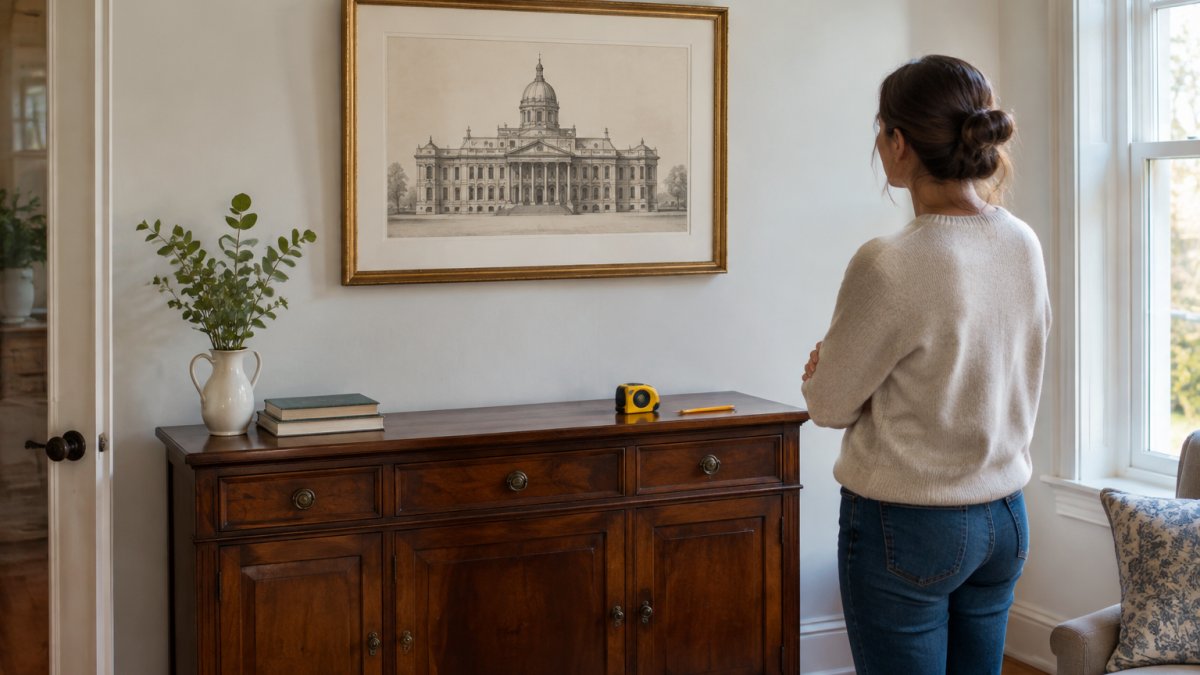
A useful rule: hang the artwork so its width is roughly two-thirds the width of the furniture below it. That single proportion fixes most placement problems.
For height, aim for the centre of the print to sit at eye level, or around 15-30 cm above the top of the furniture. In rooms with high ceilings, you can hang higher without the print feeling stranded.
The woman is Australian.
How to Frame Antique Prints Without Causing Harm
Framing is where good prints get ruined. The wrong materials cause acid burn, condensation and permanent staining, and the damage often appears years later.
Use acid-free mount board and a frame deep enough that the glass does not touch the paper. Add a spacer or a mount to keep a gap. Avoid sticking the print down with tape, and skip backing boards that are not acid-free.
Hang the frame away from direct sun and away from heat sources. Ultraviolet light fades ink, and a hot spot behind glass encourages foxing.
Our guide on how to frame antique paper prints covers the materials and steps in full.
Watch out: trimming a print to fit a standard frame destroys its margins and much of its value. Always frame to the print, never the other way around.
Planning an Architectural Prints Gallery Wall
A gallery wall works best when the arrangement follows a logic, not a whim.
Start by measuring the available wall. Mark the width and height you have to work with, then subtract the gaps you plan to leave.
Decide the layout before you buy or hang anything. Three layouts work reliably for architectural prints:
- Grid: equal-sized frames in even rows and columns. Best for a set of prints from the same publication or series, and the most formal option.
- Salon: a large central print with smaller pieces balanced around it. Suits a mix of sizes and a feature wall above a fireplace or sideboard.
- Linear: a single row of prints at the same centre line. Works well in hallways and above long furniture where a grid would feel heavy.
Lay the arrangement out on the floor first.
Wall type matters. On plaster walls, use the appropriate fixings and avoid hanging heavy frames from a single point; on brick or masonry, masonry anchors are needed.
Mix vertical and horizontal pieces only when the grid still reads as a set.
Our step-by-step guide on creating an antique print gallery wall takes you through measuring, templating and hanging.
Watch out: hanging the frames before checking the layout against the furniture below often leaves the group too high or off-centre.
Building Your Collection with Antiquarian Print Shop
Building a collection is a slow process, and that is the point. Buy one good print rather than three mediocre ones, and let the wall grow as you learn what the house wants.
We offer a curated selection of over 1,200 authentic original antique prints, alongside high-quality reproductions and custom print options. Our collections include botanical, bird and fashion prints.
Start with a single architectural engraving that matches your home's era, then build outward from there.
A classic home deserves wall art that earns its place, and the right print will outlast every trend that passes through the room. Antiquarian Print Shop can help you find it, with a curated collection of original and reproduction prints, traditional printmaking methods, and custom sizing to fit your space. Get started with Antiquarian Print Shop and hang a piece of architectural history on your wall.
Frequently Asked Questions
How can you tell whether an architectural print is an original antique?
Look at the paper, the ink and the impression. Originals from the 16th to 18th centuries were printed from copperplates, so you can usually feel a plate mark, a slight embossed border where the plate pressed into the paper. Paper should show even ageing, not the bright white of modern stock, and hand colouring sits unevenly within the lines. Ask for the date, artist, engraver and paper size, and compare the listing against known copies. Reproductions are usually printed with even, dot-based colour and no plate mark.
Should antique architectural prints be framed with glass?
Yes, but not touching the print. Glass protects the surface from dust and handling, and UV-filtering glass slows fading from light. Use acid-free mounts or spacers so the paper never presses against the glass, and keep the frame backing acid-free. Avoid sealing a print directly against glass, because condensation can cause foxing and staining over time. If the print is valuable, ask a framer to use conservation mounting so the process can be reversed.
How do you arrange a group of architectural prints?
Plan the group on paper or the floor first, using a consistent gap of about 5 to 8 cm between frames. Keep the centre of the arrangement at roughly eye level, and align outer edges so the set reads as one shape. A grid suits prints of the same size, while a salon-style hang works for mixed sizes. Keep subject matter coherent, for example Palladian elevations together, and leave at least 15 to 30 cm between the group and nearby furniture.
What is the difference between an antique print and a reproduction?
An antique print was printed from the original plate or block at or near the time it was published, often centuries ago. A reproduction is a modern copy of that image, usually printed digitally or offset. Originals carry a plate mark, period paper and natural ageing, and their price reflects rarity and condition. Reproductions are far cheaper and let you fill a large wall or awkward space, especially with custom sizing. Both are legitimate choices; just know which one you are paying for.