
7 Ways to Display Vintage Fashion Art in Modern Homes
Last Updated: November 1, 2026
Quick Summary
Display vintage fashion art by choosing one focal wall, limiting vintage pieces to three to five per room, and framing prints in slim black, natural timber or brushed metal. Hang a single frame centred around 145cm from the floor, or size artwork to roughly two-thirds the width of the furniture below it.
- Keep gaps of around 5-7cm between frames in a gallery wall, widening to 8-10cm for deep frames or large walls.
- Hang a bedroom piece with the frame centre about 145cm from the floor or 15-20cm above the furniture.
- Place a living room print with the frame bottom about 20-25cm above the sofa back.
- Hang hallway art slightly higher, centred around 150-155cm from the floor, because you view it standing.
- A 1960s Mode Studio print at $60 is a smart first buy for small walls and first-time buyers.
Table of Contents
- Start With a Focal Point: Where Vintage Fashion Art Belongs
- How to Mix Vintage and Modern Decor Without Clutter
- Vintage Art Gallery Wall Ideas That Look Collected, Not Crowded
- Framing Antique Prints: Styles That Suit a Modern Interior
- Protecting Antique Prints From Sunlight and Everyday Damage
- Room-by-Room Placement for Fashion Illustrations and Advertising Prints
- Choosing Your First Vintage Fashion Print to Display
- Frequently Asked Questions
Start With a Focal Point: Where Vintage Fashion Art Belongs
The best place for vintage fashion art in a modern home is the wall you look at first when you walk into a room. That prominent position gives the artwork a job: it anchors the space and draws the eye before anything else.
A single framed fashion illustration above a low sofa will do more than six prints scattered across a hallway. One strong focal point beats a busy wall every time.
So pick your hero wall first. Then plan everything else around it.
Measuring Height, Spacing and Scale Before You Hang
For scale, aim for artwork that covers roughly two-thirds of the width of the furniture below it. A print above a sofa that's too small looks lost. Too big and it crowds the room.
Before you drill, mock it up:
- Cut paper to the exact frame size
- Tape it to the wall with masking tape
- Step back and check the balance
- Adjust before you commit to a hook
This five-minute step saves patched holes and regret.
How to Mix Vintage and Modern Decor Without Clutter
Mixing vintage and modern decor works best when you limit the vintage pieces and let them lead. Choose three to five collected pieces per room, then keep the rest of the styling quiet.
The trick is contrast, not competition. A 1960s fashion print in a slim black frame against a plain white wall reads as intentional. The same print surrounded by thrifted decor, patterned cushions and busy wallpaper reads as noise.
A few rules we follow:
- Keep the wall colour neutral so the artwork carries the colour
- Repeat one frame style across the room to tie pieces together
- Leave breathing room between frames and furniture
- Let one piece be the boldest thing in the space
Nostalgia works when it's edited. Clutter kills it.
Vintage Art Gallery Wall Ideas That Look Collected, Not Crowded
A good vintage fashion gallery wall looks collected over time, not bought in one afternoon. The secret is a shared thread: a colour palette, a subject, or a frame style that unifies the group. For fashion art, that thread is easy to define and easier to break, so decide it before you buy a single frame.
Pick Your Unifying Thread Before You Hang
Fashion art spans couture illustrations, editorial photography, advertising prints and sewing-pattern covers. Grouping across those categories works only when one visual element repeats. Choose one of these threads and hold to it:
- Era: all 1920s, all 1960s, all 1970s. A row of 1960s Mode Studio prints in matching frames feels deliberate; a 1920s chromolithograph beside a 1980s poster feels accidental.
- Palette: keep to one colour family, say, muted rose and cream, or black-and-white with a single red accent. This is the easiest thread to maintain when you buy piece by piece.
- Subject: all dressmaking patterns, all couture house advertisements, all fashion photography. Subject-led walls read as a collection rather than a scatter.
- Frame finish: one finish across the wall, slim black, natural timber, or brushed metal, ties mismatched eras together.
A common pattern among collectors is to let the largest piece set the thread, then buy only pieces that repeat it. If a print doesn't repeat the thread, it belongs on a different wall.
Plan the Layout With Real Measurements
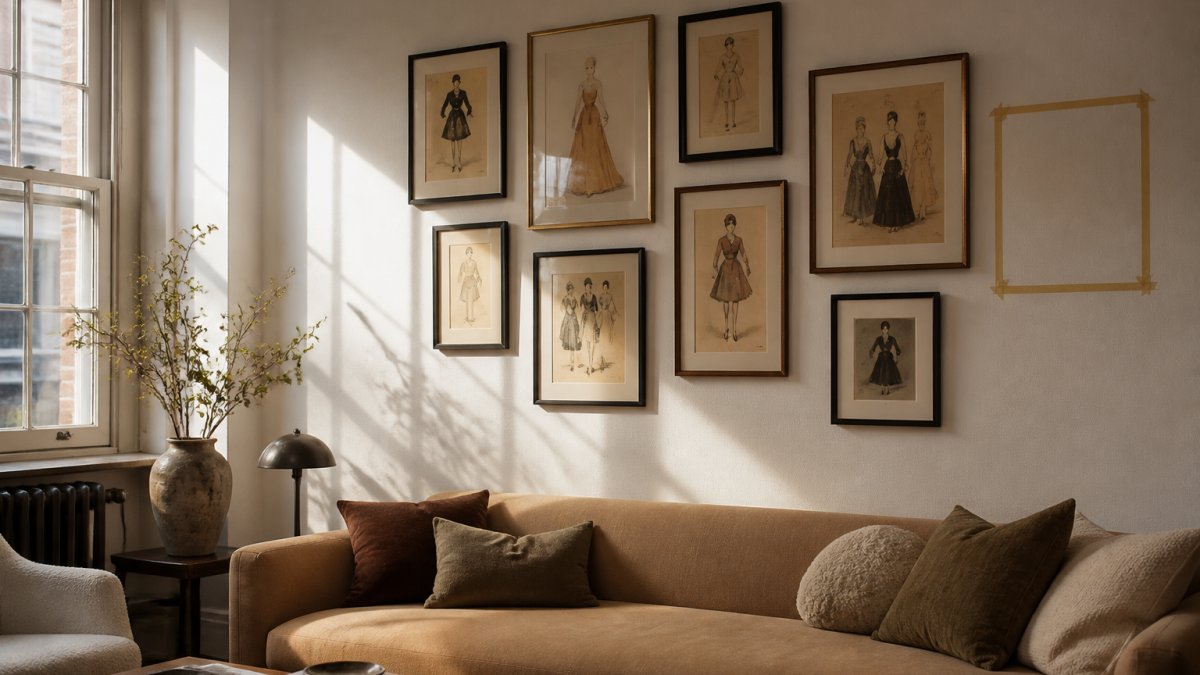
Start with the largest piece and build outward. Keep gaps even, around 5-7cm between frames is a reliable default for a tight, collected look; widen to 8-10cm if the frames are deep or the wall is large. Treat the whole group as one shape: the outer edges of the arrangement should form a rough rectangle or square, not a ragged blob.
Before you drill, mock it up:
- Cut paper to the exact outside frame size for every piece.
- Tape the papers to the wall with masking tape, starting with the largest in the centre.
- Step back to check the outer shape and the gaps.
- Adjust the papers until the group reads as one unit, then mark the hook points.
This five-minute step saves patched holes and regret. For a proven step-by-step method, our guide on how to create an antique print gallery wall step by step walks through the full process.
Renter-Friendly Layouts Using Masking Tape and Hooks
Renting doesn't mean bare walls. Map the whole layout in masking tape first. Measure twice, tape once, then hang. Keep the heaviest piece on a stud or use a rated hook with a wide backing plate. You get the gallery wall without the deposit drama.
When to Stop Adding
A gallery wall stops looking collected and starts looking crowded when the gaps close up or the threads multiply. If you can count more than two threads, say, two eras and three frame finishes, remove pieces until one thread leads. Nostalgia works when it's edited.
Framing Antique Prints: Styles That Suit a Modern Interior
Slim frames suit modern interiors best. A thin black, natural timber or brushed metal frame lets an ornate antique print feel current instead of dusty.
Fashion of the 60s, New Lines from the Fashions in Vienna, Mode Studio, A4313 →
Skip heavy gilded frames unless the room is traditional. They fight a modern scheme. A simple frame with a wide white mat gives the artwork room to breathe and lifts the colours.
Our guide on how to frame antique paper prints covers the materials and methods in detail.
Protecting Antique Prints From Sunlight and Everyday Damage
Sunlight is the biggest threat to antique prints. Ultraviolet light fades inks and yellows paper, and the damage can't be reversed. Keep prints off walls that get direct sun, or fit UV-filtering glass.
Everyday damage adds up too:
- Hang away from heat sources and steamy rooms
- Dust with a soft dry cloth, never a wet one
- Keep prints out of damp areas like bathrooms
- Handle paper by the edges only
If you're matting a piece yourself, get the materials right.
Room-by-Room Placement for Fashion Illustrations and Advertising Prints
Fashion illustrations and advertising prints suit different rooms. Match the mood of the art to the mood of the space, then use the measurements below to place it so it looks intentional rather than improvised. This room-by-room approach is the practical step most display guides skip.
Bedroom or Wardrobe
Soft fashion illustrations in pale palettes suit bedrooms and dressing areas. Hang a single piece or a tight pair centred above the bedhead or a dresser, with the centre of the frame about 145cm from the floor, or roughly 15-20cm above the top of the furniture, whichever reads better in the room. Keep the palette quiet so the room stays restful. Avoid direct sun on the wall; morning light through a curtain is enough to fade inks over time.
Living Room
Bold advertising prints work as a focal point. Hang above a low sofa so the artwork covers roughly two-thirds of the sofa's width, with the bottom of the frame about 20-25cm above the sofa back. If you group pieces, treat the group as one shape and keep the gaps at 5-7cm. This is the room where a single strong print beats a busy wall.
Hallway
A slim vertical print suits a narrow gap between doors or at the end of a corridor. In a hallway, hang slightly higher than in living areas, centre around 150-155cm from the floor, because you view it standing and moving. One well-placed print beats a crowded cluster in a hallway; if the wall is long, use a row of same-size frames with even gaps rather than mixed sizes.
Home Office
A single statement fashion photography piece works best where you sit and look up. Place it at seated eye level, centre around 120-130cm from the floor, or on the wall you face, not behind you. Keep it off the wall that takes the strongest screen glare.
Scale Rules That Apply in Every Room
- In small rooms, one well-placed print beats a crowded cluster.
- In large rooms, group pieces to fill the wall without gaps that look accidental.
- Keep the centre of a single frame around 145cm from the floor unless furniture dictates otherwise.
- Leave at least 20cm between the bottom of the frame and the furniture below it.
Choosing Your First Vintage Fashion Print to Display
Start with one piece you love, then build around it. For a first buy, a 1960s fashion print is a smart entry point: affordable, colourful and easy to frame.
Our Fashion of the 60s print from Mode Studio is a good example. If you want something rarer, a French 1920s chromolithograph like our Les Grands Modeles No 14 at $130 brings real couture history to a wall.


For collectors, a hand-coloured steel engraving such as The Fashions, La Mode Illustree in Paris c1884 at $350 is a serious piece.

Two guides help you choose well: our collectors' guide to rare antique fashion illustrations and our curated guide to vintage fashion print collections online.
| First print option | Price | Best for |
|---|---|---|
| Fashion of the 60s, Mode Studio, 1965 | $60 | First-time buyers, small walls |
| French Les Grands Modeles, 1920s | $130 | A statement piece with couture history |
| La Mode Illustree, Paris, 1884 | $350 | Collectors wanting a rare engraving |
Displaying vintage fashion art well comes down to one good focal point, a shared thread, and materials that protect the paper. That's where we can help. Antiquarian Print Shop curates over 1,200 authentic original and reproduction prints, including fashion collections, with custom print options available in multiple sizing formats.
Frequently Asked Questions
How do you display vintage fashion art in a modern home without it looking old-fashioned?
Keep the surrounding pieces simple and let the print carry the detail. Hang vintage fashion art on a plain painted wall, use a slim frame rather than an ornate one, and pair it with contemporary furniture in neutral tones. Grouping two or three prints in a tight grid reads as a deliberate collection rather than scattered decoration. A single larger piece above a modern sideboard often works better than many small frames spread across a wall.
What frames work best for vintage fashion prints?
Slim timber or matte black frames suit most modern interiors because they hold the eye on the artwork rather than the border. A wide acid-free mat keeps the print off the glass and gives it breathing room.
How high should vintage wall art be hung?
The centre of the artwork should sit roughly 145 to 150 centimetres from the floor, which is about eye level for most adults. Above a sofa or sideboard, leave 15 to 25 centimetres between the furniture top and the bottom of the frame. For a gallery wall, lay the frames on the floor first, measure the full arrangement, then mark the outer corners with masking tape before drilling anything.
Can vintage fashion prints work in a minimalist room?
Yes, and they often work best there. A minimalist room gives a single fashion illustration or advertising print room to be the focal point. Choose one piece with strong colour or line work, frame it in a thin profile, and avoid filling the rest of the wall. Original prints from the 1960s or 1920s French fashion catalogues carry enough detail on their own without extra styling around them.