
7 Basement Risks That Damage Antique Prints
Quick Summary
An antique prints basement is one of the worst places to keep paper prints, because damp air, cold walls and flooding risk all damage old paper. Conservators aim for 45-55 per cent relative humidity, kept within about ±5 per cent daily.
- Conservators generally aim for 45-55 per cent relative humidity in storage.
- Above roughly 65 per cent humidity, distortion, foxing and mould risk all rise.
- Below about 40 per cent, paper becomes brittle and can crack or flake.
- Keep prints off the floor on sturdy shelving and away from exterior walls.
- Use acid-free board, archival tissue and polyester sleeves, never tape or PVC.
Table of Contents
- Why Basements Are a Problem for Paper Prints
- Humidity Levels That Threaten Antique Prints
- Mould, Mildew and Pest Damage in Damp Storage
- Water Damage, Leaks and Flooding Scenarios
- How to Store Antique Prints Safely If a Basement Is Your Only Option
- Acid-Free Materials and Enclosures That Reduce Risk
- Booking a Condition Check Before Your Next Storage Decision
- Frequently Asked Questions
Why Basements Are a Problem for Paper Prints
Last Updated: November 9, 2026
Antique prints are paper, and paper reacts to its surroundings. Our guide on how to identify authentic antique prints explains how to confirm what you have before you decide where to store it. An antique prints basement is one of the worst places in a home to keep them. Damp air, cold walls and the risk of flooding all work against old paper. This guide covers the main risks, and what to do if a basement is your only option.
Paper absorbs moisture from the air. When it takes in water, it swells, warps and can start to stain. Once the moisture dries, the paper may cockle and stay distorted. Old paper is often more fragile than it looks, so repeated cycles of damp and dry can cause lasting harm.
Basements are also prone to:
- High relative humidity, especially in summer
- Temperature swings between seasons
- Poor air circulation, which lets mould settle
- Water seepage through walls or floors
- Pests such as silverfish and paper-eating insects
Most people store prints in basements because it is out of sight, not because it is suitable. Storing an antique prints basement collection is a trade-off worth reconsidering before the prints are put away.
Humidity Levels That Threaten Antique Prints
Humidity is the biggest single threat to paper prints in a basement, and it is also the one you can measure and manage. Paper is hygroscopic: it takes on and gives off moisture as the air around it changes, and every swing forces the fibres to expand and contract. Conservators generally aim for a stable relative humidity in the range of 45-55 per cent, with fluctuations kept within about ±5 per cent over a day.
Above roughly 65 per cent relative humidity, the risks multiply. Paper and inks absorb moisture and begin to distort. Foxing, the brown spotting seen on old paper, becomes more likely, because the iron and other impurities in the sheet become mobile in damp conditions. Mould spores, which are always present in the air, find the conditions favourable to grow. Below about 40 per cent, paper becomes brittle and can crack or flake, and some inks and pigments are more prone to flaking when the sheet is dry and stiff. The goal is stability, not a particular extreme.
Basements rarely sit in that band on their own. A common pattern is for relative humidity to climb through summer and autumn, when warm air carries moisture into the space, and to fall in winter as heating dries the air. The swing between seasons is often more damaging than a steady but slightly high reading, because repeated expansion and contraction weakens the paper and can loosen media from the surface.
A simple hygrometer placed near stored prints will show whether the room is swinging too far in either direction. Inexpensive digital units are adequate for home use; look for one that records minimum and maximum readings so you can see the range across a day, not just the figure at the moment you check. Watch the readings across a full season, not just one afternoon.
Watch out: a hygrometer placed on a shelf near an exterior wall can read several points higher than the air in the middle of the room, so position it where the prints actually sit rather than where it is convenient. Maintaining this precise environmental awareness prevents the insidious chemical degradation often discussed at LagomDesigns, where the underlying mechanisms of why art prints fade over time are explored in greater detail.
Relative humidity sets the stakes for paper prints, and the article gives clear bands to watch for.
| Relative humidity | Effect on prints |
|---|---|
| 45-55 per cent | Conservator target range |
| ±5 per cent daily | Acceptable fluctuation |
| Above 65 per cent | Distortion, foxing and mould risk |
| Below 40 per cent | Brittleness, cracking and flaking |
Mould, Mildew and Pest Damage in Damp Storage
Mould and mildew are among the most common reasons basement-stored prints are damaged. Mould spores are always present in the air (Mould). They need moisture and still air to take hold, and basements often supply both. Once mould is active, it can eat into the paper fibres and leave permanent marks, and it can spread to neighbouring prints through shared folders and boxes.
Signs of mould on paper include fuzzy or powdery patches, often grey, green or black; a musty smell coming from a folder, box or frame; and stains that spread outward from one spot. Pests add another layer of risk. Silverfish, book lice and rodents are drawn to damp paper and starch-based glues. Their damage can look like tiny holes, nibbled edges or droppings.
Most guides stop at describing the signs. The more useful question is what to do when you find them, so here is a practical recovery sequence.
- Isolate the item. Remove the suspect print from the room and place it in a sealed polyethylene bag or a clean, dry box away from the rest of the collection. Do not carry it through the house open, as moving air can spread spores.
- Protect yourself. Wear nitrile gloves and a P2 or N95 respirator when handling mouldy paper, and work in a well-ventilated area or outdoors on a dry day.
- Do not wipe or vacuum the surface. Dry-brushing or vacuuming mouldy paper drives spores into the fibres and can tear fragile sheets. Leave active mould removal to a conservator.
- Dry the item slowly. If the print is damp, lay it flat between clean, unbuffered blotting paper in a dry room with good air circulation. Do not use direct sunlight, a hairdryer or a heater, as heat can set stains and warp the sheet.
- Photograph the damage before doing anything else. A dated photograph is useful for insurance and for a conservator's assessment.
- Seek a professional opinion. A conservator can assess whether the mould is active, whether the paper can be treated, and whether the item is safe to return to storage.
For pests, the response is different. Freeze treatment is a common approach for insect-infested paper: sealing the item in a vapour-proof bag and holding it at around −20°C for at least 48 hours will kill most insect stages, though it will not remove the damage already done. Check with a conservator before freezing anything with fragile media, photographic components or mixed materials.
Watch out: mouldy prints should never be returned to the same basement spot until the humidity and airflow problem has been fixed, or the mould will simply return.
Water Damage, Leaks and Flooding Scenarios
Water is the most dramatic threat. A small leak can ruin a print in hours, and a flood can ruin a whole collection.
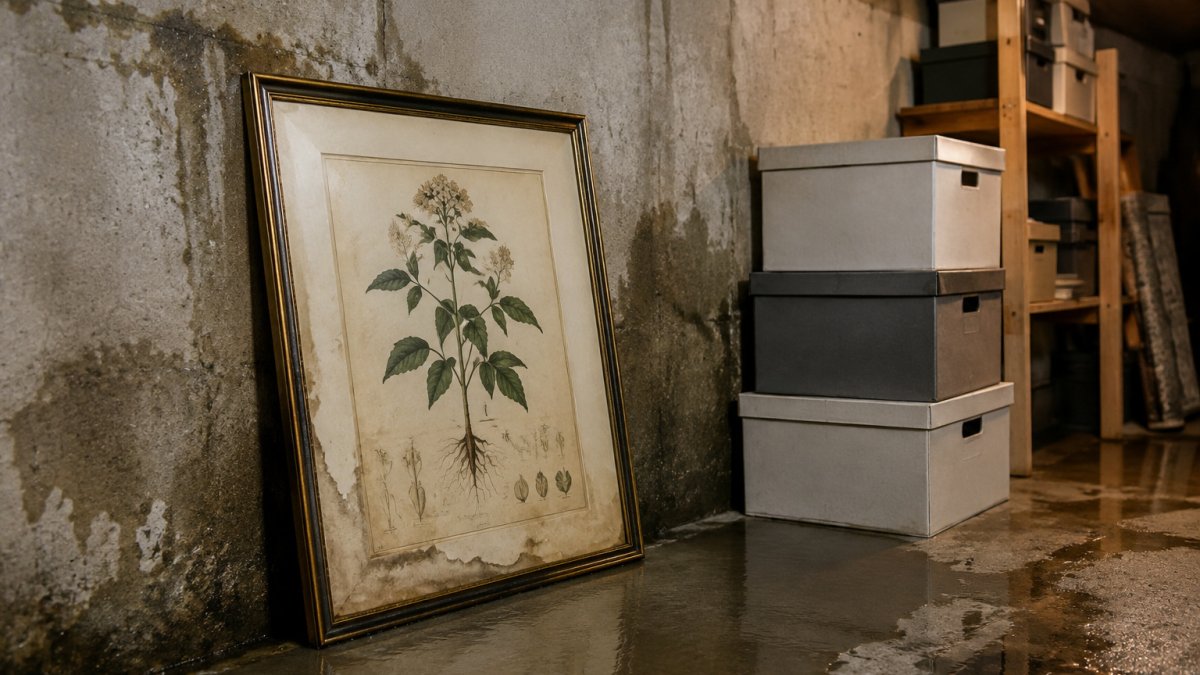
Common scenarios include:
- A slow leak from a pipe or water heater left unnoticed for weeks
- Rain seeping through a cracked wall or window well
- Groundwater rising after heavy rain
- A burst pipe that soaks a box on the floor
If you find a print that has been wet, act quickly. Lift it out of the water if you can. Do not try to dry it in direct sunlight or with a hairdryer, as heat can make damage worse. Lay the print flat between clean, unbuffered blotting paper and seek advice from a professional conservator. Acting within the first day or two gives the best chance of saving the work.
Keeping prints off the floor is a simple step that reduces risk from small leaks. Raising storage on shelves well clear of the floor helps too.
How to Store Antique Prints Safely If a Basement Is Your Only Option
Sometimes a basement is the only space available. Our guide to preserving original antique paper prints covers how to protect them in a less-than-ideal space. If that is your situation, you can reduce the risk considerably.
Start with these steps:
- Pick the driest, most stable corner, away from exterior walls
- Keep prints off the floor on sturdy shelving
- Use a dehumidifier and aim for stable humidity
- Improve air circulation with a small fan on a timer
- Place a hygrometer near the storage area and check it often
- Inspect prints every few months for early signs of damage
Keep the area clean and free of cardboard boxes that can trap moisture. Store prints flat in archival folders rather than rolling them. Avoid placing them against bare masonry.
A dehumidifier is often the most effective single improvement. Empty it regularly, as a full tank will stop it working.
Acid-Free Materials and Enclosures That Reduce Risk
The materials you use to store prints matter as much as the room. Ordinary cardboard, tape and cheap mounts contain acids that break down paper over time, a process that can cause yellowing and brittleness.
Look for:
- Acid-free, lignin-free board for folders and boxes
- Buffered or neutral mat board, if the print is matted
- Polyester or polypropylene sleeves rather than PVC, which can off-gas
- Archival, pH-neutral tissue for interleaving
- Photo corners or hinges made from archival materials, never tape or glue
Keep prints in closed enclosures to slow the exchange of moisture and pollutants. Label folders on the outside, not with adhesive stickers on the print itself.
Acid-free storage does not stop damp damage. For practical advice on protecting older work, see our guide to preserving vintage lithographs. It works best combined with the humidity and airflow measures above.
Booking a Condition Check Before Your Next Storage Decision
If you are unsure whether your prints are safe where they are, it is worth getting a professional opinion. A conservator can assess the condition of each piece, identify early damage and recommend storage that suits the collection.
Our team at Antiquarian Print Shop can help you understand what your prints need. If you are thinking about a new storage arrangement, you can book a condition check before moving anything.
Storing prints well takes a little planning. Choose the driest space you have, control the humidity, and use materials made for the job. Your prints will last far longer for it.
Frequently Asked Questions
Is it safe to store antique prints in a basement?
Generally, no. Basements tend to have higher and more variable relative humidity, condensation on walls and floors, and a greater chance of flooding or leaks than rooms above ground. Paper is hygroscopic, so it absorbs and releases moisture with the air around it, which can cause warping, foxing and mould growth. If a basement is the only space available, use sealed archival enclosures, raise storage off the floor, and monitor humidity with a hygrometer. For valuable pieces, a climate-controlled room upstairs or professional storage is a safer choice.
How does humidity damage antique prints?
Paper expands when it absorbs moisture and contracts as it dries, which over time causes cockling, curling and cracks in the sheet and in any hand-applied colour. Sustained humidity above roughly 60 per cent encourages mould spores to germinate, and mould can leave permanent stains. Low humidity makes paper brittle and can cause flaking of pigments or media. Keeping relative humidity steady, ideally between about 45 and 55 per cent, and avoiding rapid swings reduces these risks considerably.
What should I do if a stored print shows signs of mould or water damage?
Stop handling the print with bare hands and isolate it from other works so spores do not spread. Look for musty odours, fuzzy or powdery growth, tide lines, swelling or discolouration. Do not attempt to dry a wet print with heat or press it flat yourself. Move it to a dry, stable environment and seek advice from a professional paper conservator before attempting any treatment, as improper cleaning can cause further damage.
Where should I store valuable paper prints instead of a basement?
The best locations are interior rooms on upper floors that stay at a steady temperature and humidity, away from external walls, direct sunlight and heating or cooling vents. Store prints flat in acid-free boxes or mounted in archival-quality frames with UV-filtering glazing. Avoid attics, which see extreme temperature swings. If you need to keep a collection off-site, a professional storage facility with climate control is a reasonable option, and a condition report before and after storage gives you a useful record.