
Rare Antique Seashell Prints for Coastal Home Styling
Last Updated: November 5, 2026
Quick Summary
Rare antique seashell prints are original engravings or lithographs of shells, printed and hand-coloured centuries ago, that bring museum-quality presence and real provenance to coastal interiors. Look for a plate mark, uneven hand colour and textured laid paper to confirm an original before you buy.
- Niccolò Gualtieri's 1742 Index Testarum Conchyliorum is a landmark hand-coloured copperplate example.
- The Victorian conchology craze peaked between the 1820s and 1880s, producing thousands of shell plates.
- Frame with acid-free matting at least 5cm wide and UV-filtering glass, and never trim original paper.
- Aim for stable indoor humidity between 40 and 55 per cent to protect antique paper.
- Antiquarian Print Shop holds over 1,200 authentic original and reproduction prints, curated by Iris Windsor.
Table of Contents
- Why Rare Antique Seashell Prints Define Coastal Style
- Types of Antique Seashell Prints: From Conchology to Sailor's Valentines
- How to Identify an Original Antique Print
- Framing Antique Prints for a Coastal Interior
- Coastal Gallery Wall Ideas with Shell Art
- Conservation and Preservation of Antique Paper
- Building Your Curated Collection with Antiquarian Print Shop
- Frequently Asked Questions
Why Rare Antique Seashell Prints Define Coastal Style
A rare antique seashell print is an original engraving or lithograph of shells, printed and hand-coloured centuries ago, that carries the faded warmth and scientific precision no modern reproduction can copy. Coastal interiors have been moving away from mass-produced beach signage toward pieces with real provenance, and the shift makes sense. Genuine conchology plates, the study of shells as natural history art, bring a quiet, museum-quality presence to a room.
That matters more than most decorating guides admit. A framed wall art piece from the 1700s has patina, texture, and a story. It reads as collected rather than bought. Below, we explain exactly how to spot an original, frame it properly, and build a curated collection that suits a coastal palette.
Types of Antique Seashell Prints: From Conchology to Sailor's Valentines
Antique shell art falls into three broad families, and knowing which is which helps you buy with confidence. The first is the scientific illustration: copperplate engravings and lithographs produced for natural history books. Niccolò Gualtieri's 1742 Index Testarum Conchyliorum is a landmark example, with shells drawn from two angles and hand-coloured. Henri-Joseph Redouté's shell plates for Histoire Naturelle follow the same tradition decades later.
The second family is shellwork and the sailor's valentine, intricate Victorian decor where shells were arranged in geometric patterns inside wooden cases. These are decorative objects rather than prints, though they share the same seaside motif.
The third is reproduction art, later printed copies of early plates. For a collector wanting the real thing, we suggest starting with an authenticated original. You can view a rare Gualtieri seashell engraving and a Redouté Histoire Naturelle shell plate to see the difference in person.


| Type | Era | What to Look For | Best For |
|---|---|---|---|
| Conchology engraving | 1700s-1800s | Plate marks, hand colour, laid paper | Serious collectors |
| Lithograph shell print | 1800s | Even tone, fine detail | Gallery walls |
| Sailor's valentine | 1800s | Shell mosaic in wooden case | Statement decor |
| Reproduction print | Modern | Uniform colour, smooth paper | Budget styling |
How to Identify an Original Antique Print
An original antique print shows three reliable signs: a plate mark from the printing press, hand-applied colour with slight variation, and paper with visible texture or age toning. Reproductions usually miss all three. But authentication is a skill built from many small observations, and the difference between a genuine 18th-century conchology plate and a modern digital reproduction often comes down to details you can only see under raking light or magnification.
Start with the plate mark. A genuine copperplate engraving leaves a faint indented rectangle where the plate pressed into damp paper. Hold the print to a raking light and look for that embossed border. The plate mark is widely regarded as one of the more reliable indicators, because modern digital printing cannot replicate the physical pressure of an intaglio press. A lithograph, by contrast, may show a flat edge rather than an indentation, so know which process you are examining before you judge.
Next, examine the colour. Hand colouring looks uneven under magnification, because a person applied it brushstroke by brushstroke. You may see slight variations in density, tiny overlaps at the edges of a shell, or a brush hair trapped in the pigment. Modern reproduction art prints flat and uniform, often with colours that are too saturated or too consistent across the entire edition. Watch out: some later reproductions are deliberately distressed to mimic age, so colour alone is not enough.
Check the paper too. Genuine period pieces often show foxing, a light brown spotting from age, and a chain or laid texture. Hold the sheet up to a light source: laid paper shows closely spaced parallel lines, while wove paper has a finer, more uniform mesh. Text on the reverse, called bleed-through, is another reassuring sign, as is a watermark or countermark from the papermaker. Our guide to identifying authentic antique prints walks through each test in detail.
The historical context matters as much as the physical evidence. The Victorian-era conchology craze, which peaked between the 1820s and 1880s, produced thousands of shell plates for natural history books. Knowing the major publications helps you date a print and spot anachronisms. Niccolò Gualtieri's 1742 Index Testarum Conchyliorum used copperplate engraving with hand colouring, while later Victorian works increasingly used lithography, which allowed finer detail and larger editions. If a seller claims a print is from a 1740s publication but the image quality and paper suggest lithography, that is a red flag. Once a print’s publication date and printing method are established, archival quality framing can help preserve its paper and hand colouring while keeping those historical details visible.
Finally, consider provenance. Auction records, dealer catalogues, and institutional collections can help you trace a print's history. A clean, bright, perfectly even print at a low price is usually a reproduction, not a bargain. Authentic originals carry the patina of age, and that patina is difficult to fake convincingly.
Framing Antique Prints for a Coastal Interior
Framing antique prints well protects them and completes the coastal aesthetic. The goal is archival mounting: acid-free matting, UV-filtering glass, and a frame that lets the paper breathe.
A simple timber or slim gilt frame in a soft white, pale oak, or driftwood tone suits a coastal setting, and restraint often works well for beach house styling. Let the hand-coloured engraving carry the colour.
- Matting: acid-free, at least 5cm wide to keep paper off the glass
- Glass: UV-filtering to slow fading
- Backing: acid-free board, never cardboard
- Hanging: out of direct sun and away from heat
A common mistake is trimming a print to fit a standard frame. Never cut original paper. Custom sizing is one option to consider.
Seashells, Gualtieri Niccolo, Rare, 1742 →
Coastal Gallery Wall Ideas with Shell Art
A coastal gallery wall works best when you mix sizes and let one large shell print anchor the arrangement. Group three to seven framed pieces, keeping gaps even at around 5cm.
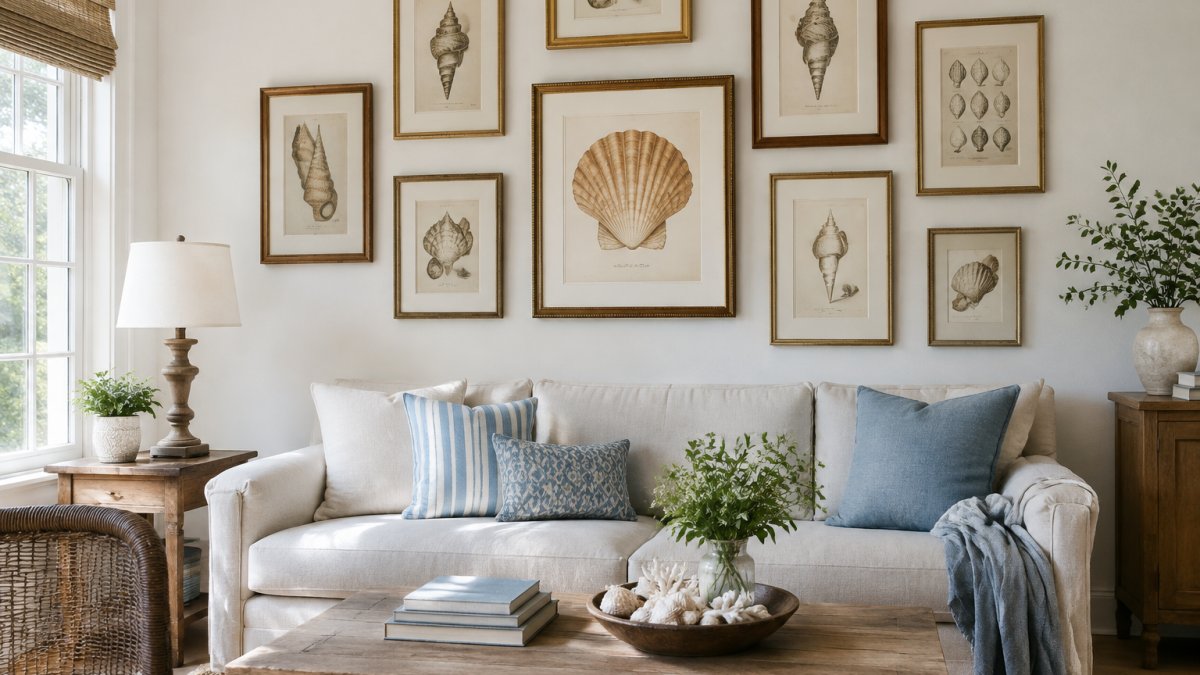
Start with the largest piece slightly off-centre, then build outward with smaller prints. A coastal palette of soft blues, sandy neutrals, and faded coral ties the collection together. Add a nautilus or ornamental shell print for contrast. For a full plan, our step-by-step gallery wall guide covers measuring, spacing, and hanging order.
Conservation and Preservation of Antique Paper
Antique paper is fragile, and light, heat, and humidity do the most damage. In coastal environments, those risks are amplified: salt air, higher ambient moisture, and strong natural light all accelerate deterioration. Most conservation guides for collectors focus on buying, not protecting, so this section addresses the specific challenges of keeping antique shell prints safe in a coastal home.
Humidity is the primary enemy. Paper is hygroscopic, meaning it absorbs and releases moisture from the air, causing it to expand and contract. Over time, this cycling leads to cockling, foxing, and embrittlement. In humid coastal areas, framed prints can suffer inside the frame as moisture condenses on the glass or migrates through the backing. Keep framed prints away from external walls, which tend to be cooler and damper, and avoid hanging them in bathrooms or kitchens where steam is present. A simple hygrometer can help you monitor room humidity; aim for a stable range between 40 and 55 per cent where possible.
UV light is the second major threat. It fades inks and hand colouring, yellows paper, and breaks down cellulose fibres. Standard glass offers little protection, so specify UV-filtering glass or acrylic when framing. Even with UV filtering, keep prints out of direct sunlight and away from strong reflected light. Rotate pieces on display if you want to limit cumulative exposure.
Salt air is less discussed but relevant in coastal homes. Airborne salt particles can settle on surfaces and, over time, attract moisture and promote corrosion of metal frames or fixings. Keep frames sealed at the back with acid-free backing board and frame sealing tape, and dust prints gently with a soft brush rather than a damp cloth.
For unframed pieces, store them flat in an acid-free folder, interleaved with archival tissue. Avoid plastic sleeves, which trap moisture and can cause condensation. Handle prints by the edges with clean hands, and never tape or glue anything to the paper. If a print is already cockled or stained, consult a paper conservator rather than attempting repairs yourself; improper intervention can reduce value significantly.
Our article on preserving original antique paper prints explains storage and display in more depth. A little care now protects both the patina and the investment value, and in a coastal setting, that care needs to be deliberate rather than incidental.
Building Your Curated Collection with Antiquarian Print Shop
Building a curated collection starts with one strong piece and grows around a theme. We suggest choosing a single artist or period first, then adding complementary plates over time.
Antiquarian Print Shop holds over 1,200 authentic original and reproduction prints, created through traditional methods including etching, engraving, and lithography. Our specialised collections cover botanical, bird, and fashion prints, and our founder, curator Iris Windsor, curates the collection. Custom print options let you size a piece to suit your wall.
- For investors: start with rare originals like the 1742 Gualtieri plates
- For styling: pair originals with reproductions
Frequently Asked Questions
How can you tell whether a seashell print is an original antique?
Look for a plate mark, the indented rectangle left by a copperplate press, which reproductions rarely have. Check for hand-colouring that sits unevenly within the lines, and examine the paper for laid texture, foxing or a watermark. Original seashell prints also carry text on the verso from the bound volume they came from. Ask for provenance details and examine high-resolution images before buying, since age-related imperfections are expected on prints over 200 years old.
How do you style seashell prints without making a room feel overly themed?
Treat the prints as art rather than décor. Mix two or three shell engravings with botanical or bird illustrations in a gallery wall, and keep the palette restrained: sand, cream, muted blue and warm timber. Avoid pairing them with nautical props like rope, anchors or model boats. A single large nautilus or conch engraving above a sideboard often reads more sophisticated than a wall of small themed pieces, and period-accurate framing in gilt or dark timber lifts the whole arrangement.
How should antique prints be protected from sunlight and humidity?
Keep framed prints out of direct sun, since UV light fades hand-colouring and yellows paper quickly. Use acid-free matting and backing boards, and ask your framer for UV-filtering glass or acrylic. Hang them on interior walls rather than external ones, where condensation builds up, and avoid kitchens and bathrooms. Aim for a stable indoor humidity around 40 to 50 per cent. If you store prints unframed, use an acid-free box in a dark, dry cupboard.
Where can you buy authentic antique seashell prints?
Specialist dealers who provide provenance, condition notes and high-resolution images are the safest source. Antiquarian Print Shop holds over 1,200 original and reproduction prints, including first edition Gualtieri shell engravings from 1742 at $1,250 and Redoute Histoire Naturelle plates from $350. Ask about the publication the plate came from, the engraver and any restoration, and request a condition report before committing, especially when buying online without seeing the piece in person.
Ready to bring genuine history to your walls? Explore our collection of rare antique seashell prints and let us help you find the piece that anchors your coastal interior. Get started with Antiquarian Print Shop and build a collection that grows in beauty and value.